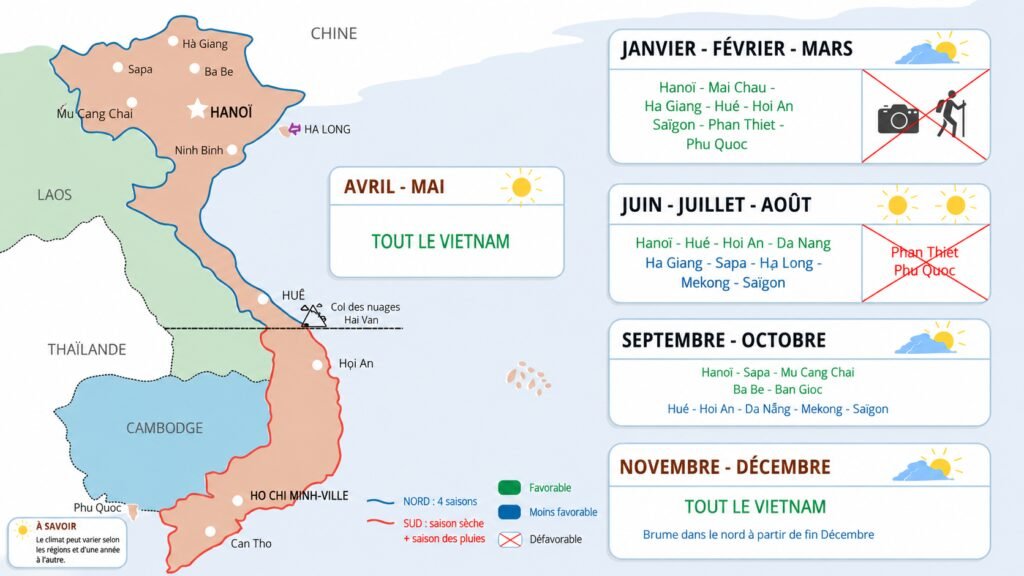
The South is at its best, the North is cool and misty, the Centre is finishing drying out. January is a month for the South — and sometimes the month of Tết, which changes everything.
In brief
Best region
The South: Saigon, the delta, Con Dao and Phu Quoc
To avoid
The northern mountains, shrouded in mist
Temperatures
14–20°C in Hanoi, 22–32°C in Saigon
Watch out
Tết sometimes falls at the end of January: check the date
The weather in January
January is the most contrasted month of the year: eighteen degrees’ difference between Hanoi at dawn and Saigon at midday. Here are the 1991–2020 reference averages.
Region
Temperatures
Rain
Verdict
North — Hanoi
14 to 20°C
20 mm
Cool, grey, frequent drizzle
Centre — Hue
17 to 24°C
125 mm
End of the monsoon, still damp
South — Saigon
22 to 32°C
15 mm
Perfect: dry and sunny
The figure that matters: Saigon gets 15 mm of rain over the whole month and eight hours of sunshine a day. Hanoi gets about as much rain, but under cloudy skies — only two and a half hours of sunshine a day.
Sea, sun and light in January
Region
Sea
Sunshine per day
Rainy days
North
21.5°C
2 h 30
10 days
Centre
23.5°C
3 h 30
14 days
South
25°C
8 hrs
2 days
The table says it all: eight hours of sunshine a day in Saigon against two and a half in Hanoi. It isn’t a question of rain — both cities get the same amount — but of cloud cover.Swimming only makes sense in the South: 25°C in Phu Quoc and Con Dao, against 21.5°C on the north coast, where nobody swims in January.
Where to go in January
The South, without hesitation. Saigon, the Mekong Delta, Con Dao and Phu Quoc are in their best window: calm sea, clear skies, bearable heat. It is the only time of year when you can combine the delta and an island without fear of rain.The North works, provided you know what you are coming for. Hanoi in January has real charm: heated cafés, steaming soup, mist on the lake. Ninh Binh and Lan Ha Bay remain magnificent, with fewer people. The mountains, however — Sa Pa, Ha Giang — vanish for whole days behind the fog.An itinerary that works well: start in the North accepting the cool weather, move gradually south, and finish on a beach in the South where it is thirty degrees.
Fifteen millimetres of rain in Saigon over the whole month: January is the South’s best time.
What to avoid
The northern mountains as the only highlight. In Sa Pa or Ha Giang, January hovers around 5 to 12°C with visibility sometimes zero. If the terraced rice fields are the reason for your trip, change month: they are bare in January.Three days in Hue. The Centre still gets 125 mm and the first fortnight stays wet. Two nights are enough, and we schedule the tomb visits in the morning.
What happens in January
Tết sometimes falls at the end of January — the date varies between late January and mid-February depending on the year. It is the only event that can make a trip complicated: domestic flights full, shops closed for three days, hotel rates up. Check the date before booking your flights.It is also the European low tourist season after the holidays: outside Tết week, the northern sites are quiet and accommodation is negotiable.
North to South or South to North: which way to travel in January
In January, the North is cool and often grey, the South hot and bright. So the direction of travel changes the impression the trip leaves.We most often advise you to start in the North. You face the drizzle of Hanoi and the bay with the energy of the start of the trip, then head south towards light that brightens day by day, finishing in the sunshine of the Mekong Delta or an island. It is a pleasant curve to live.The reverse direction has a practical advantage: if you arrive tired from a long flight, a few days of gentle warmth in the South act as a buffer before the more active days in the North. It has a drawback: finishing in the damp cold of Halong Bay leaves a duller memory.Either way, keep two nights in the Centre rather than one. Hoi An and Hue in January alternate very fine days with overcast ones; with two nights, you have a chance of catching the good one.
A typical January itinerary
Here is the outline we most often suggest for January dates, over ten days. It gives two thirds of the time to the South, where the weather is a safe bet.Days 1 to 3 — Hanoi and Ninh Binh. Arrival, old quarter, then the karsts of Ninh Binh by rowing boat. The cold doesn’t stop anything; it even makes walking days more comfortable.Days 4 and 5 — Lan Ha Bay. A night on board a junk with cabins. The January mist is very photogenic and the bay is much less crowded than in spring.Day 6 — flight south. We skip the Centre, still damp in January, rather than crossing it by road.Days 7 and 8 — Saigon and the Mekong Delta. Cholon, street food, then a night in a guesthouse beside a creek.Days 9 and 10 — Phu Quoc or Con Dao. Three nights on the beach at 32°C to finish, with a calm sea.
What to pack in January
It is the month when travellers get it wrong most: you leave for South-East Asia, imagine the heat, and shiver for three days in Hanoi.For the North: a warm jumper, a waterproof windproof jacket, a scarf. Hotel rooms and boats in the bay are rarely heated and the humidity makes 15°C bite harder than in Europe. If you go up to Sa Pa or Ha Giang, add gloves and a hat.For the Centre and South: light cotton or linen clothes, a hat, sun cream. The contrast with the North is total in a single day’s flight.Everywhere: closed shoes that dry quickly for wet alleys, a small personal first-aid kit, and an adaptor — Vietnamese sockets generally take European two-pin plugs, but not always those with an earth pin; UK and North American plugs need an adaptor.The general principle: thin layers rather than one heavy coat. You take them off and put them back on several times a day.
Budget and recommended tour
The Paris–Hanoi flight is around €700 to €900 in January outside school holidays, and climbs above €1,100 over the Christmas holidays and around Tết.For January, we recommend an itinerary that gives more room to the South than the North: twelve to fifteen days with two nights on the beach at the end. Tell us your dates before buying your tickets — if they fall on Tết, we will tell you straight away.
Prices and crowds in January
This month
Paris–Hanoi flight
€700 to €900 outside holidays, over €1,100 over the festive season
Accommodation
High season in the South, negotiable rates in the North
Crowds
High in the South, low in the North
Book early
Junks and beach hotels in the South
January is a two-speed month: the South is in full international high season, the North is almost empty. That is good news for anyone who accepts the cool — in the North you get rates you won’t see in March.
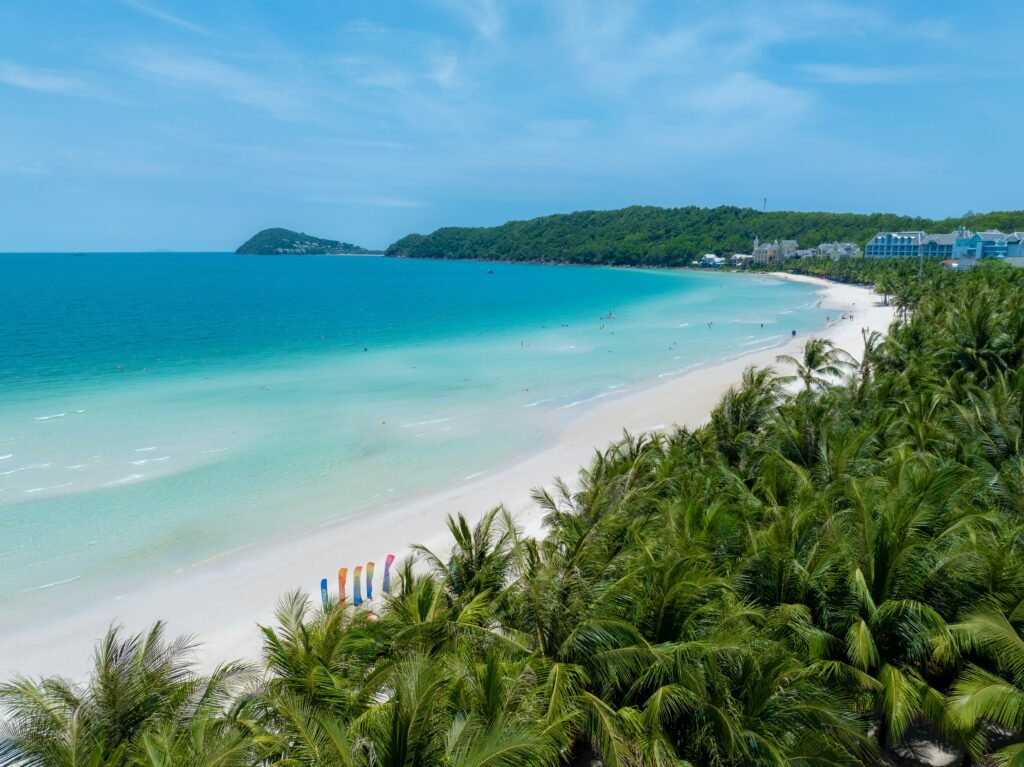
In the South, yes: the sea is 25°C in Phu Quoc and Con Dao, and calm. In the Centre and North, no — the water drops to 21–23°C and the swell is strong.
Is it really cold in Hanoi?
Cool rather than cold: 14 to 20°C, with spells down to 8°C. The humidity and lack of heating make it feel sharper than the same temperature in Europe. A jacket and a scarf are enough.
Is January a good time for a first trip?
Yes, if you accept a South-focused programme. For a balanced North–South trip, March–April and October–November are still better.
What should you pack in January?
Two wardrobes: a warm jumper and a windproof jacket for Hanoi, where it is 14 to 20°C with no heating in homes, and light clothes for the South, between 22 and 32°C.
What itinerary should you build in January?
A trip centred on the South — Saigon, the Mekong Delta, then Phu Quoc or Con Dao — with a few days in Hanoi and the bay if you want to see the North, accepting the mist.
When is Tết in 2027?
Saturday 6 February 2027. So January 2027 isn’t affected by the new year closures, except for the very last days when transport prices are already rising.
Putting it into practice
The tours where you experience what this article is about
Audience measurement. We would like to know which pages are useful to you, using Google Analytics. Nothing is stored without your consent, and you can change your mind at any time. Learn more





 HoneymoonHoneymoon — 12 daysHanoi — Ninh Binh — Lan Ha Bay — Hoi An — Con Dao — Saigon12 days / 11 nightsdès 2 250 €