Vietnamese women: two thousand years of a special place
The first two figures of Vietnamese national resistance are two sisters, in the year 40 AD. Two thousand years later, Vietnam has one of the highest female employment rates in Asia — and a very solid glass ceiling. It isn’t a contradiction, it is a history.
The Trưng sisters, year 40
The first uprising against Chinese domination of which Vietnamese history has kept an account was led by two women. In the year 40, Trưng Trắc and her sister Trưng Nhị raised an army that drove out the Han governor and held sixty-five citadels for three years before being crushed. Two centuries later, Bà Triệu tried again, at twenty, mounted on an elephant, leaving a phrase every Vietnamese schoolchild knows: she wanted to drive out the invader, not bow down to become a man’s concubine.These stories are not decorative. They are taught, celebrated in temples, and they occupy in the national imagination the place Boudicca or Joan of Arc hold elsewhere. A country that places two women at the origin of its resistance doesn’t tell its story like others.
A country that places two women at the origin of its resistance doesn’t tell its story like others.
Confucianism, or the exact opposite
Yet this ancient background collided with a thousand years of Chinese administration and then Confucian morality. The doctrine of the “three obediences” — to the father, then the husband, then the eldest son — and the “four virtues” structured the Lê and then the Nguyen codes. Women were excluded from the mandarin examinations, and therefore from any public office.But Vietnamese customary law held out in places. The Hồng Đức code, promulgated in the 15th century, recognised daughters’ right to inherit and wives’ ownership of the property they brought into marriage — provisions unknown in China at the same time. The most quoted proverb on the subject is telling: “the husband is the pillar, the wife is the foundation”.In the mountains, the question doesn’t even arise in these terms. Highland societies — Bahnar, Jarai, Ede — are matrilineal: the house belongs to the women, inheritance passes through them, and it is the husband who joins his wife’s family.
The wars, and what they shifted
Thirty years of war, from 1945 to 1975, did what wars do everywhere: they put women to work and into positions of responsibility. Tens of thousands served in the thanh niên xung phong, the youth brigades charged with maintaining the Ho Chi Minh trail under bombing, defusing ordnance, rebuilding bridges at night. The Dong Loc crossroads, where ten young women aged seventeen to twenty-four died in 1968, has become a national place of memory.On their return, many never married — the men of their generation were dead. This generation of single women, often very poor, is a subject Vietnamese literature addressed long before the history books.
Today: the market, the factory, the business
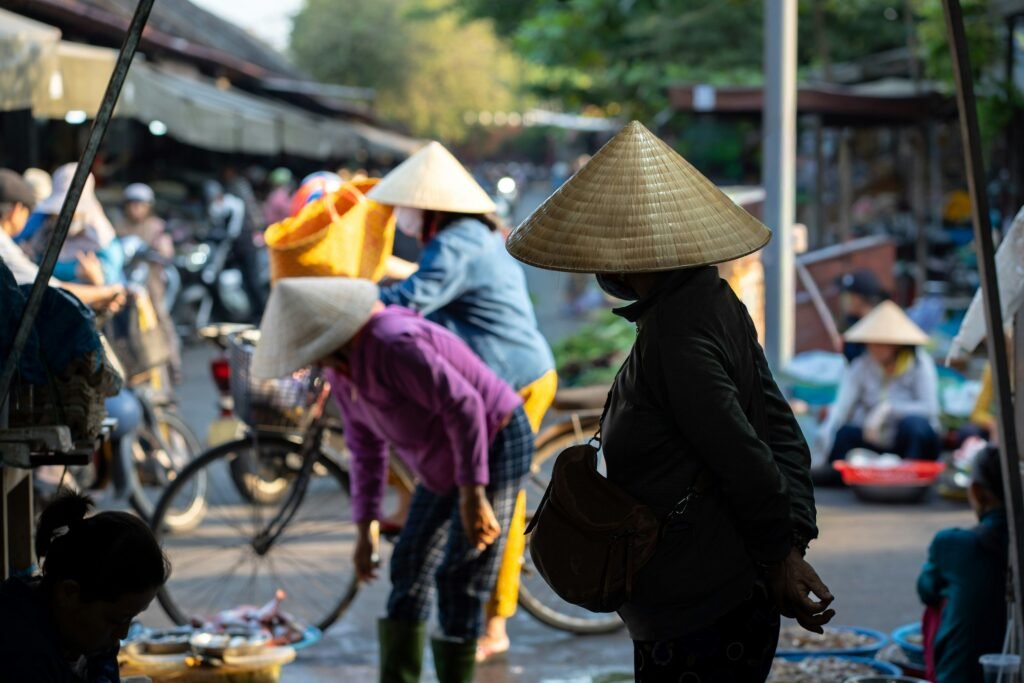
Vietnam has one of the highest female employment rates in Asia — around seventy per cent of working-age women, against a much lower world average. You will see it at the very first market: the stalls are run by women, the accounts kept by women, and household money is most often managed by them.In industry, textile and electronics factories employ an overwhelmingly female workforce, often young women from the countryside who send part of their wages to their parents. It has been one of the country’s great social movements for thirty years, and it has transformed villages as much as cities.The proportion of businesses run by women is one of the highest in South-East Asia. But the ceiling remains low at the top: few women in the Politburo, few at the head of big state companies.
Two women’s days
Vietnam celebrates women twice a year: on 8 March, International Women’s Day, and on 20 October, Vietnamese Women’s Day. On those days, men give flowers to their colleagues, their mother and their partner, florists overflow and restaurants are fully booked. It is a chance to see how much the place of women is celebrated, even if real equality remains a subject of debate.
The Vietnamese Women’s Museum
In Hanoi, the Vietnamese Women’s Museum is one of the best-designed museums in the country. It presents the role of women in the family, marriage and birth rites, the costumes of the different peoples and women’s involvement during the wars, with portraits of the heroic mothers. Allow an hour and a half; explanations are available in English and French.
The women you will meet
During your trip, many of the people you meet will be women: guides, homestay hosts, market traders, cooks running cooking classes, artisans in the craft villages. They are often at the heart of the family economy, and their stories give a very true view of the country.
In one sentence
From the Trưng sisters to the businesswomen of Saigon, Vietnam’s history can also be read through that of its women.
What you will see, and how to read it
A few scenes come up on every trip, and they are easier to understand with what precedes.
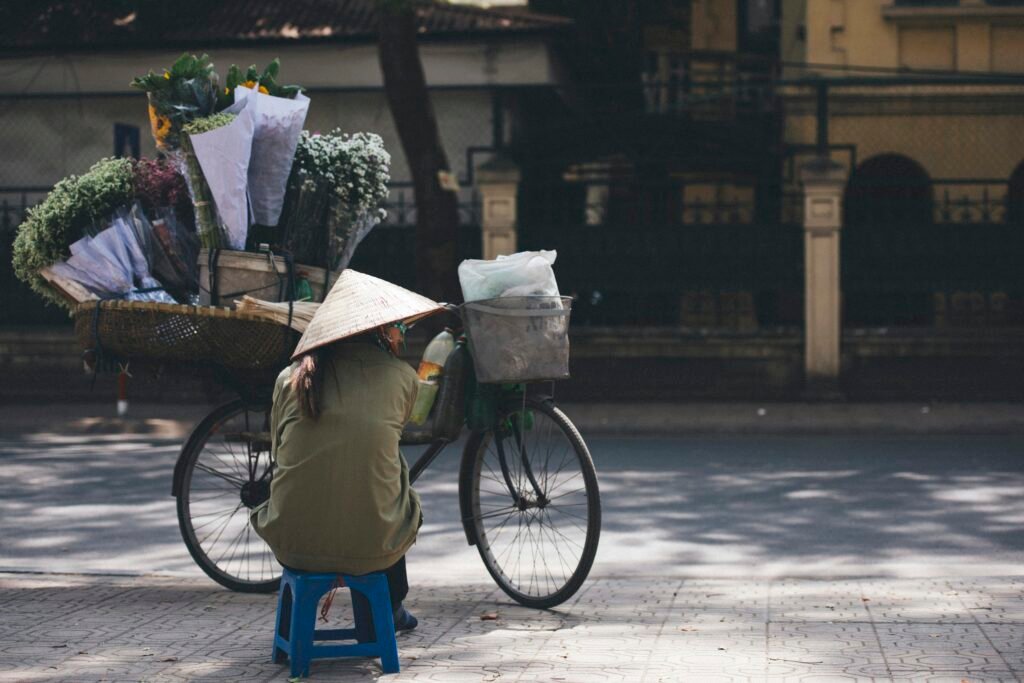
The woman carrying a shoulder pole. Shoulder-pole carrying, two baskets in balance, has always been women’s work. It isn’t picturesque: it is very hard work, often done by women over fifty from the provinces.
The Tam Coc rower. She rows with her feet for two hours, for a tiny share of the ticket price. The tip isn’t a bonus, it is most of her income.
The Hmong vendors in Sa Pa. They walk with the groups for hours before offering their embroidery. It has become a real job for families whose land is no longer enough, and the most honest way to handle it is to decide in advance: buy from one person, or say no clearly from the outset.
The restaurant owner. In nine stalls out of ten, she is the one who decides, keeps the till and passes the business on to her daughter.
The birth imbalance
What isn’t right must be mentioned. Since the 2000s Vietnam has had one of the most marked sex-ratio imbalances at birth in Asia after China and India: about a hundred and eleven boys for every hundred girls, with higher peaks in the Red River Delta.The cause is known: preference for sons, linked to ancestor worship — it is the eldest son who maintains the family altar — combined with fewer children per family and ultrasound scans. The government has banned revealing the sex of the foetus and runs regular campaigns; the gap is slowly narrowing.It is the kind of subject your guide will happily talk about if you ask. Vietnamese people discuss these things with far less gravity than we assume.
Two sisters who in the year 40 led the first known uprising against Chinese domination, and held sixty-five citadels for three years. They are honoured by temples throughout the country and taught at school.
Is Vietnamese society patriarchal?
Officially yes, through its Confucian heritage. In practice, women run the household economy, retail trade and a large share of entrepreneurship. Highland societies, for their part, are matrilineal.
How should a woman dress when travelling in Vietnam?
With no particular constraint in towns and on the coast. In pagodas and temples, shoulders and knees covered. In mountain villages, simple clothing is appreciated, nothing more.
Is it safe to travel alone as a woman in Vietnam?
Vietnam is among the safest countries in South-East Asia for a woman travelling alone. The precautions are those of anywhere: watch your bags in the big cities, and be vigilant on isolated night journeys.
Why do you mostly see women at markets?
Because retail trade is traditionally female, and so is managing household money. A Vietnamese saying has it that the wife is the household’s finance minister.
What is the birth imbalance?
Vietnam has about a hundred and eleven boys for every hundred girls at birth, a consequence of the preference for sons in ancestor worship. Revealing the sex of the foetus is banned and the gap is slowly narrowing.
Putting it into practice
The tours where you experience what this article is about
Audience measurement. We would like to know which pages are useful to you, using Google Analytics. Nothing is stored without your consent, and you can change your mind at any time. Learn more

 The essentialsVietnam in 15 daysHanoi — Pu Luong — Ninh Binh — Lan Ha Bay — Hue — Hoi An — Saigon — Mekong Delta15 days / 14 nightsfrom €2,070