Nearly two thousand limestone peaks in jade-green water: Vietnam’s most famous landscape. How to see it without the crowds, how many nights to plan, and why we often set off from neighbouring Lan Ha Bay.
In brief
Best time
March to May, September to November
Getting there
About 2½ hrs from Hanoi by expressway
Length
One night on board minimum
Our advice
Prefer Lan Ha or Bai Tu Long to the classic routes
Halong Bay in a few words
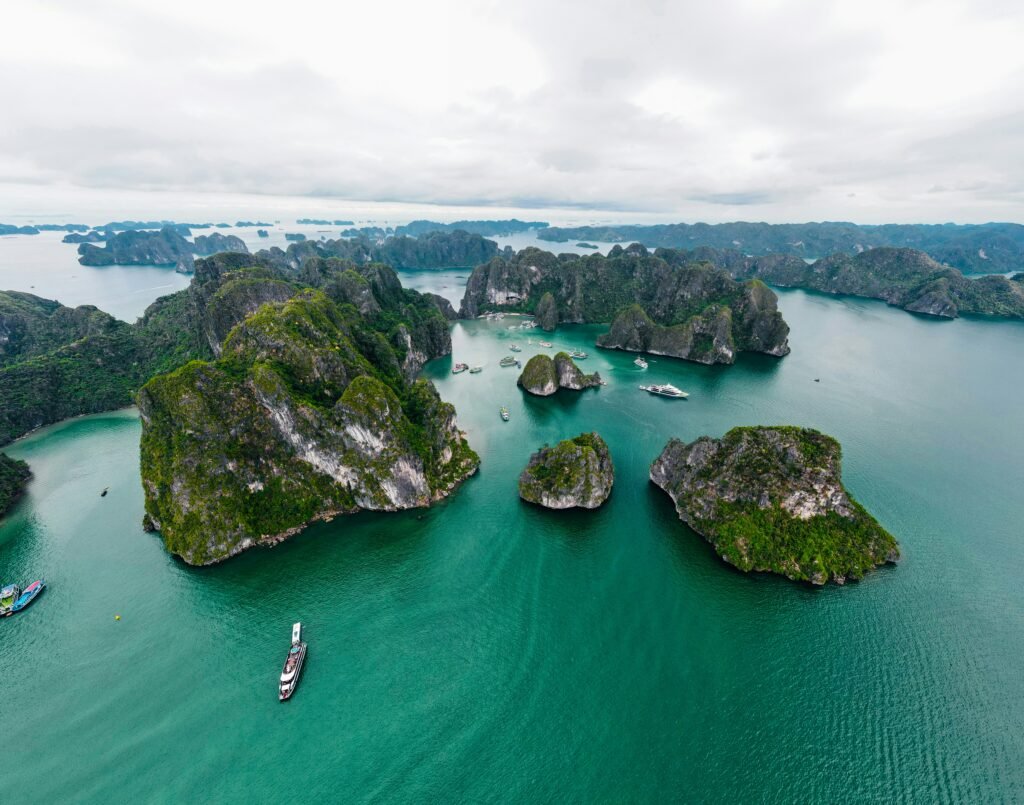
Nearly two thousand limestone islands and islets rise from jade-green water, over more than 1,500 square kilometres, in the north-east of the country. Legend has it that a dragon came down from the mountains and scattered them to defend the country against invaders from the sea: Ha Long means “where the dragon descends”. The bay has been a UNESCO World Heritage Site since 1994, and the listing was extended in 2023 to the neighbouring Cat Ba archipelago.It is Vietnam’s most famous landscape, and that is also its main drawback: the classic routes from Ha Long port see hundreds of boats pass every day. Yet the same geology continues to the south, in Lan Ha Bay, and to the north-east, in Bai Tu Long Bay, with far fewer people. The whole art of a successful visit lies in that choice.
Halong, Lan Ha or Bai Tu Long: which to choose?
Halong Bay proper concentrates the most visited caves and the best-known viewpoints. It is the right choice for a short excursion, to see the iconic sites, or when the budget calls for the most widely available boats.Lan Ha Bay, to the south, on the Cat Ba side, offers the same landscape with far fewer boats, beaches reachable by kayak and often clearer water. That is where we send most of our travellers.Bai Tu Long Bay, to the north-east, is the calmest of the three, with fishing villages that are still inhabited; journeys there are a little longer.Our page on Lan Ha Bay and our guide to choosing your junk detail these differences, boat by boat.
What you see in the bay
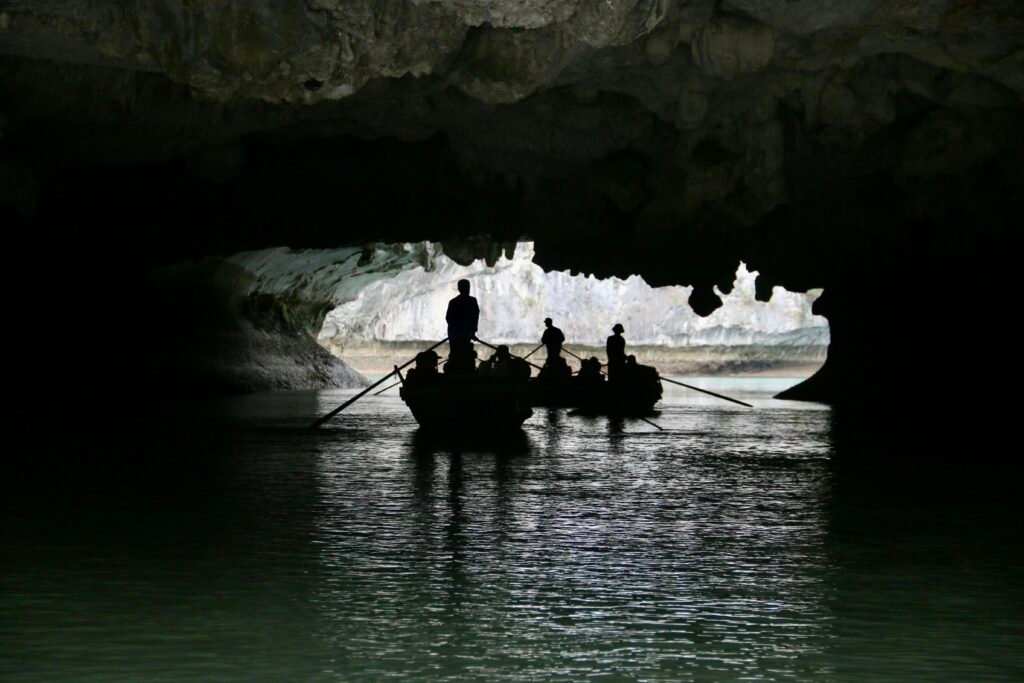
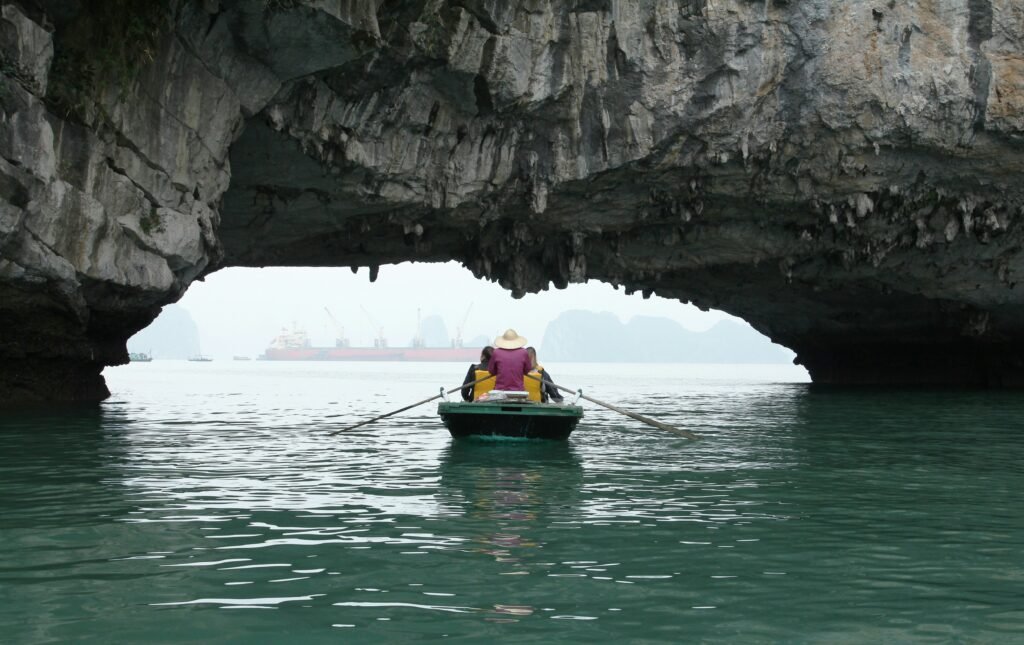
The caves. Sung Sot, the “Cave of Surprises”, is the largest: a succession of chambers several tens of metres high. Thien Cung and Dau Go, closer to the port, are very busy. They are spectacular, but lit in bright colours and often packed in the middle of the day.Ti Top island. A beach and a staircase leading to a viewpoint taking in the whole bay. The view is superb, the beach very busy.Kayaking and rowing boats. Between the peaks, in the lagoons and under the arches, it is the best way to feel the scale of the landscape. Most cruises include it.Floating villages. Fishing communities long lived on the water; many have been rehoused on land in recent years, and some villages now survive only for visits. Those in Bai Tu Long remain the most authentic.
A night on board, or a day trip?
The day trip from Hanoi exists, but it means about six hours on the road there and back for four hours on the water, at the busiest times. A night on board changes everything: sunset on deck, dinner at anchor in a cove, kayaking early in the morning before the day boats arrive. Two nights let you go further, where one-night boats don’t go.Our bay cruise guide details our options, what is included and the prices.
When to come
Period
What you find
Our view
March – May
Mild weather, calm sea, mist lifting
A very good period
June – August
Hot, pleasant swimming, late-afternoon storms
Good, with a risk of cancelled sailings in a storm
September – November
Crisp light, often clear skies after September
The best season, apart from weather alerts in early autumn
December – February
Cool, often misty
Mystical atmosphere, reduced views, no swimming
From July to October, the authorities suspend sailings during typhoon alerts, usually for a day or two. We then keep a fallback on land, often Ninh Binh.
How to get there from Hanoi
Ha Long and Tuan Chau ports are about two and a half hours by expressway from Hanoi. For Lan Ha Bay, you board near Hai Phong or at Cat Ba, at a comparable driving time. Our travellers make the journey by private car with their guide, which lets them choose the departure time and stop along the way.The bay combines very well with Ninh Binh, without going back through Hanoi: it is the combination in most of our northern tours.
The caves and islands to know
Most cruises in Halong Bay pass through the same places. Sung Sot cave, the Cave of Surprises, is the largest, with vast halls fitted out and lit. Ti Top island offers a viewpoint after a few hundred steps and a small, very busy beach. The former floating villages tell the story of the bay’s fishermen, even though most of the inhabitants have been rehoused on land in recent years. These sites are beautiful, but very crowded in the middle of the day: it is one of the reasons we often prefer the quieter Lan Ha Bay.
Kayaking and swimming
Kayaking is the best way to see the bay up close, passing under limestone arches and into enclosed lagoons. Swimming is possible from April to October, from the boat or a beach on an islet, when the water is above 25 °C. In winter, the water is cool and the sky often hazy: the bay keeps its misty beauty, but you stay on deck.
The bay with children
A night on a junk is one of children’s favourite memories: the cabin, the kayak, the cooking class on deck and waking up among the peaks. Choose a boat with family or connecting cabins, and check the children’s life jackets. A single night is enough with young children.
The bay and the environment
Listed as a UNESCO World Heritage Site since 1994, the bay is under pressure from very heavy tourism. The authorities have restricted some single-use plastics on boats and regulate the routes. For your part, choosing a reputable, small-capacity operator and bringing a water bottle rather than plastic bottles are two simple gestures that count.
The best time of day
The most beautiful moment in the bay is early morning, when the mist lifts between the peaks and the day boats have not yet arrived. That alone is a good reason to spend the night on board.
The mistakes we see most often
Choosing the cheapest boat. For the same bay, the price of a night can double. The difference is paid in noise, crowding and an overcrowded route.Doing a same-day round trip. You see the bay at its busiest times, after six hours on the road.Going straight to the bay the day after a long-haul flight. Keep at least two nights in Hanoi before heading out on the water.
What to do in Halong Bay
Sail between the karst peaks at sunset, from the deck of a junk.
Visit Sung Sot, the Cave of Surprises, one of the largest in the bay.
Climb to the Ti Top island viewpoint for the panoramic view, then swim on its small beach.
Paddle a kayak into enclosed lagoons, reachable only through a rock arch at low tide.
Discover a floating fishing village and its fish farms.
Join tai chi on deck at dawn, when the bay is still empty.
Take a cooking class on board, often devoted to spring rolls.
Extend to Cat Ba and its national park, for a forest hike.
Typical programme: one or two nights on board
One night on board is the most common format. You leave Hanoi around 8 am, board around noon, have lunch as the boat enters the bay, then spend the afternoon on a cave, kayaking or swimming. Sunset on deck, dinner, night at anchor. The next day, tai chi, a short visit and brunch on the way back, disembarking around 11 am.With two nights, the boat moves away from the busiest routes, towards the south of Lan Ha Bay or towards Bai Tu Long. The second day is spent entirely at sea: kayaking in deserted lagoons, a private beach, a fishing village, sometimes cycling on an island. This is the format we recommend for travellers with time who want to see the bay without the crowds.
How much a cruise costs
Prices vary greatly depending on the boat, the season and the route. For one night on board, meals, activities and shuttle from Hanoi included, expect about 100 to 150 € per person on a simple, decent boat, 150 to 300 € on a boutique junk, and more on top-end boats. Rates rise during Vietnamese holidays and in high season, from October to April. Price is not everything: look first at the route, the number of cabins and what is included.
Halong Bay or the inland Halong Bay?
Ninh Binh, two hours from Hanoi, is often called the inland Halong Bay: the same limestone peaks, but rising from rice fields, discovered by rowing boat. The two are not alternatives but complements. On a trip of ten days or more, we almost always combine two nights in Ninh Binh and one night in the bay, linking the two directly by the coastal road, without going back through Hanoi.
Halong during the typhoon season
From July to October, the authorities sometimes suspend sailing for a day or two when a typhoon approaches. Cruises are then postponed or refunded by reputable companies. To limit the risk, place the bay at the start of your time in the North rather than at the end, so you can move it, and keep a spare day before your flight. The rest of the year, the bay can be visited without worry, with a light, poetic mist in winter.
Audience measurement. We would like to know which pages are useful to you, using Google Analytics. Nothing is stored without your consent, and you can change your mind at any time. Learn more




 The essentialsNorthern Vietnam — 8 daysHanoi — Ninh Binh — Pu Luong — Lan Ha Bay — Hanoi8 days / 7 nightsfrom €1,190