Bamboo, lotus and banyan: three plants that tell the story of Vietnam
Three plants appear everywhere: around villages, on ponds, at temple entrances. They aren’t decorative. Bamboo built the houses and the weapons, the lotus gives the country its image, and the banyan shelters the village spirit.
Bamboo, the material of everything
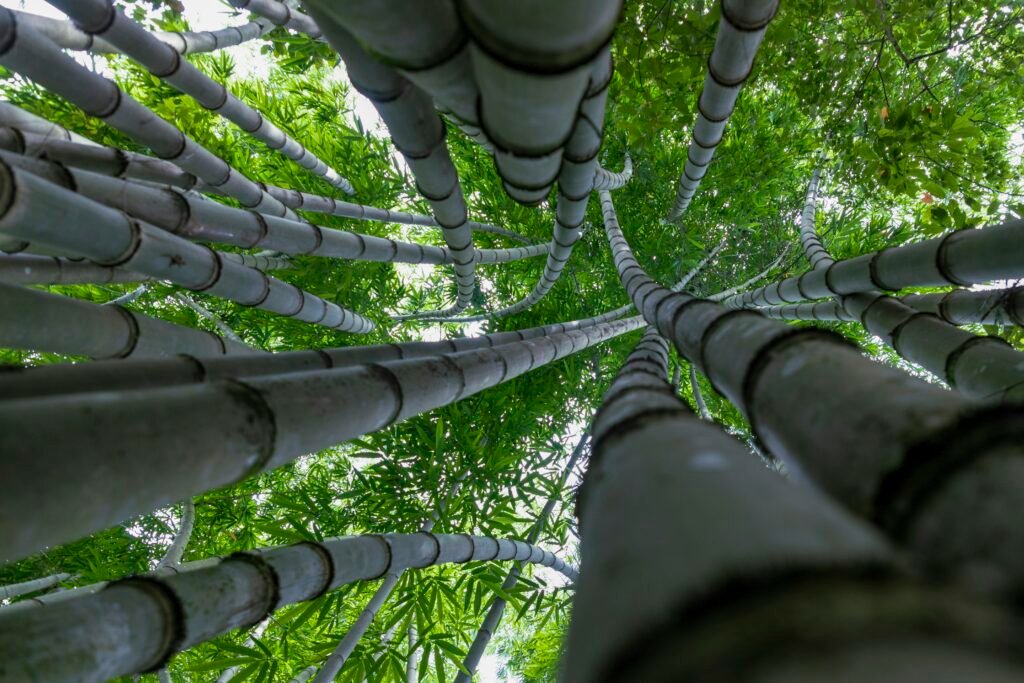
Vietnam has more than two hundred species of bamboo, and there is practically no traditional object that can’t be made from it. The house frame, the partitions, the stilt-house floor, the shoulder pole, the basket, the fish trap, the mat, the chopstick, the sticky-rice tube, the scaffolding, the raft, the water wheel that lifts water to the terraces of Pu Luong, the round boat of the central coast.Some species grow up to a metre a day, reach adult size in three to five years, can be cut without killing the root and grow back by themselves. No wood does that. That is why bamboo has remained the material of the poor and of emergencies — and of resistance.
A metre a day, adult size in three years, and it grows back by itself: no wood does that.
The bamboo hedge, the lũy tre, encircled every village in the Red River Delta. It served as a windbreak, a store of material and a rampart: dense, thorny, impossible to burn while green, it stopped horsemen for centuries. The proverb puts it bluntly: the village is stronger than the king — literally, the king’s law gives way to village custom.And the iron-tipped stakes planted in the Bach Dang estuary, which destroyed three Chinese fleets in 938, 981 and 1288, were fire-hardened tree trunks. The Vietnamese national story was partly written with this plant.
What you can see and bring home
Basket-weaving villages are easy to visit around Hanoi and in the delta. Phu Vinh, thirty kilometres from the capital, has woven rattan and bamboo for four centuries; you can watch the stem being split into even strips with a billhook, a skill that takes years.The distinction to know is between bamboo and rattan. The first is hollow and rigid, you split it; the second is a solid, supple vine, you twist it. A good basket combines both: bamboo frame, rattan binding.What travels well: fine mats, fans, double-walled rice boxes, steamer baskets. What doesn’t: furniture, unless you have it shipped.
The lotus, national flower in all but name
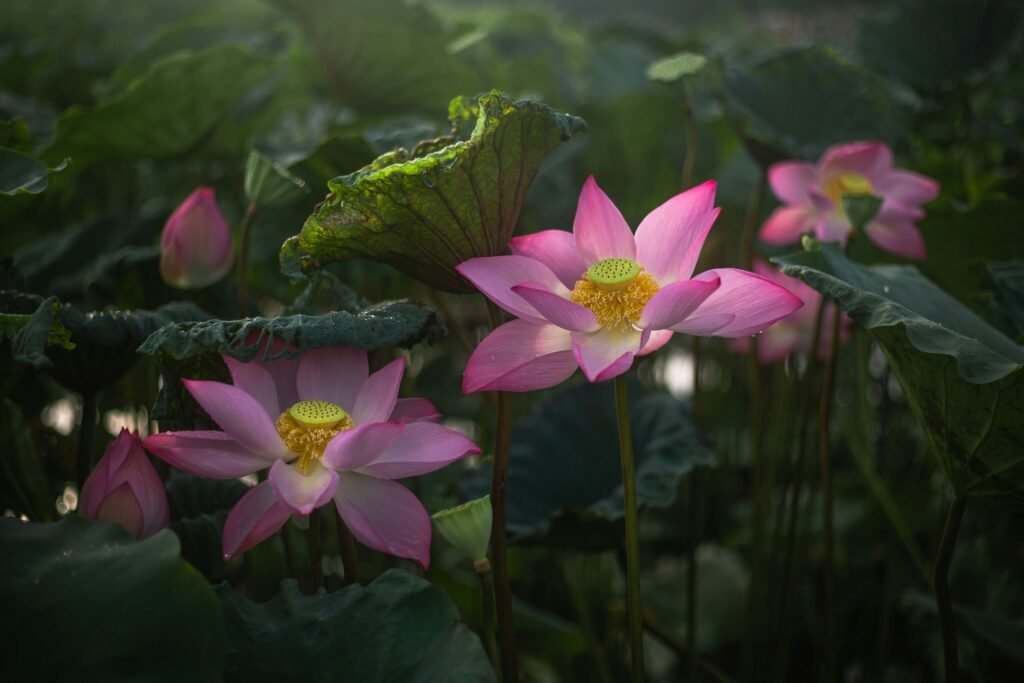
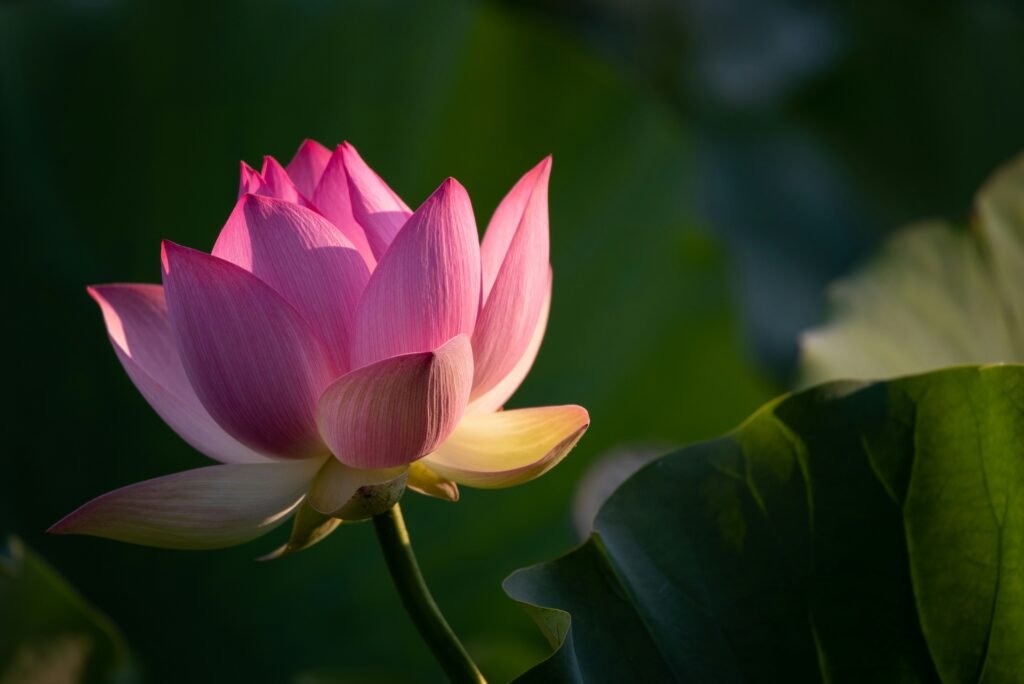
The lotus has never been officially declared the national flower, and yet it is: logo of the national airline, motif of the temples, emblem of 11th-century sculpture. Its Buddhist symbolism is well known — it grows in mud and opens pure at the surface — and a folk poem everyone knows draws the moral: “near the mud, yet without its smell”.But the lotus is also a complete vegetable, and that is what travellers discover. The seed is eaten fresh or candied, and goes into mooncakes. The rhizome is cut into lacy slices and pickled for lotus salad, a Hue dish. The young stem, peeled, is eaten raw. The green germ at the heart of the seed, very bitter, is infused against insomnia. The leaf is used to wrap rice.
Lotus tea, and why it is so expensive
The most refined speciality of West Lake in Hanoi is trà sen. The traditional method is to remove the stamens from the heart of the flower — about twelve hundred flowers are needed for one kilo of tea — and mix them with green tea for several days, repeating the operation five to seven times with fresh stamens.The result sells for several hundred euros a kilo and is drunk from very small cups. A more poetic variant involves slipping a pinch of tea into a still-closed flower on the pond, tying it shut, and collecting it the next morning.The lotus season runs from June to August. If you are in Hanoi during those months, West Lake at dawn is worth getting up for: the ponds are entirely pink and the harvesters wade in up to their waists.
The banyan, the village tree
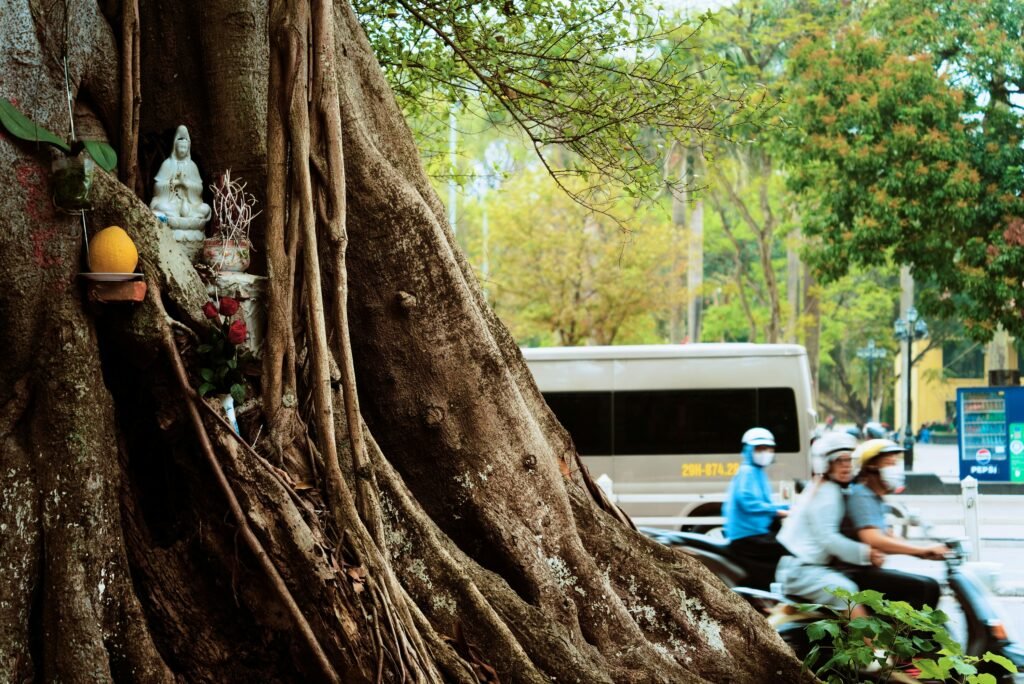
The banyan, cây đa, is a strangler fig whose aerial roots hang down from the branches and eventually form new trunks. An old banyan easily covers several hundred square metres and lives for centuries.In the Red River Delta, together with two other elements it forms the founding scene of the village: cây đa, bến nước, sân đình — the banyan, the landing stage, the courtyard of the communal house. The banyan is where you rest, wait and meet; it is also where spirits live, and there is almost always a small altar at its foot.You don’t cut down a banyan. Stories of misfortune befalling those who did circulate everywhere, and new roads go round them more often than you would think. The great banyan of Hai Duong, several centuries old, or the one at the temple of Bà Chúa Xứ in the South, are places of pilgrimage.
The lotus season
Lotuses bloom from June to August. In Hanoi, the ponds around West Lake are covered in pink flowers, and you see photographers and young people in áo dài crowding there from dawn. The flowers open in the morning and close in the heat of the day: come early, before 7 am, to see them at their best.
Bamboo on the plate
Bamboo can also be eaten. The young shoots, fresh or dried, go into soups and stir-fries, and in the mountains sticky rice is cooked directly in a section of bamboo set on the embers. Tasting these dishes in a homestay shows how much this plant is part of everyday life.
Sacred trees
Many old trees, banyans or kapok trees, shelter a small altar at their foot, with incense and offerings: people honour the spirit that lives in them. Do not lean against them for a photo, and do not touch the offerings.
Seeing a village differently
With these three plants in mind, a delta village can be read at a glance. The bamboo hedge marks the boundary — often reduced to a few clumps today, but the line remains. The pond in the centre, dug to provide earth for the embankments, is planted with lotus and water vegetables. The banyan and the communal house form the square.These three elements make up an organisation that has changed little in a thousand years, and which explains the saying you will hear: phép vua thua lệ làng, the king’s law gives way to village custom. A Confucian central power, and behind the bamboo hedge, real autonomy.Ask your guide to stop in an ordinary village with nothing to visit. It is often the half-hour travellers remember best.
Because it grows up to a metre a day, reaches adult size in three to five years and grows back after cutting without replanting. It is used for everything: frames, baskets, mats, scaffolding, boats, water wheels.
Is the lotus Vietnam’s national flower?
Officially no, no text has declared it. In practice yes: it is the emblem of the national airline, the dominant motif in temples and the Buddhist symbol of purity.
When can you see the lotus in bloom?
From June to August, peaking in July. West Lake in Hanoi and the ponds of Ninh Binh are then entirely pink. Go at dawn.
Why is lotus tea so expensive?
Because the stamens of about twelve hundred flowers are needed to scent one kilo of tea, and the process is repeated five to seven times with fresh stamens. That is several days of manual work.
What is a banyan?
A strangler fig whose aerial roots form new trunks. It stands at the centre of delta villages, alongside the landing stage and the communal house, and there is almost always an altar at its foot.
Can you bring bamboo basketware home?
Yes, and it is light. Fine mats, fans, double-walled rice boxes and steamer baskets travel very well. Furniture doesn’t, unless you have it shipped.
Putting it into practice
The tours where you experience what this article is about
Audience measurement. We would like to know which pages are useful to you, using Google Analytics. Nothing is stored without your consent, and you can change your mind at any time. Learn more


 The essentialsVietnam in 15 daysHanoi — Pu Luong — Ninh Binh — Lan Ha Bay — Hue — Hoi An — Saigon — Mekong Delta15 days / 14 nightsfrom €2,070