The áo dài: a national costume younger than you think
It is said to be a thousand years old. Its current silhouette dates from the 1930s and came out of the studio of painters trained at the École des beaux-arts de l’Indochine. What it says, how to read it in the street, and how to have something made in Hoi An without making a mistake.
A national costume born in the 1930s
The áo dài is often presented as a thousand-year-old garment. It isn’t. The ancestral tunic, the five-panelledáo ngũ thân , was loose, dark and designed to hide the figure. Its modern silhouette — close-fitting, waisted, two panels slit very high over wide trousers — dates from the 1930s.It is the work of painters trained at the École des beaux-arts de l’Indochine, who recut the tunic along European lines, with darts and fitted armholes. So the most Vietnamese garment of all is, in its current form, a direct product of the colonial encounter — which takes nothing away from how natural it looks.It then went through contradictory periods: emblem of Saigon elegance in the 1960s, set aside after 1975 as bourgeois frivolity, back in force since the 1990s. Today, schoolgirls wear it in white, flight attendants in blue, and women of all generations for a wedding or Tết.
Reading what you see
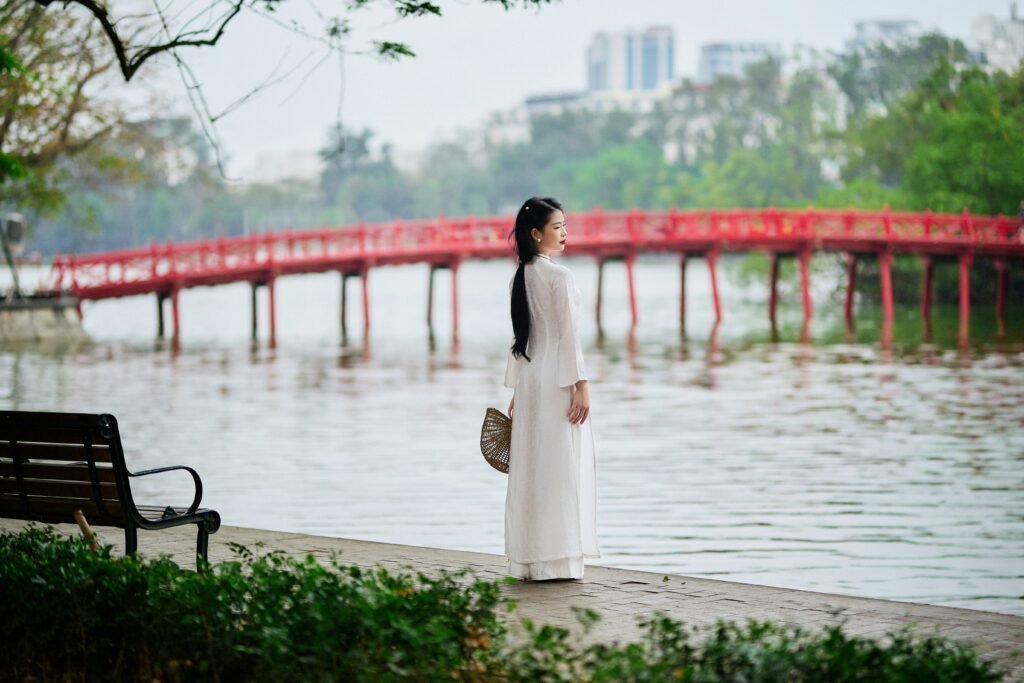
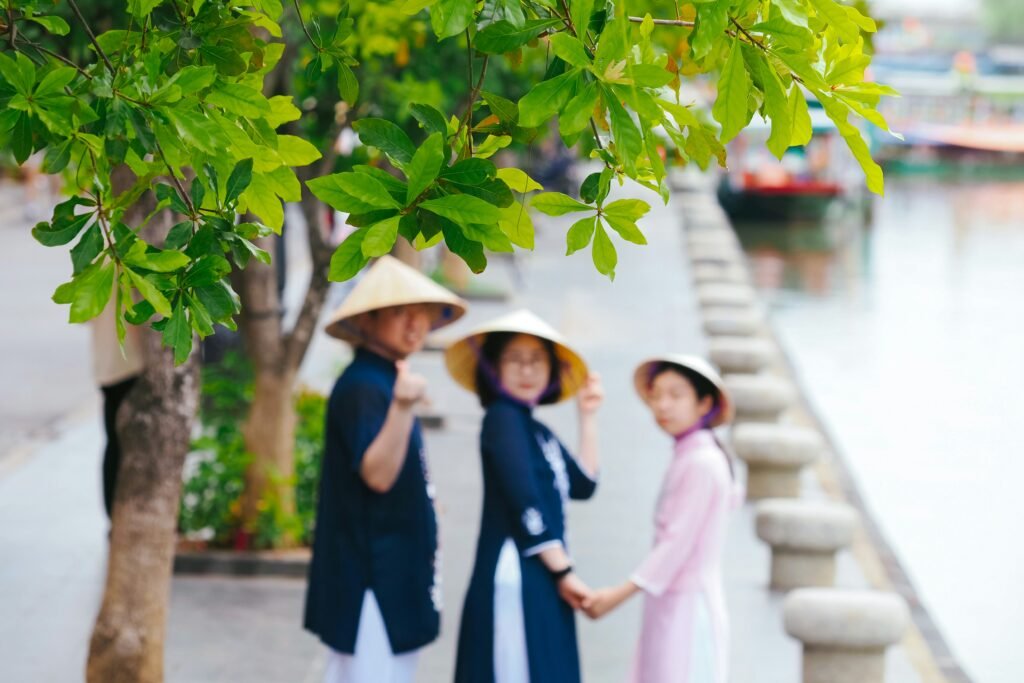
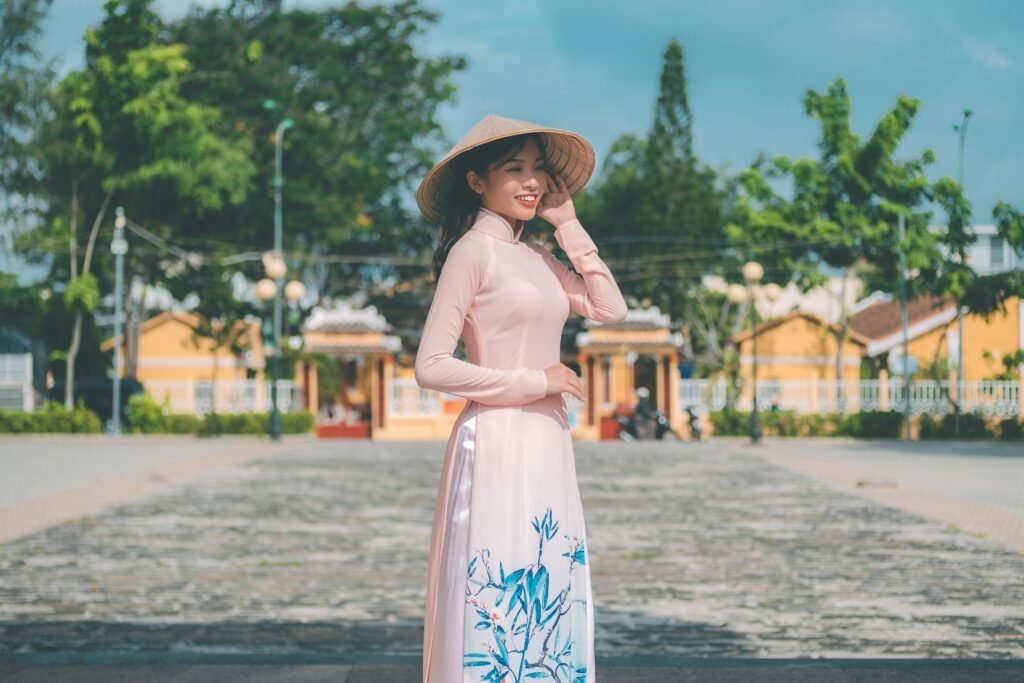
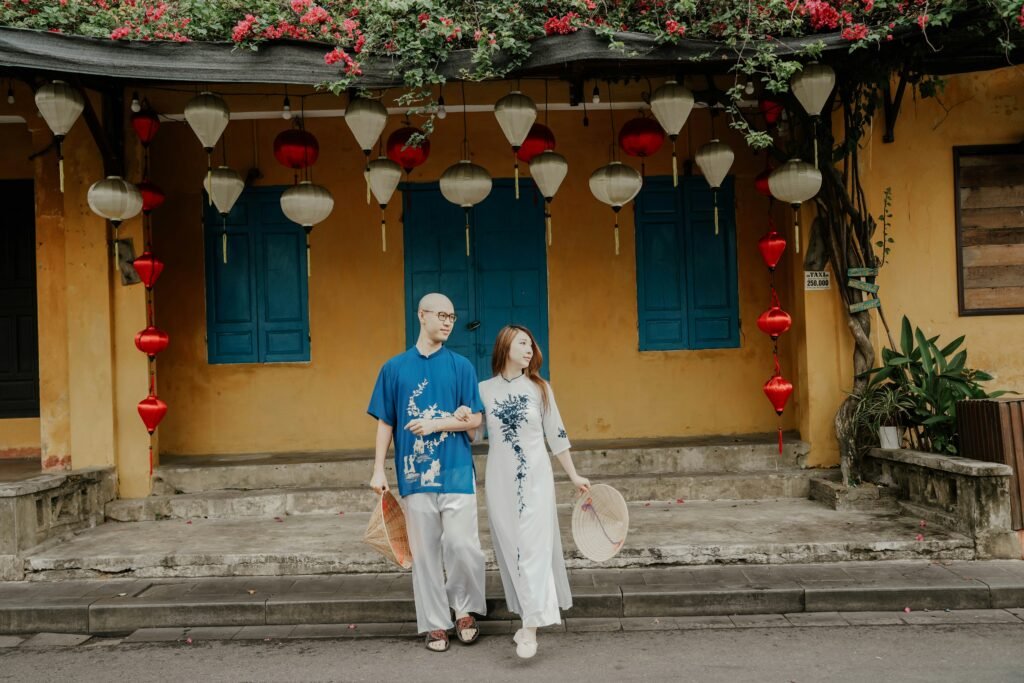
White is for secondary-school girls: in some towns, a whole district turns white when classes come out. Bright colours and embroidery signal a celebration, a wedding, a family photo. Red is for weddings; it is also worn at Tết.Men wear a looser version, often blue or brown, reserved for weddings, ancestral ceremonies and village festivals — you will see it mostly in Huế and the Red River Delta.Alongside the áo dài, two garments deserve a look. The nón lá, the conical hat of palm leaves sewn onto sixteen bamboo rings, whose Huế version hides a pattern visible only against the light. And the áo bà ba, the straight shirt of the South, the work clothing of delta women, infinitely more common in real life than the áo dài.
The most Vietnamese garment of all took its shape in a studio of French-trained painters.
Getting dressed in Hoi An
Hoi An has several hundred tailoring workshops, a legacy of its past as a trading port and of the nearby silk villages. You can have an áo dài made there, but also a suit, a coat, a dress, in twenty-four to forty-eight hours.How to recognise a good workshop:
It sews on site. Ask to see the workshop. Many shops in the centre subcontract to outside workshops and control nothing.
It offers at least two fittings, and refuses twelve-hour deadlines for a structured garment. A suit botched overnight shows at the shoulder.
It lets you touch the fabrics and says where they come from. “Silk” at a derisory price is polyester; the burnt-thread test settles it in three seconds.
It gives a firm price before starting, alterations included.
Have your measurements taken on the first day of your stay in Hoi An, not the day before leaving: that leaves time for an alteration. And bring a photo of what you want — a verbal description crosses the language barrier badly, a picture doesn’t.
Wearing it without a faux pas
A foreign woman wearing an áo dài gives pleasure, provided she wears it correctly. It isn’t a costume: it is worn with the matching trousers, never on its own, and fastened up to the high collar.Avoid white if you aren’t a schoolgirl — the effect is that of an adult in school uniform — and avoid religious or imperial motifs used out of context. For a photo session in a temple, cover your shoulders and respect the rules of the place like any visitor.Many of our women travellers have one made and never wear it again at home. That is predictable and doesn’t matter: the point lies elsewhere. A well-cut silk shirt or a made-to-measure jacket, on the other hand, will be worn for years — and cost a fraction of the European price.
The áo dài in everyday life
Far from being a museum costume, the áo dài is still widely worn. In many high schools, especially in Huế and the South, girls wear it in white as a uniform, and their bicycle rides home, panels flying in the wind, are a classic image of the country. It is also a uniform for airlines, some banks, hotels and official ceremonies. At Tết, for weddings or graduation photos, women of all ages bring out their finest áo dài, and photo studios set up their backdrops in the streets of Hanoi and Hoi An.
The men’s áo dài
It is often forgotten, but the áo dài also exists for men. Looser, in a dark or plain colour, it is worn with a round turban, the khăn đóng. It is mostly reserved for weddings, family ceremonies and Tết, and more and more young grooms choose it rather than a Western suit. For a couple on honeymoon, having two matching áo dài made in Hoi An is a much-loved souvenir.
Silk, brocade or synthetic
The price of an áo dài depends first on the fabric. Natural silk, light and flowing, remains the most beautiful, but it is delicate and more expensive; brocade, woven with patterns, is worn for special occasions. Many áo dài sold to travellers are made of synthetic fabric, easier to care for, which is nothing to be ashamed of as long as you know it. Ask to touch the fabric, see how it hangs on the mannequin and know its composition before ordering.
How long a made-to-measure áo dài takes
In Hoi An, a made-to-measure áo dài usually takes twenty-four to forty-eight hours: measurements on the first day, a fitting the next day, alterations and delivery to your hotel. Allow at least two nights there, and if possible bring a photo of the style you like. A good workshop takes about twenty measurements; be wary of one that only takes three.
Caring for your áo dài
A silk áo dài is washed by hand, in cold water, and ironed at a low temperature on the reverse side. For the journey home, roll it rather than fold it, with a sheet of tissue paper: creases set quickly. Synthetic fabrics are far less demanding.
Where to see, where to have made
In Huế, the áo dài remains the most worn day to day in the country, and the city has made its reintroduction a local policy. In Hanoi, the silk street of the Old Quarter and the village of Vạn Phúc supply the fabrics. In Hoi An, you have it sewn. In Saigon, contemporary designers reinterpret the cut, sometimes radically.We are happy to organise a half-day of tailoring in Hoi An at a workshop we know, with measurements in the morning and a first fitting the next day. Tell us when building the itinerary: it simply means placing Hoi An early enough in the trip.
It depends entirely on the fabric, which makes up most of the price: real silk costs several times as much as synthetic. Ask for a firm price including alterations before starting, and be wary of very low offers — they always skimp on the material.
How long until it is ready?
Twenty-four to forty-eight hours for an áo dài, two to three days for a lined suit. Have your measurements taken as soon as you arrive in Hoi An rather than the day before you leave: you need to keep time for an alteration.
Can you wear the áo dài as a foreigner?
Yes, and it is well received. Two conditions: wear it with its matching trousers, never alone, and avoid white, which is the schoolgirls’ uniform. In a temple, the usual rules apply despite the costume.
How can you recognise a good tailor in Hoi An?
They sew on site and show you the workshop, offer at least two fittings, refuse absurd deadlines, and state the origin of their fabrics. The burnt-thread test settles the silk question in three seconds; an honest seller accepts it.
Do men wear the áo dài?
Yes, in a looser, more sober version, reserved for weddings, ancestral ceremonies and village festivals. You see it mostly in Huế and the Red River Delta.
What should I have made if I won’t use an áo dài?
A silk shirt, a made-to-measure jacket or coat: that is what our travellers actually wear once home, for a fraction of the European price. Bring a photo of the design you want; it is better than any description.
Putting it into practice
The tours where you experience what this article is about
Audience measurement. We would like to know which pages are useful to you, using Google Analytics. Nothing is stored without your consent, and you can change your mind at any time. Learn more


 The essentialsVietnam in 15 daysHanoi — Pu Luong — Ninh Binh — Lan Ha Bay — Hue — Hoi An — Saigon — Mekong Delta15 days / 14 nightsfrom €2,070