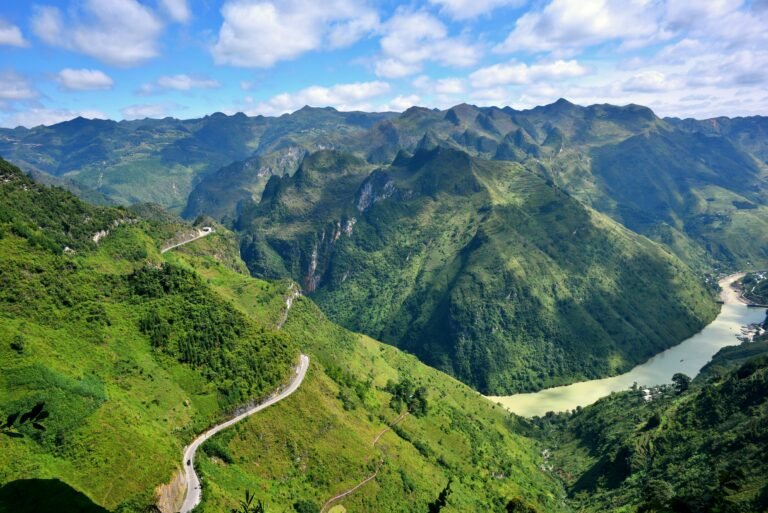
A waterfall straddling the Chinese border, a UNESCO Global Geopark, valleys where you meet more buffaloes than cars. Cao Bang is the north-eastern province that classic tours still overlook — and the one where we send travellers who have already seen Ha Giang.
In brief
Best time
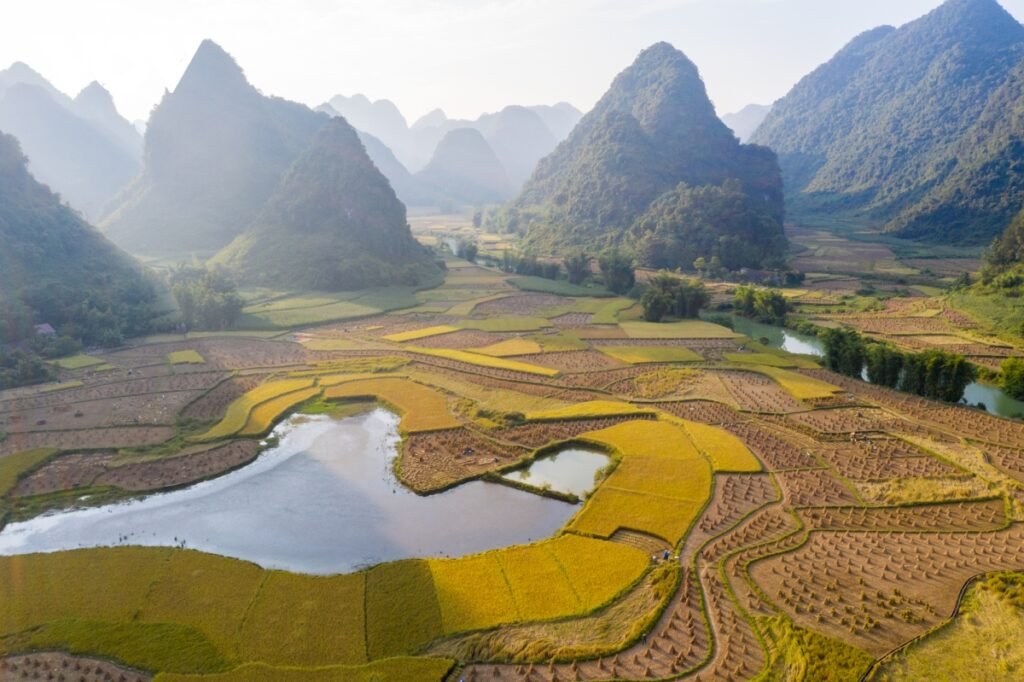
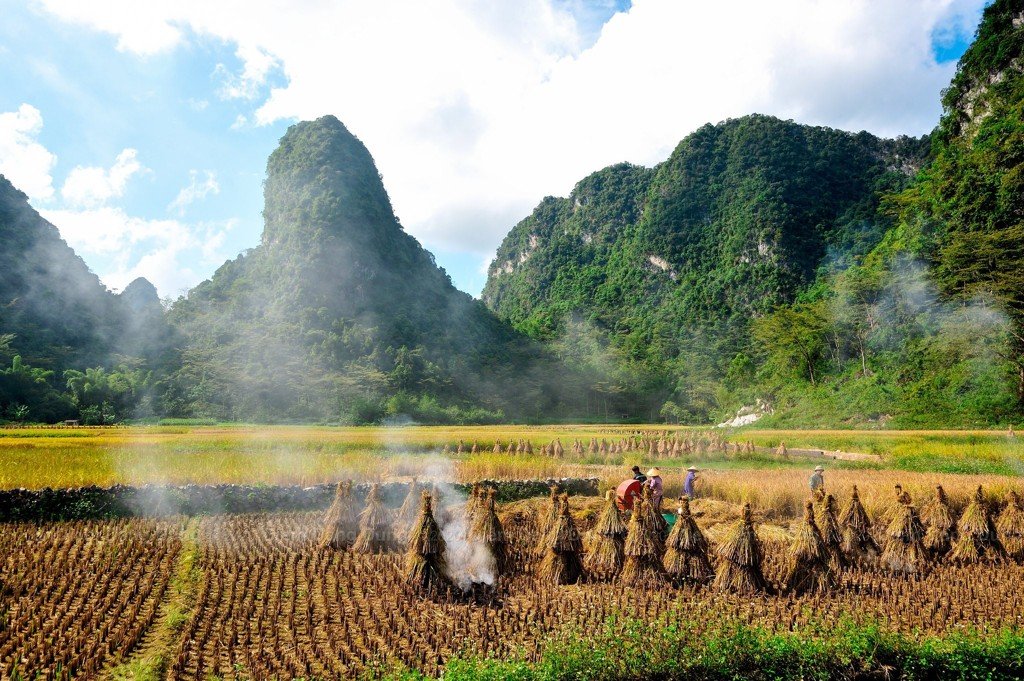
September to November: waterfall at full flow and golden rice fields; March–May quieter
Getting there
6 h from Hanoi by motorway then mountain road; 2 h more to Ban Gioc
How long
Two to three nights
Combine with
Ha Giang via the Bao Lac road, Ba Be and its lake 3 h away, Hanoi
Ban Gioc waterfall
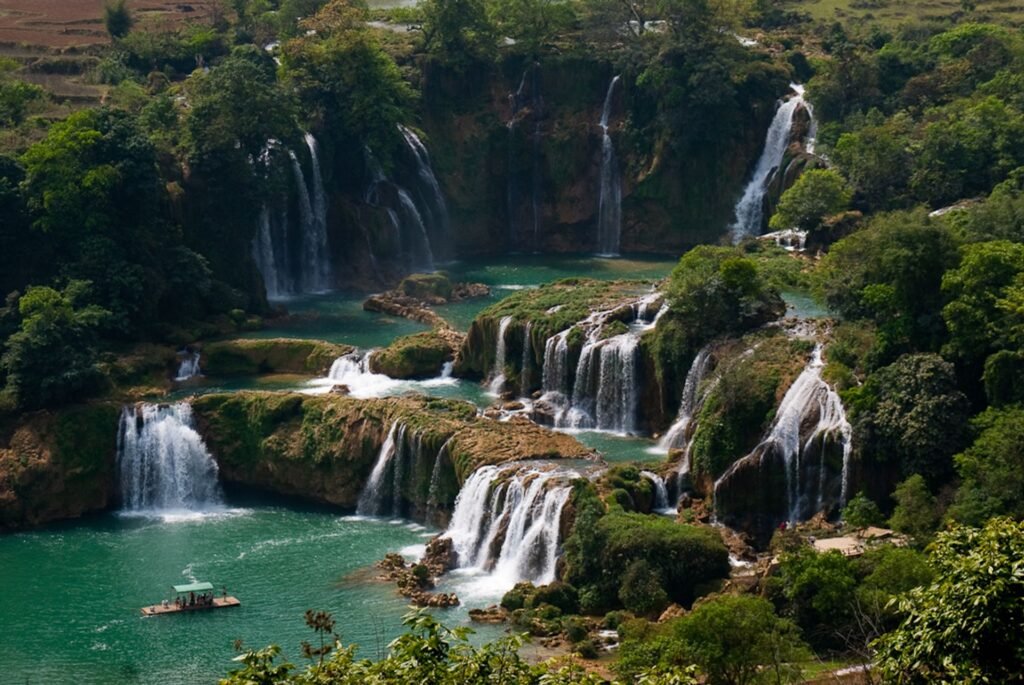
Ban Gioc is the largest waterfall in Vietnam and the fourth-largest border waterfall in the world: three hundred metres wide, thirty high, in tiers, with China on the other bank. The Quay Son river is a jade green you would think had been retouched in photos.A bamboo raft takes you to the foot of the falls, right up to the border line where Chinese and Vietnamese boats pass each other. The flow decides everything: from September to November, after the monsoon, the falls are full and the rice fields below are golden. From March to May, the flow drops and the waterfall splits into trickles.
The Quay Son river is a jade green you would think had been retouched in photos.
Nguom Ngao cave and the stone village
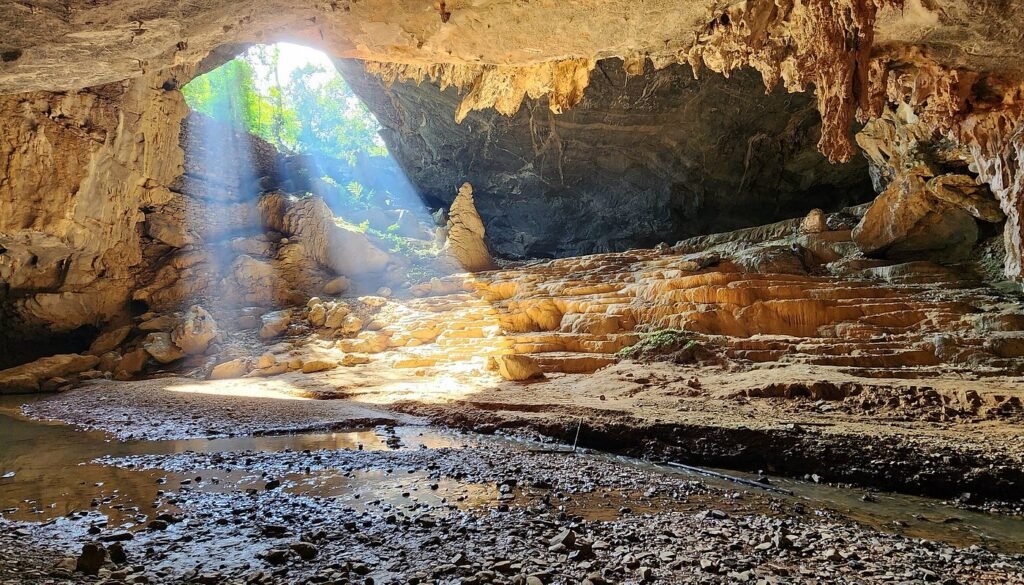
Three kilometres from the waterfall, Nguom Ngao runs for more than two kilometres, one of them fitted out for visitors. It was discovered in 1921 and its name means “tiger cave” in the Tay language. The formations, ochre and white, are among the most beautiful in the North; the visit takes an hour and combines naturally with Ban Gioc.The village of Khuoi Ky, between the two, is a Tay hamlet of houses built entirely of dry stone, walls and roofs included, a technique dating back to the 16th century. About fifteen families welcome travellers there.
A UNESCO Global Geopark
The whole province has been a Global Geopark since 2018, covering three thousand square kilometres of limestone, underground rivers and enclosed valleys. Three marked routes cross it, from the south-west to the east.Two stops stand out. Thang Hen lake, a string of mountain lakes whose level rises and falls by several metres with the seasons because of underground channels. And the Ma Phuc pass, “the kneeling horse”, where the road runs between two upright blocks of limestone.
Pac Bo, to understand the country
On the border, Pac Bo cave is where Ho Chi Minh returned to Vietnam in February 1941, after thirty years in exile, to organise the Viet Minh. He lived there in rudimentary conditions, sleeping on a plank, working at a stone table beside a stream he named Lenin, facing a peak he named Karl Marx.The site is a place of national pilgrimage, much visited by Vietnamese and almost never by foreigners. For a French traveller it is a visit that sheds light on a shared history, provided you are accompanied by a guide able to tell it.
Combining with Ha Giang, or with Ba Be
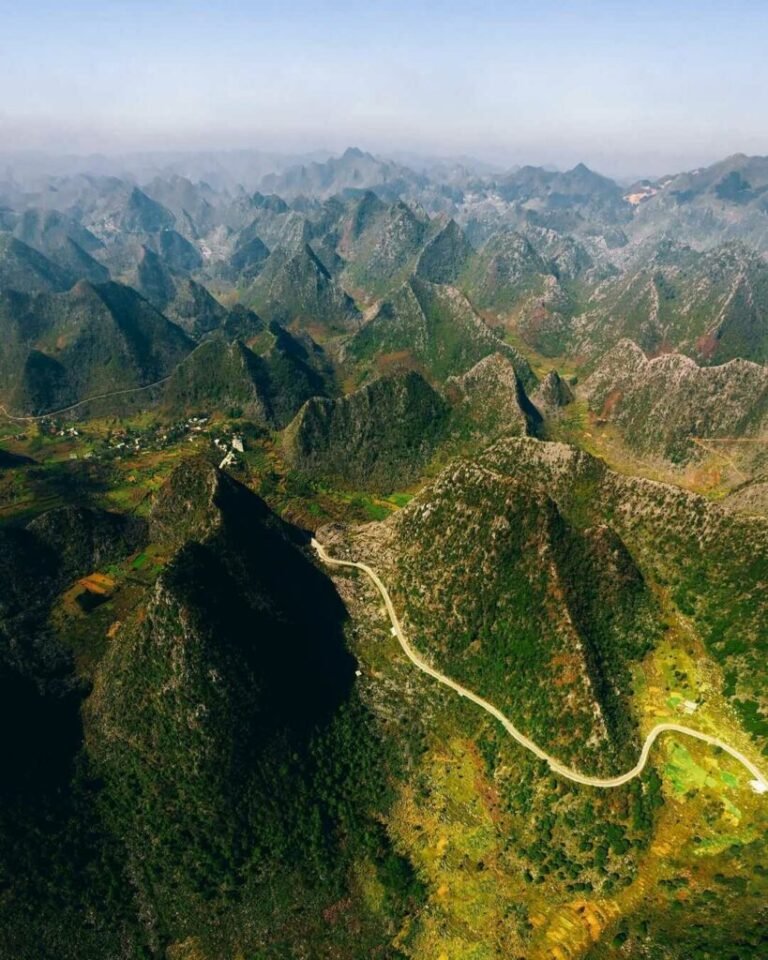
The Bao Lac road links Cao Bang to Ha Giang in six to seven hours, over passes and through valleys that see very little traffic. It is one of the most beautiful routes in the North and it avoids going back down to Hanoi between the two regions.To the south, Ba Be lake, three hours away, adds a night in a Tay homestay by the water and a boat trip through the gorges. The Hanoi – Ba Be – Cao Bang – Ha Giang – Hanoi sequence is our favourite northern loop, in ten to twelve days.
Access, accommodation, formalities
Six hours from Hanoi by private car, then two more hours to Ban Gioc. There is neither train nor airport. A permit is required to approach certain border areas; we take care of it.Accommodation is simple: Tay guesthouses in Khuoi Ky and Bang Ha, from €15 to €40, a few charmless hotels in town, and a resort facing the waterfall.
The mistakes we see most often
Coming in April hoping for the great waterfall: the flow is at its lowest.
Doing Ban Gioc as a return trip from Hanoi: sixteen hours on the road in two days.
Going back through Hanoi to get to Ha Giang when the Bao Lac road exists.
Visiting Pac Bo without a guide: without the story, it is a cave and a stream.
The Cao Bang calendar
Here, the question is not the temperature but the waterfall’s flow. Ban Gioc changes completely depending on the month.
Period
Ban Gioc flow
Landscape
September – November
Maximum
Full falls 300 m wide, golden rice fields below. The best window.
June – August
Steep
Strong flow but often brown water after storms, and slippery roads.
December – February
Average
Cold — 5 to 15 °C — and frequent mist on the passes.
March – May
Low
The falls split into trickles. The rest of the province is still very beautiful.
If the waterfall is your main motivation, don’t come in April: it is the month when the photos sold by agencies look least like what you will see.
Combining Cao Bang with Ha Giang or Ba Be
The Bao Lac road to Ha Giang
Six to seven hours of passes and valleys that see very little traffic. It is one of the most beautiful routes in the North, and above all it avoids going back down to Hanoi between the two provinces — which most tours do, at the cost of two lost days.
Ba Be lake to the south
Three hours away, the country’s largest natural mountain lake. You sleep in a Tay homestay by the water and go down the Dong Kong gorges by boat. It is the stop that softens the return to Hanoi.
Our northern loop
Hanoi – Ba Be – Cao Bang – Ha Giang – Hanoi, in ten to twelve days. It is our favourite itinerary in this region, because it never passes the same place twice.
What a stay in Cao Bang costs
Item
Indicative price
Tay guesthouse in Khuoi Ky
€15 – 40 for two
Resort facing the waterfall
90 – 180 €
Meal
3 – 8 €
Bamboo raft at the foot of the falls
~ €2 per person
Nguom Ngao cave entrance
~ 2 €
Private car from Hanoi
€110 – 150 one way
A permit is required to approach certain border areas; we take care of it before your arrival. Bring cash: outside Cao Bang town, ATMs are rare and cards are almost never accepted.
The stone village of Khuoi Ky
Between the waterfall and the cave, about fifteen Tay houses built entirely of dry stone — walls, fences and even roofs — using a technique attested since the 16th century. The blocks are fitted without mortar, and the whole village is listed as national cultural heritage.The reason for this architecture is practical: the region is a limestone geopark where stone is plentiful and timber scarce. So the Tay built with what they had, and the houses hold the heat in summer as well as the cold in winter.Several families welcome travellers. It is our favourite address in the province: you sleep in a stone house three kilometres from the largest waterfall in Vietnam, and in the morning there is nobody by the water before eight.
September and October: the waterfall is at full flow after the summer rains and the rice fields around it are golden. From March to May, the flow is much weaker.
How many nights should you plan in Cao Bang?
Two nights let you see the waterfall, the cave and a valley. Three nights open up the geopark and the north-eastern loop without spending your days in the car.
Do you need a special permit?
Some border areas require authorisation, which we obtain for you before your arrival. Your passport is enough on site.
Can you continue on to Ha Giang?
Yes, but the road between the two takes seven to eight hours over the passes. We only advise it for tours of nine days or more, and never as a single transfer day.
When is Ban Gioc waterfall at its most beautiful?
From September to November, after the monsoon: the falls are full across three hundred metres and the rice fields below are golden. In April, the flow drops and the waterfall splits into trickles.
Can you go directly from Cao Bang to Ha Giang?
Yes, by the Bao Lac road: six to seven hours over very quiet passes. It avoids going back down to Hanoi between the two provinces, which costs two days.
Where to stay near Ban Gioc?
In Khuoi Ky, a Tay hamlet of dry-stone houses three kilometres from the waterfall, listed as national heritage. Allow €15 to €40 for two, and you have the water to yourselves before eight.
Audience measurement. We would like to know which pages are useful to you, using Google Analytics. Nothing is stored without your consent, and you can change your mind at any time. Learn more
 Off the beaten trackHa Giang off the beaten track — 9 daysHanoi — Ha Giang — Dong Van — Cao Bang — Ban Gioc — Hanoi9 days / 8 nightsfrom €1,390