Vietnamese markets: when, where, and how far to bargain
The Mekong floating market and the great hall of Bến Thành are in every guidebook. The market that really counts is the one on your street at five in the morning, which will have vanished before your breakfast.
The neighbourhood market, at five in the morning
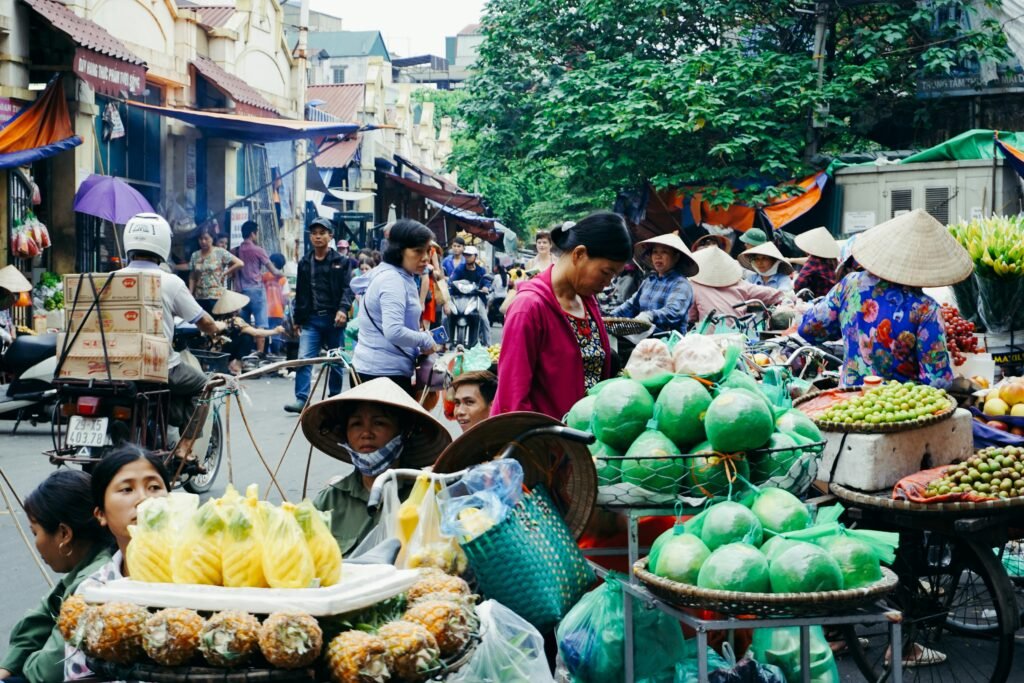
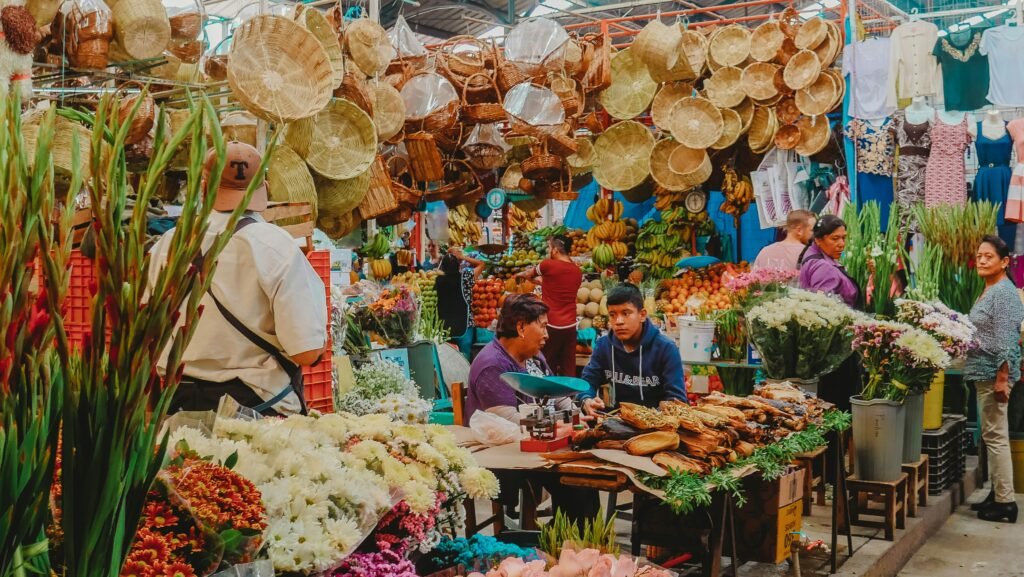
It is the market travellers miss, because it is over by the time they get up. The chợ cóc — literally the “toad market”, because it appears and disappears in a single leap — occupies a street or a crossroads from five to eight, then vanishes without a trace.People buy for the day, never for the week: few Vietnamese households stock up, and the very idea of shopping on Saturday for seven days seems strange. The herbs were picked the day before, the pork is cut in front of you, the tofu is still warm, and the fish live in a basin until they are bought.It is the best place in the country to understand a cuisine. In twenty minutes you will see thirty herbs you can’t name, six kinds of tofu, fertilised duck eggs, fresh bamboo shoots and shrimp paste you can smell ten metres away. Go with your guide and have everything explained: it is worth three museums.
The floating markets of the delta
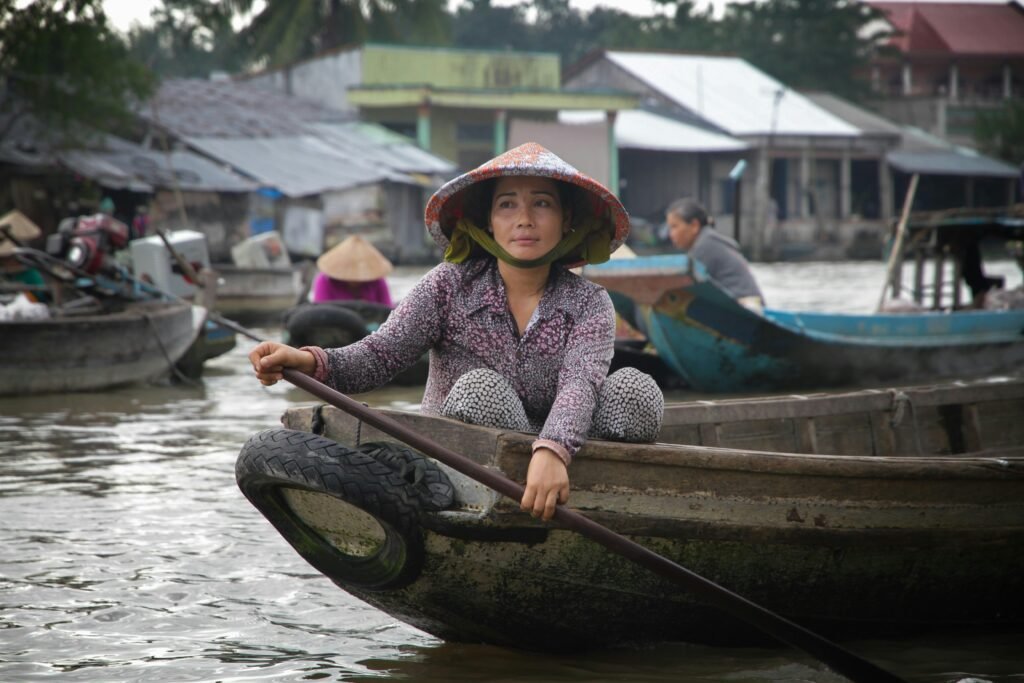
On the Mekong, the market settled on the water for a practical reason: before roads, the river was the only network. Wholesalers moor, retailers circulate among them by boat, and each boat signals its goods by hoisting them on a pole — the cây bèo. A pole with a pineapple means: pineapples here.Cái Răng, near Cần Thơ, remains the largest. You need to be there between five-thirty and seven: by eight, the big boats have left and only coffee boats for visitors remain.Let us say it frankly: these markets are in decline. Bridges and trucks have made the waterway less necessary, and the number of boats falls year after year. Phong Điền, smaller and further away, today gives a truer picture of what Cái Răng was twenty years ago. It is the one we point people to.
Mountain markets
Nothing like it. Here the market is weekly, held on Sunday or Saturday depending on the place, and people walk in from hamlets three hours away. They sell two chickens, buy salt and thread, settle family business and drink a lot of maize spirit. Trade is only a pretext.Bắc Hà, on Sunday, is the largest in the North-West: horses and buffaloes are still traded there in a separate enclosure. Cán Cầu, on Saturday, is smaller and rougher. Đồng Văn and Mèo Vạc punctuate the Ha Giang loop.The Khâu Vai love market, in Ha Giang, is held only once a year: former lovers who never married meet there, with the tacit agreement of their spouses. It is one of the most unusual traditions in South-East Asia, and it is announced nowhere online.A nuance: some markets have been damaged by visitor numbers — concrete halls, imported goods, women paid to pose. We favour the smaller ones and the days when the coaches don’t come up, even if it means shifting a stop by a day.
A mountain market is judged by one thing: the number of people there who are neither selling nor buying anything.
The great colonial halls, and the night markets
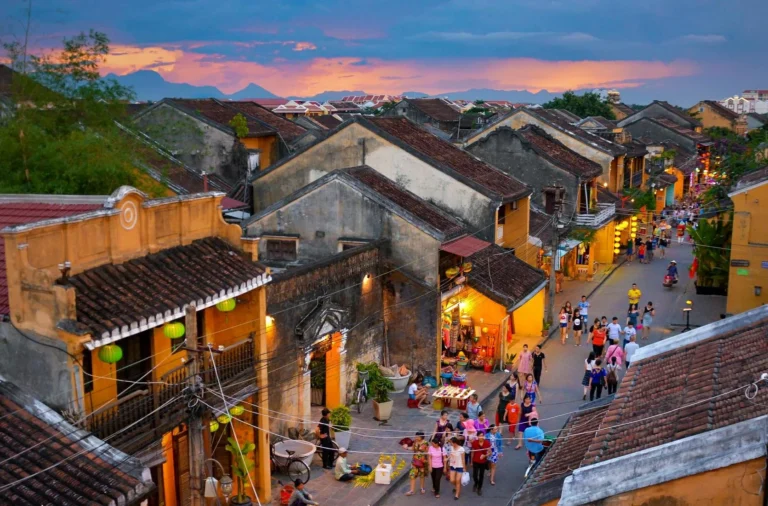
Bến Thành in Saigon and Đồng Xuân in Hanoi are the two great market halls inherited from the colonial period. They remain impressive, but let us be clear: their ground floors are now largely geared to visitors, first prices are multiplied by three or four, and quality is uneven.What is worth the detour is what surrounds them: the food streets behind Bến Thành, where the traders eat, and the upper floors of Đồng Xuân, reserved for wholesale, where no tourist goes. Night markets are another genre: Hanoi’s at weekends, Hội An’s along the river, Đà Lạt’s where you eat bánh tráng nướng — “Vietnamese pizza” — in the cold. You go for the atmosphere and the food, never for shopping: almost all the goods are imported.
The flower markets
In Hanoi, the Quang An flower market, on the shore of West Lake, comes alive at night, when florists come to stock up. In the weeks before Tết, markets of peach trees, kumquats and flowers take over the streets of every city, and motorbikes leave loaded with trees in blossom. It is one of the most beautiful sights of the year.
The wholesale markets, at night
For early risers, or night owls, wholesale markets are fascinating. In Hanoi, Long Bien market, at the foot of the bridge of the same name, receives fruit and vegetables from the countryside all night long, carried by porters and overloaded motorbikes. Come between 2 and 5 in the morning, with your guide, keeping a low profile: it is a very busy place of work.
Taking photos at the market
Markets are very photogenic, but they are first and foremost places of work. Ask with a gesture before photographing someone close up, buy something from the stall you photograph and do not block the narrow aisles. A smile and a thank you, cảm ơn, open many doors.
Tasting at the market
Almost every market has its corner of food stalls, where vendors and customers have breakfast or lunch. That is often where you eat best: morning soups, pancakes, sweet chè desserts, cut fruit. Choose the busiest stalls, where produce turns over quickly.
In one sentence
Go early, buy something, smile, and let your guide explain what you see: a Vietnamese market is often worth more than a museum.
Bargaining, and how far
You bargain at markets and stalls without displayed prices; never in a restaurant, a craft workshop, a metered taxi or a shop with price tags.
In the touristy market halls, the first price is often three to four times the real price. Elsewhere, the gap rarely exceeds twenty to thirty per cent.
Smile, make an offer, leave a silence. Silence brings prices down better than insistence.
Don’t bargain over the equivalent of fifty cents. It makes everyone uncomfortable, you first of all.
Don’t ask a price if you don’t intend to buy, especially as the first customer of the day: the first sale brings luck and a refusal after negotiation is badly taken.
Have small change. A 500,000-dong note at six in the morning is a problem for the vendor, not for you.
A word about photos: ask, with a gesture if necessary. Vendors gladly agree, often laughing, and sometimes refuse — in which case you put the camera away without insisting.
Between five and seven for a neighbourhood market or a floating market: by eight, most of it is over. Mountain markets last all morning but are at their busiest between eight and ten. Night markets open around six in the evening.
Are the floating markets still worth the detour?
Yes, provided you choose. Cái Răng is still active but declining, and tourist crowds there are heavy. Phong Điền, smaller and further away, looks more like what Cái Răng was twenty years ago. In both cases, leave before dawn.
Should you bargain?
At markets yes, with a smile. Expect three to four times the real price as the first offer in tourist market halls, twenty to thirty per cent elsewhere. Never in a restaurant, a craft workshop or a shop with displayed prices.
Can you eat at markets safely?
Yes, and it is often where you eat best. Choose a stall frequented by Vietnamese people, where turnover is fast. The risk rarely comes from cooked food but from water: avoid crushed ice and watered-down juices outside the cities.
Can you photograph the vendors?
Ask, with a simple gesture if you don’t speak the language. Most agree, laughing. Some refuse, and then you put the camera away. Never pay for a photo: that is what turned some markets in the North into stage sets.
Which market should you choose if you only do one?
A neighbourhood market at dawn with your guide, in the city where you start your trip. It is free, takes an hour, and it will make the rest of your stay much easier to read — far more than a famous market hall.
Putting it into practice
The tours where you experience what this article is about
Audience measurement. We would like to know which pages are useful to you, using Google Analytics. Nothing is stored without your consent, and you can change your mind at any time. Learn more



 Off the beaten trackHa Giang off the beaten track — 9 daysHanoi — Ha Giang — Dong Van — Cao Bang — Ban Gioc — Hanoi9 days / 8 nightsfrom €1,390