
Day 01Arrival in HanoiD
French-speaking guide & private driver · Transfer 40 km · 45 min
Welcome at Noi Bai and transfer to the Old Quarter. Twelve days is the length we recommend most often: it is the first format in which you can cross the country from the Red River Delta to the Mekong without rushing, with two nights in the South rather than a stopover.
This tour follows one thread: the table. Not out of greed, but because in South-East Asia food is the best gateway to everything else — geography, migration, colonisation and social class can be read on a plate before they can be read in a museum.
Vietnam has three cuisines. In the North, sober, not very spicy, salty, focused on broths and fresh herbs, marked by a thousand years of Chinese proximity and by real winters. In the Centre, the cuisine of the Hue court, in small portions and decidedly fiery. In the South, sweet, herbal, exuberant, fed by a delta where everything grows three times a year.
Welcome dinner with your guide: bún chả, charcoal-grilled pork served in a warm sweet-and-sour broth into which you dip noodles and herbs. It is Hanoians’ everyday lunch, eaten on a low stool, and the best possible starting point.
Day 02Hanoi, the city of a thousand tradesB, L
French-speaking guide · Short trips · About 5 km on foot
Dong Xuan market at opening time, before breakfast. It is Hanoi’s largest covered market, rebuilt by the French in 1889 on the site of a much older market. On the ground floor, fresh produce; upstairs, textiles and hardware. What strikes you is the range of herbs: some twenty varieties that English has no name for — perilla, sawtooth coriander, Thai basil, fragrant rice-paddy herb.
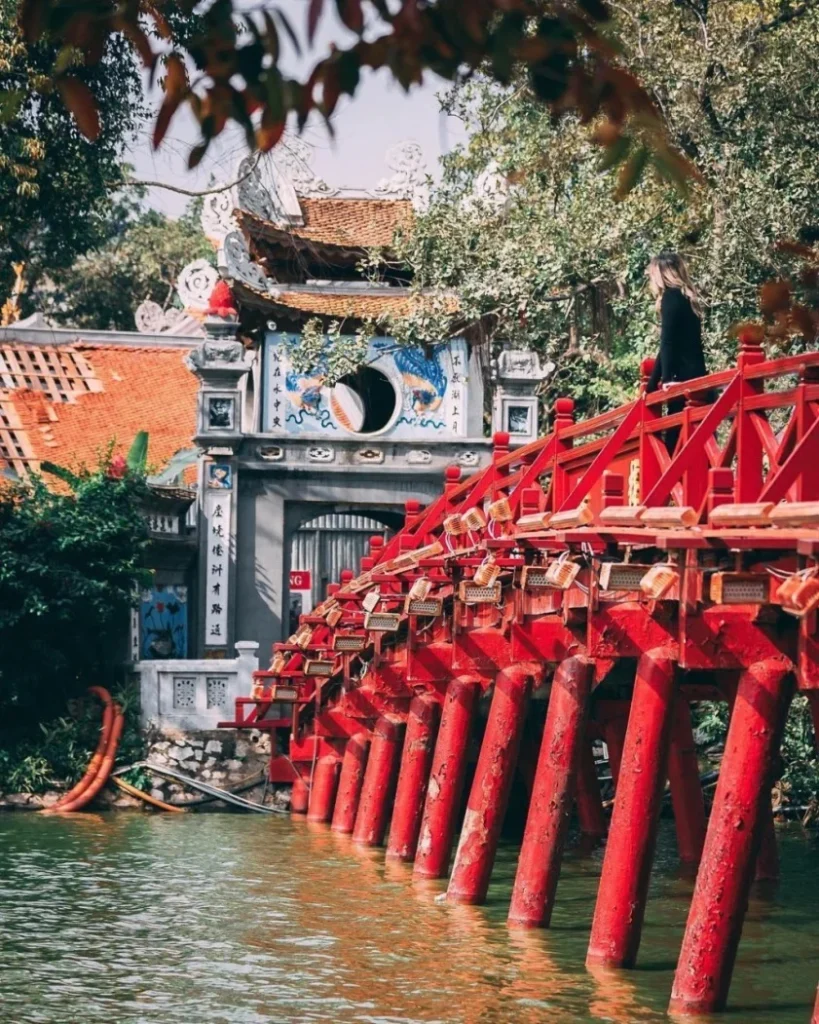
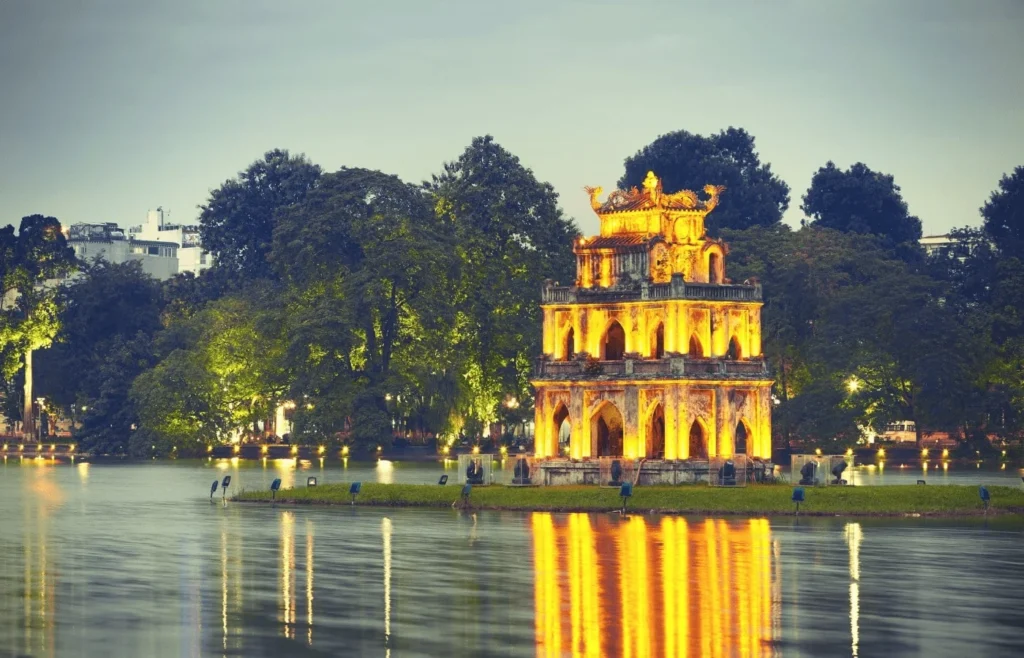
The Old Quarter is called “the thirty-six streets” and each one bears the name of a trade. Several still sell what their name says: Hang Duong sugar and candied fruit, Hang Muoi salt, Hang Ca fish. Guilds from the delta villages settled here by district from the 15th century, each with its temple and its recipes.
Lunch around chả cá, fish with turmeric and dill cooked at the table in a cast-iron pan, served on Cha Ca street by the same family for five generations. Dill, a European herb, arrived here with the French: the dish is less than a hundred and fifty years old.
In the afternoon, the Museum of Ethnology — the best museum in the country, with houses of fifty-four ethnic groups rebuilt in the garden — then a break for egg coffee, invented here in 1946 when milk was scarce.
Day 03Hanoi — Ninh BinhB, L
Road 100 km · 2 h · Rowing boat 1 h 30
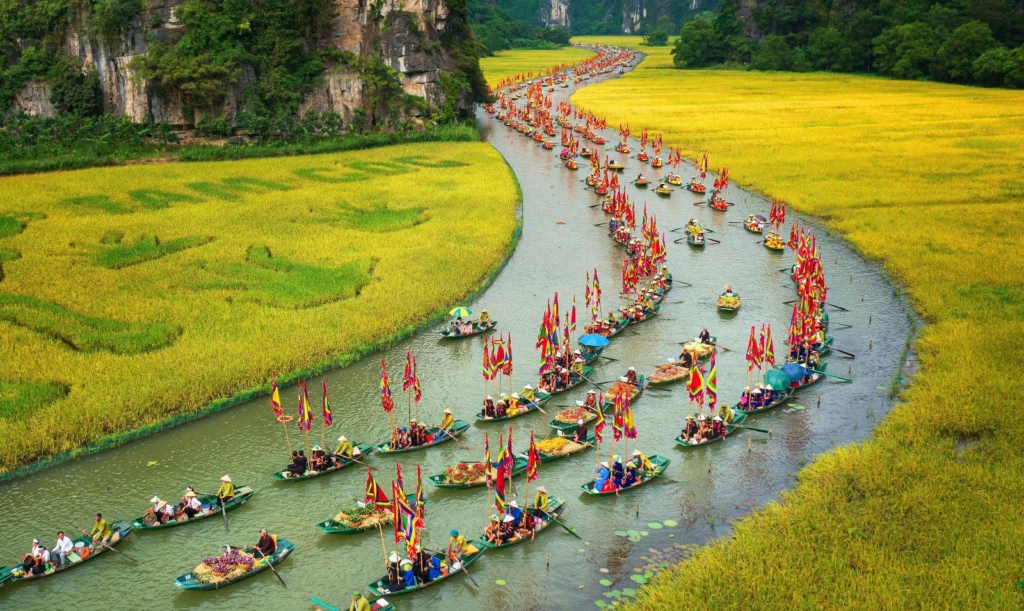
Two hours south and the delta closes in: limestone peaks rise in the middle of the rice fields, vertical, abrupt. Ninh Binh is the same massif as Halong Bay, left dry when the sea retreated six thousand years ago.
The region has fed Hanoi for a thousand years, and you understand how here. The Red River Delta gives two rice harvests a year on flood-prone land, thanks to a network of dykes and canals maintained collectively by the villages since the Ly dynasty. The word làng, the village enclosed by its bamboo hedge, still denotes the basic unit of the countryside: its temple, its well, its council of elders, and its fields managed in common.
The local speciality is mountain goat, raised on the limestone peaks where it grazes on dry grasses, served as dê tái chanh — thinly sliced, seared, marinated in lime and herbs. It comes with cơm cháy, the rice crust from the bottom of the pot, dried then fried: a dish born of scarcity that became a regional speciality, as so often.
Rowing-boat outing after three o’clock, when the light softens. The rowers of Tam Coc push the oars with the soles of their feet, a gesture you won’t see anywhere else. Night in a lodge among the rice fields, at the foot of the cliffs.
Day 04Ninh Binh — Lan Ha BayB, L, D
Road 180 km · 3 h 30 · Boarding 12 pm
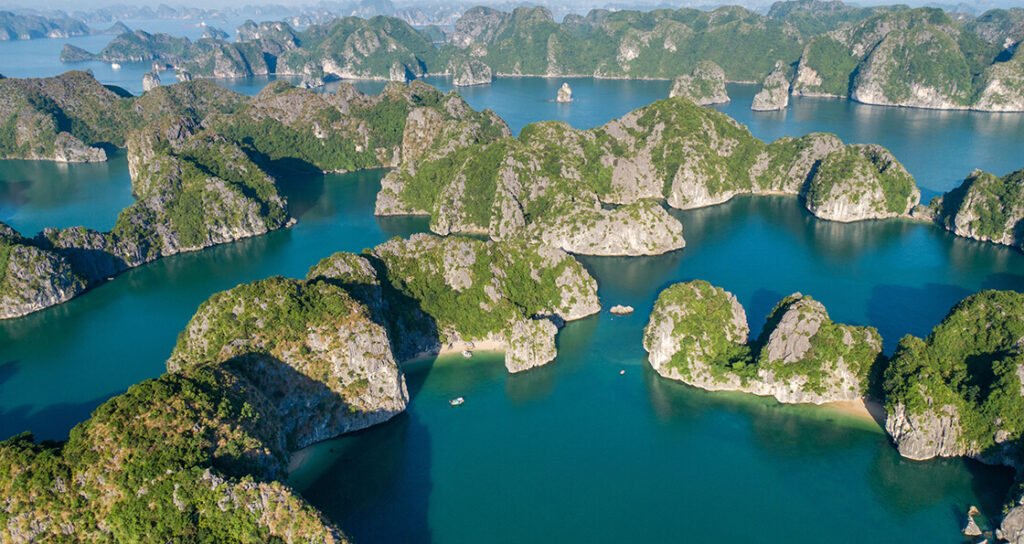
Road to the coast and boarding a small junk at noon in Lan Ha Bay, south of Halong: the same limestone, a few dozen boats instead of several hundred, and sandy coves.
The bay is for eating as much as for looking at. The sheltered waters between the islets raise grouper, abalone, scallops and above all ngán, mud clams found only in the Quang Ninh region and served in a broth with beaten egg. Lunch on board comes from the fish-farming rafts you sail past.
These three thousand islets are the remains of a limestone plateau formed three hundred million years ago at the bottom of a warm sea, dissolved by tropical rain then drowned by rising waters after the last ice age. What you see sticking out is only the top of a much higher relief.
Kayaking at the end of the day in an enclosed lagoon, reached through a sea tunnel that the tide opens for only a few hours. In the evening, all engines are switched off and you hear the fish jumping.
Day 05Lan Ha — Hanoi — flight to HueB, L
Cruise · Road 180 km · 3 h 30 · Flight 1 h 15
Early rise for the last sail: between six and eight the water is smooth and the bay belongs to you. Disembarkation mid-morning, road to the airport, flight to Hue in the early afternoon.
This hour-and-a-quarter flight crosses a real border. The North has four seasons and a winter when the thermometer drops to twelve degrees; the Centre and South have only two. You can see it on the plate: in the North people eat hot soups and little chilli, in the South salads, raw herbs and palm sugar in almost everything.
Hue was the imperial capital from 1802 to 1945. Its cuisine is the only one in the country to have been designed for a court: the chronicles speak of fifty dishes per imperial meal, each in a small portion, so that the emperor could taste without filling up. What remains is a cuisine of detail, highly worked, that Hue families still cook at home.
First evening on the banks of the Perfume River, so named because flowers from the orchards upstream fell into it in autumn. Dinner of Hue’s bánh rice cakes: bánh bèo in little dishes, bánh nậm in banana leaf, bánh khoai (crispy). You order twenty for two.
Day 06Imperial HueB, L
French-speaking guide · Dragon boat 45 min · Short trips
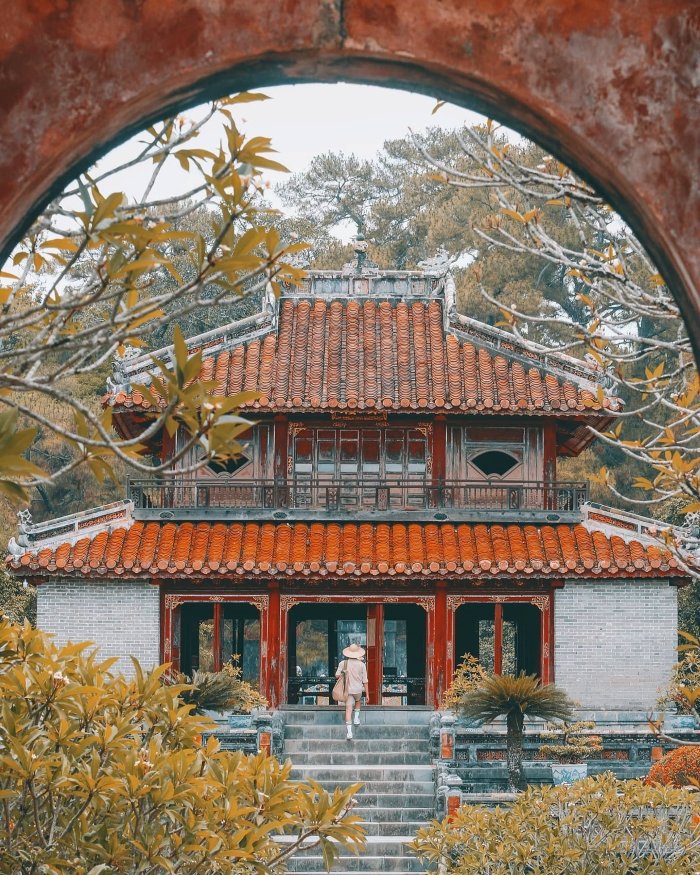
The citadel at its seven o’clock opening: a two-kilometre square, ramparts and moats, built on the Vauban model by French engineers in the service of Gia Long. Inside, the Imperial City, and inside that again, the Purple Forbidden City.
You need to know what you are going to see: in February 1968, during the Tết Offensive, the citadel was held for twenty-six days then retaken building by building. Of a hundred and sixty buildings, about twenty survived. The Purple City is today a grassy esplanade where you can make out the foundations.
Dong Ba market, by the river, is the day’s other visit and probably the liveliest. This is where you understand bún bò Huế : a beef soup with lemongrass and fermented shrimp paste, much spicier than pho, which the people of Hue consider their true national dish.
Afternoon on the river by dragon boat to Thien Mu pagoda, then two imperial tombs chosen from seven: Tu Duc, a park with a lotus lake where the emperor wrote poems during his lifetime, and Khai Dinh, blackened concrete and porcelain mosaics, completed in 1931.
Day 07Hue — Hoi An via the Hai Van PassB, L
Road 130 km · 4 h with stops · Pass at 496 m
A hundred and thirty kilometres in four hours, because you stop. The road first skirts the Tam Giang lagoon, the largest in South-East Asia at seventy kilometres, where thousands of families live from fixed-net fishing — bamboo fences planted in shallow water that trap fish as the tide goes out.
Then the Hai Van Pass, Hải Vân. Four hundred and ninety-six metres above the Pacific, twenty-five kilometres of bends, and the country’s climatic border: it is not unusual to leave Hue in the rain and come down into Da Nang in sunshine. At the top stand a Nguyen fort and French, then American, bunkers. Since the tunnel opened in 2005 trucks pass underneath and the ridge is almost empty.
A halt at Lang Co for lunch. The village lives from oysters and vong, lagoon clams gathered by hand from the mud; they are eaten grilled over embers with crushed peanuts and spring onion sizzled in oil. It is a truck stop, not a restaurant with tablecloths, and that is exactly why it is worth the detour.
Stop at the Cham museum in Da Nang, set up in 1915 by the École française d’Extrême-Orient: three hundred sculptures from the 7th to the 15th century, the finest Cham collection in the world. Arrival in Hoi An as the lanterns light up.
Day 08Hoi An, craftspeople and rice fieldsB, L
Bike 12 km · Flat terrain · Cooking class 3 h
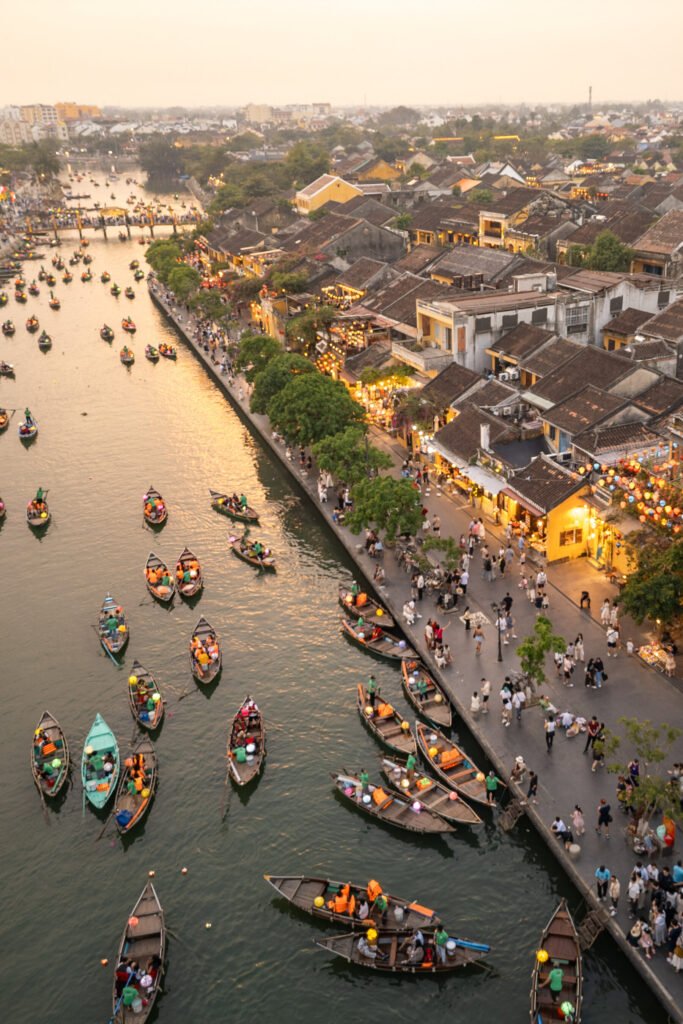
From the 15th to the 19th century, Hoi An was one of the great ports of South-East Asia. Japanese and Chinese junks waited there for the monsoon to turn, sometimes five months, and left laden with silk and ceramics. The town owes its preservation to its decline: the river silted up in the 19th century, trade moved to Da Nang, and eight hundred buildings came through a century and a half of slumber.
Morning by bike in the villages. Tra Que grows herbs for the whole region on beds fertilised with river algae — no fertiliser, four centuries of know-how, and a difference in taste you notice that very evening. Thanh Ha has been throwing pottery for five centuries.
In the afternoon, a cooking class, which starts at the market choosing the produce. You will learn cao lầu, the Hoi An noodle: it requires water from one particular Cham well and ash from wood burned on the Cham Islands, which explains why you find it nowhere else — not even in Da Nang, thirty kilometres away.
The white rose, a translucent flower-shaped dumpling, is made by a single family in town that has supplied all the restaurants for three generations and never given away the recipe.
Day 09Hoi An — Da Nang — flight to SaigonB
Road 30 km · 45 min · Domestic flight 1 h 20
Free morning. The best use of it is the quayside fish market, between six and seven: the boats come in, women buy at auction, it is all over before the town wakes up. It is the only time the old town still belongs to its inhabitants.
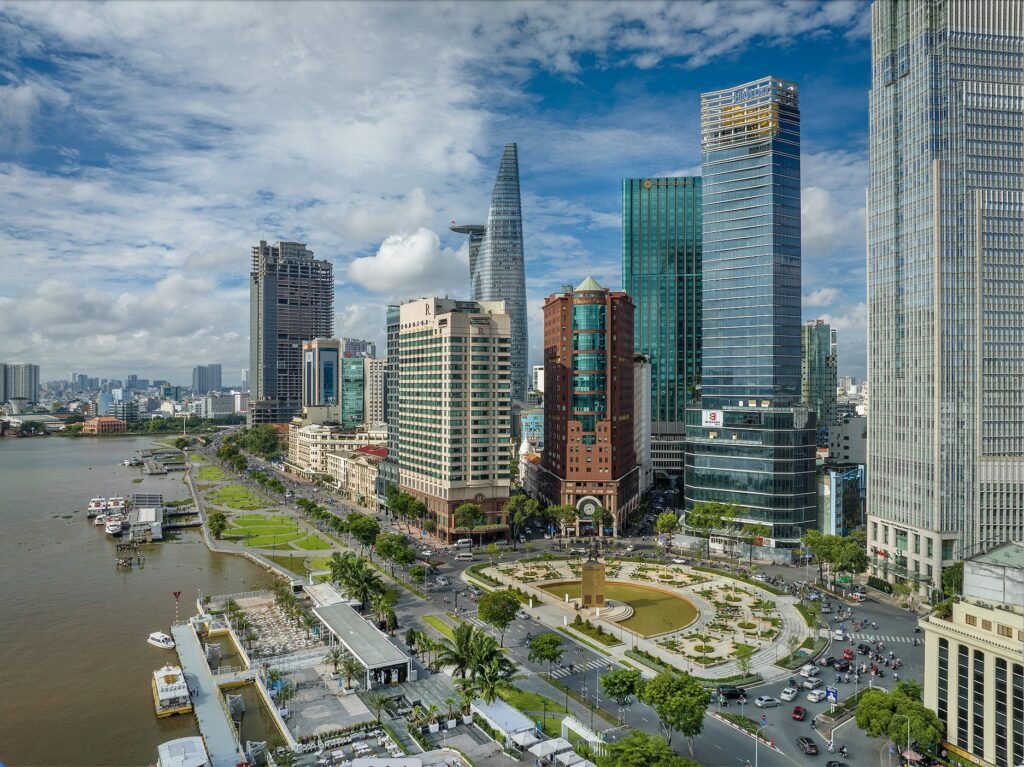
Flight to Saigon in the afternoon: a thousand kilometres, an hour and twenty minutes, and another country. Ten million inhabitants, a third of national GDP. Hanoi is a political, scholarly capital; Saigon trades, goes out at night and talks louder.
The food changes too, and abruptly. Southern cuisine is sweet — palm sugar goes into almost everything, including savoury dishes —, very herbal, and mixed with Khmer, Chinese and French influences. The bánh mì was born here from the colonial baguette, filled with pâté, cold cuts, coriander and pickled daikon: a dish exactly halfway between two cuisines.
First evening in District 1. Crossing the street takes a method: you move forward slowly, without sudden moves, without stepping back, and the scooters go around you. Waiting for a gap in the traffic doesn’t work.

Day 10Saigon — Cai BeB, L, D
Road 110 km · 2 h 30 · Sampan 2 h
Road south-west to the Mekong Delta. The river doesn’t cross the delta, it unravels into it: nine main branches — the Vietnamese call it the River of Nine Dragons — divide into thousands of hand-dug canals. Seventeen million people live here on a plain that rarely rises above two metres.
It is the country’s rice bowl and one of the largest in the world: the delta produces half of Vietnam’s rice and almost all of its exported rice, which makes Vietnam the world’s third-largest exporter. Three harvests a year are possible in the diked areas.
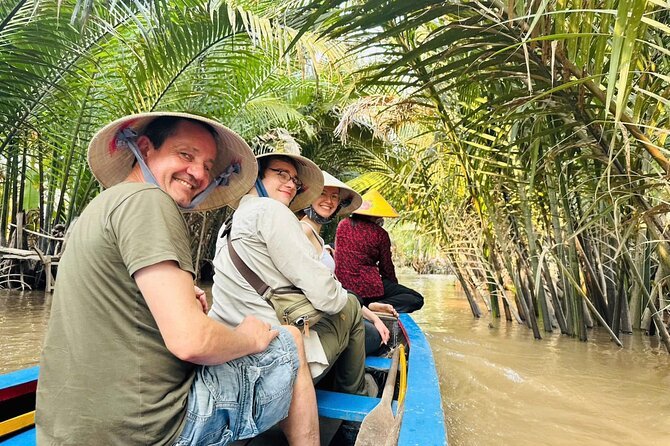
Afternoon by sampan along the canals of Cai Be: you go from a branch as wide as the Loire to a canal where branches meet overhead. Stops at family workshops — rice paper ladled onto a cloth stretched over a rice-husk fire, coconut sweets pulled by hand, rice puffed in burning sand.
Night in a guesthouse in the middle of an orchard. Dinner is the family’s own: cá tai tượng, elephant-ear fish served standing upright, which you flake yourself into rice paper with herbs.
Day 11Cai Be — Can Tho — SaigonB, L
Up at 5 am · Boat 2 h · Road 170 km · 3 h 30
Up at five for the Cai Rang floating market, the largest in the delta. It is a wholesale market: wholesalers buy from producers between five and seven, and by nine nothing is left. Each boat hangs a sample of what it sells from a pole — a pineapple, a cabbage, a watermelon — so it can be spotted from afar: a shop sign from before writing.
We say it frankly: the market has shrunk a lot. Since bridges and roads have allowed fruit to be moved by truck, about a hundred boats remain compared with several hundred twenty years ago. We go in a small boat rather than a decked one, and early, which changes everything.
Back through the orchards. The delta produces fruits Europe doesn’t know: rambutan, longan, mangosteen, sapodilla, star apple, and durian, whose smell gets it banned from hotels and which the Vietnamese adore. The season runs from May to August; outside that window, you mostly taste citrus and coconuts.
We should also talk about what threatens this rice bowl. Upstream dams hold back the sediment that built the delta, sand mining deepens the channels, and groundwater pumping makes the ground subside by one to four centimetres a year. Salt water now pushes several tens of kilometres inland in the dry season, and farmers are switching from rice to shrimp. It is an everyday conversation in the villages.
Road to Saigon in the late afternoon.
Day 12Saigon — return flightB
Transfer 8 km · 30 to 60 min depending on traffic
Depending on your flight time, a last morning. We often suggest Cholon, the Chinese quarter, and its Binh Tay market built in 1928 by a Cantonese merchant around an open courtyard. The southern Chinese have been settled here since the 18th century and long controlled the rice trade; their community was hit hard by the nationalisations of 1978, which explains much of the exodus of the boat people.
Cholon’s food is different again: egg noodles, roast duck, hủ tiếu from the Sino-Cambodian tradition, eaten at any hour. In three districts of the same city, you will have tasted three heritages.
If your flight is late, District 1 on foot is the other option: the central post office, the cathedral built of Toulouse bricks, and the Reunification Palace left as it was on 30 April 1975, orange carpets included.
Transfer to Tan Son Nhat, which is within the city itself: count on traffic rather than distance. You will have crossed the country over sixteen hundred kilometres and three cuisines, which is probably the best way to have understood it.
Continue
Other tours you might like
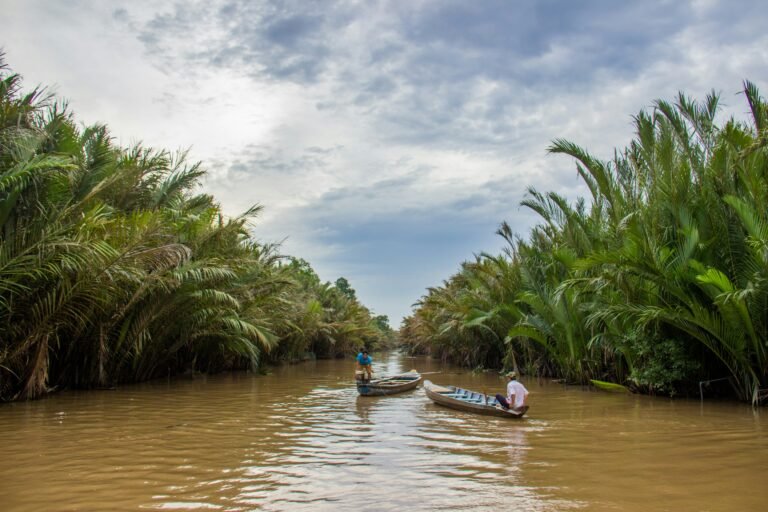 The essentialsFrom the North to the Mekong, on to CambodiaHanoi — Ninh Binh — Lan Ha Bay — Hue — Hoi An — Saigon — Mekong Delta — Chau Doc14 days / 13 nightsfrom €1,990
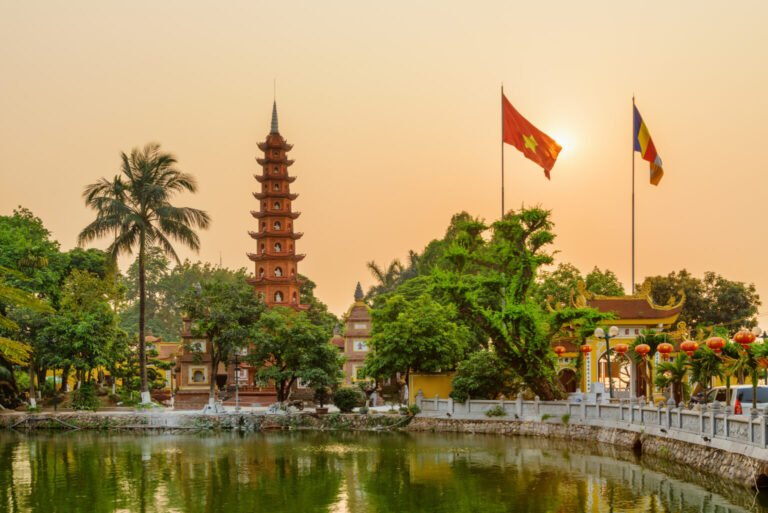 The essentialsVietnam in 10 daysHanoi — Ninh Binh — Lan Ha Bay — Hue — Hoi An — Saigon10 days / 9 nightsfrom €1,500
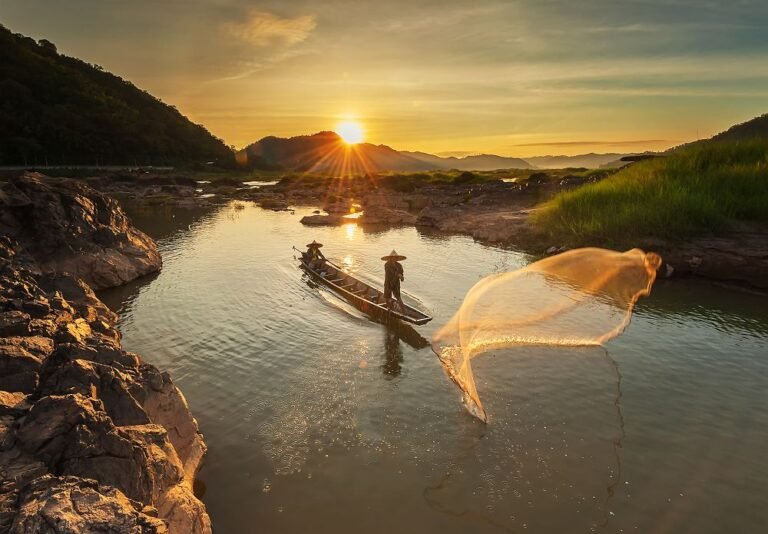 The essentialsVietnam in 15 daysHanoi — Pu Luong — Ninh Binh — Lan Ha Bay — Hue — Hoi An — Saigon — Mekong Delta15 days / 14 nightsfrom €2,070