A theatre born in a flooded rice field, court music reconstructed by a handful of elderly men, a learned chant where the listener holds a drum. Four forms, four worlds, and where to hear them for real.
In brief
The best-known form
Water puppets, born in the rice fields of the Red River Delta
Listed by UNESCO
Huế court music, ca trù and đờn ca tài tử
In the South
Cải lương, sung theatre born in the delta
Where to listen
Hanoi and Huế for the old forms, the delta for đờn ca tài tử
Water puppets
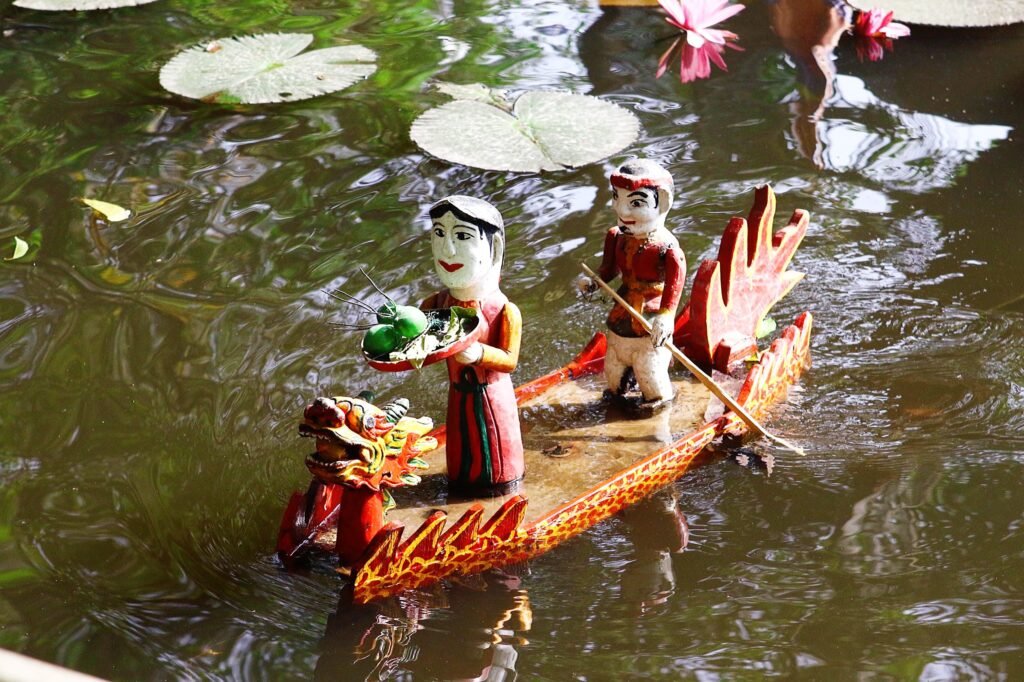
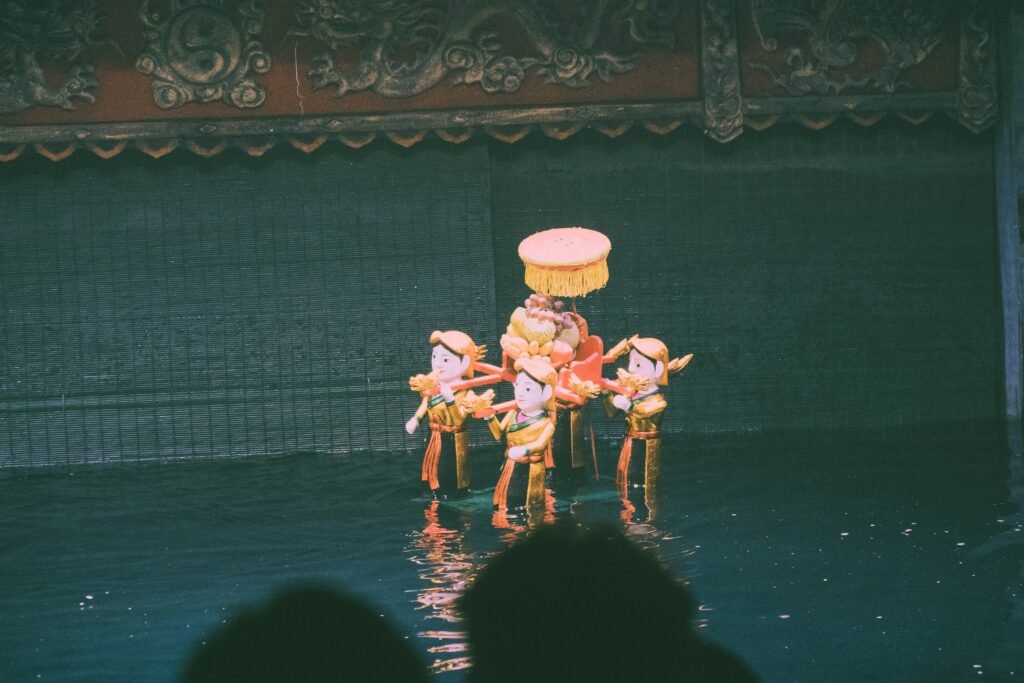
It is the only theatrical form in the world born in a rice field. When the Red River Delta was flooded, villagers performed from the water: the puppeteers stand waist-deep behind a bamboo screen and work the figures at the end of long poles hidden under the surface.The repertoire is peasant before it is royal: transplanting rice, trap fishing, boat races, the dragon bursting out in a spray of water, and the character of Chú Tểu, a pot-bellied bon vivant who opens every show. A chèo orchestra plays at the side and the singers converse with the puppets.Let us say it frankly: the Hanoi show has become a tourist product, performed several times a day before halls full of foreigners. It is still beautiful, short, and perfect with children. But if your itinerary passes through a delta village where a local troupe plays on a pond, choose that one: it is not the same thing.
Huế court music
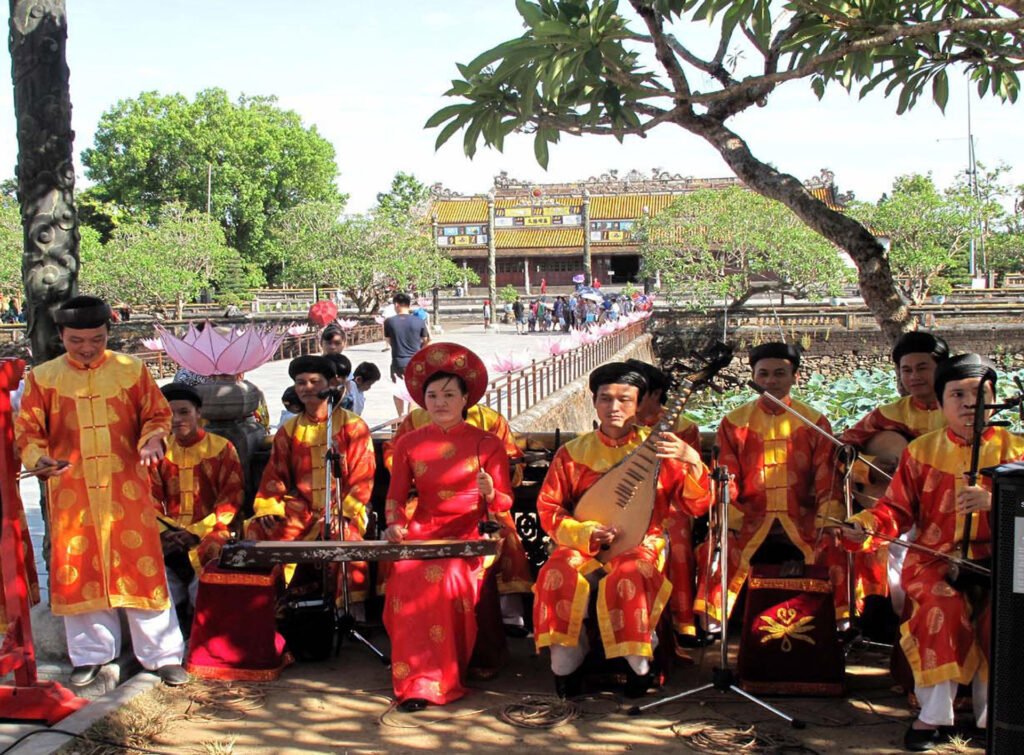
The Nhã nhạc, “elegant music”, accompanied the rites of the imperial court: sacrifices, birthdays, receptions of ambassadors. In 2003 it was inscribed on UNESCO’s intangible cultural heritage list — the first distinction of its kind awarded to Vietnam.The ensemble combines drums, gongs, flutes, a moon-shaped lute and a two-stringed fiddle. The result is slow, highly codified, without the lyricism a European ear expects. It should be listened to the way you watch a ceremony, not the way you listen to a concert.When the dynasty ended in 1945, transmission nearly broke off: a few elderly musicians made it possible to reconstruct the repertoire in the 1990s. Today you can hear it in the Imperial City and, better, at a concert on a boat on the Perfume River at nightfall.
Ca trù, and what nearly disappeared
The Ca trù is the exact opposite of a show: three people in a small room. A singer who beats the rhythm herself on two bamboo sticks, a three-stringed lute, and a third participant — the scholar who listens — striking a small drum to approve a verse. The listener is part of the ensemble.After 1945 this learned art of the singing houses was branded decadent and almost disappeared for fifty years. In 2009 UNESCO inscribed it on the list of heritage in need of urgent safeguarding, which says a lot: only a handful of masters able to teach it remained.Today a few clubs in Hanoi perform it in Old Quarter houses, before twenty people. The voice, ornamented and taut, is disconcerting at first. It is the most demanding musical experience in the country, and the most memorable.
In ca trù, the listener holds a drum. Approving a verse is part of the score.
The South: cải lương and đờn ca tài tử
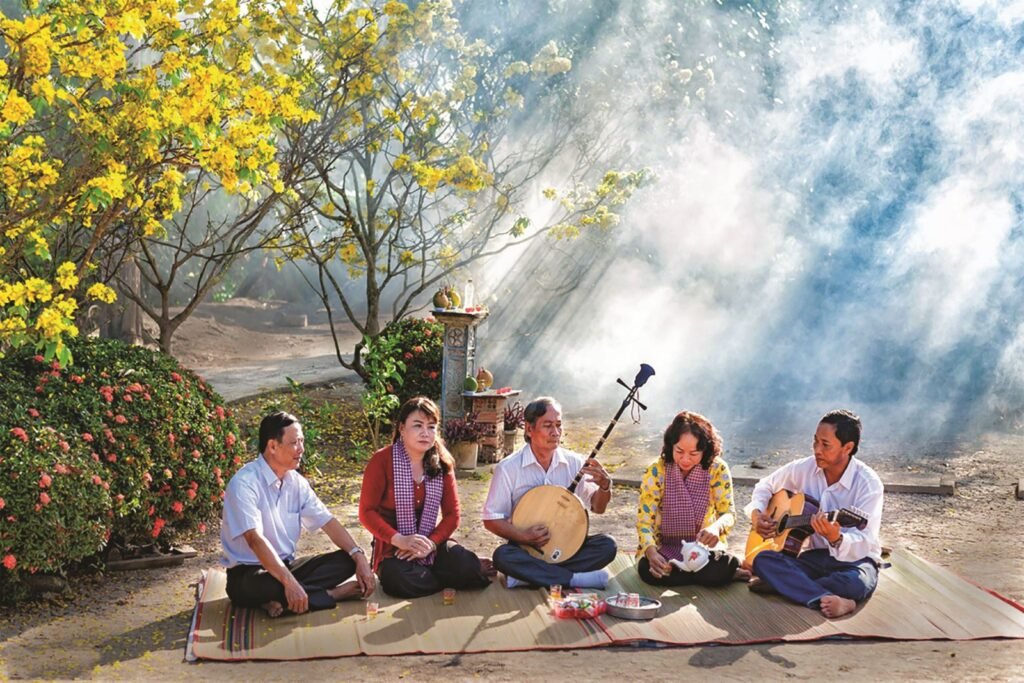
The Đờn ca tài tử is the chamber music of the Mekong Delta, played among friends after work, on a terrace or in a garden. Inscribed by UNESCO in 2013, it has the flexibility of a conversation: the musicians improvise around familiar frameworks, and stop when night falls. Cải lương is its theatrical version, born in the early 20th century: a popular opera of the South, melodramatic, with costumes, an orchestra and the famous vọng cổ aria that the audience waits for like a great showpiece. It had its golden age in Saigon in the 1950s and 1960s and today struggles to hold out against television.Finally, hát xẩm, the song of the blind wandering singers who lived from their voices in the markets and on the quays of the North. Almost extinct, it is being reborn thanks to a few young troupes, and on some evenings you can hear it in the street around Hoàn Kiếm Lake.
The instruments to recognise
The most distinctive is the đàn bầu, a monochord whose pitch the musician changes by bending a flexible rod: it produces the plaintive, gliding voice associated with Vietnam. The đàn tranh is a sixteen-string zither, close to its Chinese and Japanese cousins; the đàn nguyệt, or moon-shaped lute, accompanies the music of the South; the bamboo flute sáo is found everywhere. In the Central Highlands, the gong ensembles of the indigenous peoples form a tradition of their own, inscribed on UNESCO’s intangible heritage list.
The quan họ of Bắc Ninh
An hour from Hanoi, Bắc Ninh province gave birth to quan họ, an alternating song between groups of men and women from neighbouring villages, who answer each other with verses of love and friendship, without instruments. It is inscribed on UNESCO’s intangible heritage list. It is heard mainly in spring, at village festivals after Tết, such as the one at Lim, where singers answer one another from boats or under the trees.
Music today
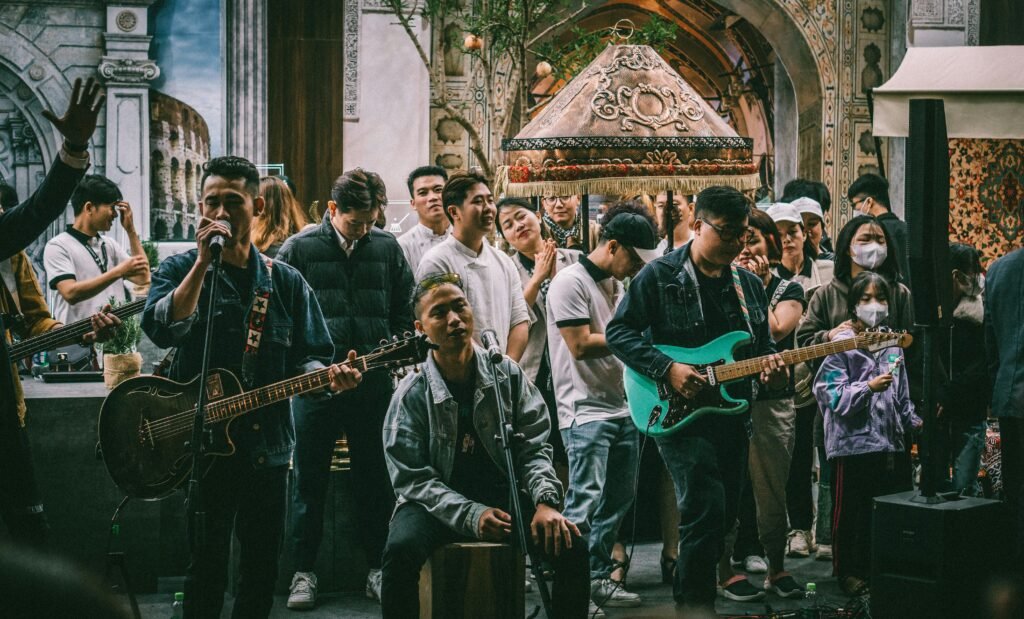
Young Vietnamese mostly listen to V-pop, Vietnamese rap and international music. The independent scene is lively in Hanoi and Saigon, in small bars and live-music cafés, and some musicians blend traditional instruments with electronic sounds. Your guide can point you to a place to spend a musical evening, far from the shows for tourists.
Avoiding the tourist-show trap
Not all shows organised for travellers should be avoided, but they often shorten and simplify traditions. Prefer venues where an established troupe plays, the ca trù clubs of Hanoi, the music houses of Huế or the đờn ca tài tử evenings in the Delta, where musicians play first and foremost for themselves.
Listening before you go
To prepare, listen to a few songs by Trịnh Công Sơn, the country’s best-loved singer-songwriter, whose melancholy melodies have accompanied several generations. You will then hear them in the cafés of Huế, Hanoi and Saigon, and your guide will be delighted to talk about them.
What to go and hear
With children : the water puppets, fifty minutes, no language problem — it is visual.
In Huế : nhã nhạc on a boat on the Perfume River, at the end of the day, rather than the short version during visits to the Imperial City.
In Hanoi, for a single evening : ca trù in an Old Quarter house. Twenty people, an hour, and nothing touristy.
In the delta : a đờn ca tài tử session in someone’s home, often after dinner, with no stage or ticket office.
In the mountains : the xòe Thái dances, inscribed by UNESCO in 2021, are danced in a circle and you will be pulled in by the hand.
None of these concerts lasts more than an hour and none is expensive. The hardest part is being there at the right time: authentic sessions don’t follow a calendar. It is our local team that spots them and slips them into the itinerary when they happen during your stay.
Yes, especially with children: fifty minutes, visual, no language problem. Just know that it has become a tourist product performed several times a day. If your itinerary crosses paths with a village troupe performing on a pond, choose that instead.
Do you need to know Asian music to enjoy it?
No, but you have to accept losing your bearings. Nhã nhạc is listened to the way you watch a ceremony; ca trù disconcerts with its taut voice. A short explanation before the concert changes everything, and our guides give it.
How long do these concerts last?
Rarely more than an hour. Puppets: fifty minutes. Ca trù: about an hour, before twenty or so people. Nhã nhạc on a boat: an hour including the trip on the river.
Can you attend a non-touristy session?
Yes, and that is the whole point: đờn ca tài tử in a home in the delta, xẩm in the street in Hanoi, xòe in a Thái village. But these sessions follow no published calendar: it is our team on the ground that spots them.
Do you need to book?
For the Hanoi puppets, yes, especially in high season. For ca trù, the room is small and booking is essential. We take care of it as part of the itinerary.
Can you bring back recordings?
Recordings of nhã nhạc and ca trù can be found online, often published by Vietnamese conservation institutes. On the spot, a few shops in Huế and Hanoi sell CDs by local troupes — a truer souvenir than an object.
Putting it into practice
The tours where you experience what this article is about
Audience measurement. We would like to know which pages are useful to you, using Google Analytics. Nothing is stored without your consent, and you can change your mind at any time. Learn more


 The essentialsVietnam in 15 daysHanoi — Pu Luong — Ninh Binh — Lan Ha Bay — Hue — Hoi An — Saigon — Mekong Delta15 days / 14 nightsfrom €2,070