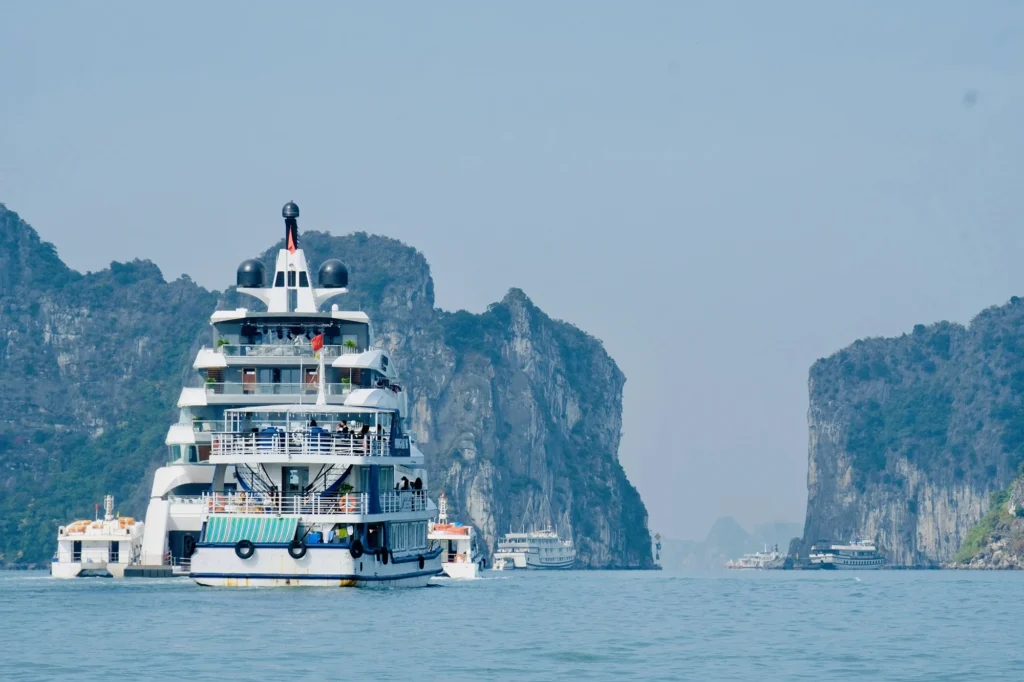
The same limestone peaks, the same jade-green water, five times fewer boats. Here is how we organise this stop for our travellers — and why we hardly offer classic Halong Bay any more.
In brief
Best time
October to December and March to May; mist in February–March, storms in July–August
Getting there
3 h from Hanoi by motorway to Hai Phong, then boarding at Got or Tuan Chau
How long
Two nights on board, or one night on a junk and one on Cat Ba
Combine with
Hanoi before, Ninh Binh on the same loop, Sa Pa by night train
Lan Ha or Halong: what is the difference, in practice?
It is the same limestone massif, the same landscape of peaks rising from the water, the same geological formation. The difference is administrative and, above all, statistical: Halong Bay receives several million visitors a year and hundreds of boats ply its waters; Lan Ha Bay, which extends it to the south and comes under Hai Phong and Cat Ba Island, welcomes a fraction of that.Lan Ha has nearly four hundred islets, sandy beaches in enclosed coves — which Halong hardly has — and floating fishing villages that are still inhabited. It is for these three reasons that we send our travellers there rather than on the classic route.
Same landscape, same limestone. The difference lies in the number of boats.
When to visit the bay
Two windows. From October to December: crisp sky, dry air, excellent visibility, calm sea — the best period. From March to May: mild temperatures, but with a risk of drizzle, the stubborn mist of the northern spring that can erase the landscape for several days.June to August are hot and bright but bring storms and typhoons; outings are sometimes cancelled by the harbour authority, and that is non-negotiable. January and February are cold and grey, between fourteen and eighteen degrees: swimming is out and mist is frequent.
What to see and do there
The day on board always follows roughly the same rhythm, and that is just fine: sailing in the morning, kayaking late in the morning through the sea tunnels of Ba Trai Dao or the enclosed lagoons, swimming from the deck, lunch at anchor, a nap, a cooking class or squid fishing in the evening.Two moments are worth asking for: kayaking at first light, when the water is a mirror and no engine is running; and visiting a floating village — Cai Beo, one of the oldest in Vietnam, inhabited for centuries — with a fisherman rather than in a group.
Sleeping on the water: junk, island or Cat Ba?
The junk remains the best option: you wake up at anchor, in silence, before the day boats arrive. Two nights on board are much better than one — the first day goes on transfers, the second is when you really reach the hidden corners of the bay. Allow €150 to €500 per person per night depending on the boat.Cat Ba Island offers an alternative: a national park, a hike to the summit of Ngu Lam, Cat Co beach, and an endemic golden-headed langur of which fewer than a hundred remain. A few eco-lodges in the Viet Hai valley allow a night on land between two sails.
How to get there from Hanoi
Three hours on the Hai Phong motorway, then boarding at Got, Ben Beo or Tuan Chau depending on the operator. The junks’ shuttles pick travellers up in Hanoi between seven and eight; the actual departure is around noon.A train now links Hanoi to Hai Phong in two and a half hours, slower but more pleasant. Avoid the direct hydrofoil in bad weather: cancellations are frequent and last-minute.
Choosing your boat
This is what decides the quality of the stay. Three criteria: the number of cabins — below fifteen, the experience is incomparably better —, the authorised sailing zone, and the wastewater treatment policy, which the best operators now display.Beware of very low prices: they correspond to forty-cabin boats that stay in Halong’s main corridor. We only work with small vessels whose licence covers Lan Ha.
The mistakes we see most often
Booking only one night on board: the real day of sailing is the second.
Choosing a big cheap boat and ending up in the congested corridor.
Coming in February–March without knowing that drizzle can hide the landscape.
Scheduling the bay on the last day before your return flight: one weather cancellation and everything falls apart.
Halong, Lan Ha or Bai Tu Long: the comparison
Three names for the same limestone massif, three different experiences. Here is what really sets them apart.
Halong Bay
Lan Ha Bay
Bai Tu Long
Traffic
Very dense
Moderate
Low
Beaches
Almost none
Many coves
A few
Floating villages
Largely relocated
Still inhabited
Yes
Boarding
Tuan Chau, Halong
Got, Ben Beo
Hon Gai
Drive from Hanoi
2 h 30
3 h
3 h
Average price / night
80 – 250 €
150 – 500 €
180 – 450 €
Our choice is Lan Ha, for the coves and the traffic. Bai Tu Long is even calmer but the choice there is narrow and the boats older. Halong is still defensible if your budget is tight: the landscape is the same, it is the number of boats around yours that changes.
How to choose your junk
The number of cabins, above all
It is the criterion that decides everything. Below fifteen cabins, you eat at your own table rather than at a buffet, you anchor in coves where the big boats can’t go, and the crew knows your first name within an hour. Above thirty, you are on a floating hotel.
The sailing licence
Not all junks are authorised in Lan Ha. A boat sold as a “Lan Ha cruise” at eighty euros a night actually sails in Halong’s main corridor. Ask for the exact zone; it is information serious operators give without difficulty.
Wastewater treatment
The best operators now display it. It is not a detail: several hundred boats sleep every night in an enclosed body of water.
One night or two
Two nights are much better than one. The first day is eaten up by transfers — departure from Hanoi at eight, boarding at noon — and it is the second that takes you into the hidden corners of the bay. On a single night, you spend twelve hours on board, eight of them asleep.
The bay calendar
Period
Conditions
Our view
October – December
18 to 26 °C, dry
The best window. Crystal-clear air, calm sea, excellent visibility.
January – February
14 to 19 °C
Cold and grey, water at 18 °C. Swimming out of the question, frequent mist.
March – May
20 to 30 °C
Mild, but drizzle in March can erase the landscape for several days.
June – August
28 to 35 °C
Hot and bright, perfect for swimming, but storms and typhoons. Cancellations possible.
September
26 to 32 °C
End of the typhoon season, sea calming down. A good compromise.
A point few agencies mention: it is the harbour authority that decides, not the operator. In the event of a weather alert, all outings are suspended and that is non-negotiable. Never place the bay on the last day before your return flight.
A day on board, hour by hour
6 am — The best moment of the cruise. The water is a mirror, mist clings to the peaks, no engine is running. Tai chi session on the upper deck.7:30 am — Breakfast at anchor, then sailing.9:30 am — Kayaking in an enclosed lagoon, reached through a sea tunnel that the tide opens for only a few hours a day. Ask for the tide slot the evening before.12 pm — Seafood lunch from the fish-farming rafts you sail past.2 pm — Swimming from the deck, or a visit to a floating village with a fisherman rather than in a group.5 pm — Cooking class or fresh-roll demonstration, depending on the boat.8 pm — Squid fishing from the stern, with a lamp that draws the creatures under the hull. Then silence: not a single light on the horizon, and you hear the fish jumping.
Is Lan Ha Bay really less crowded than Halong Bay?
Yes. Lan Ha lies in the south of the archipelago, on the Cat Ba side, and receives a much smaller fleet. The karst landscapes are the same: administratively, they are two parts of the same drowned massif.
How long should you stay?
One night on board is enough for a first time. Two nights let you reach the most remote bays, where you hardly meet anyone any more.
Can you swim?
Yes, from April to October, straight from the deck or on the islets’ beaches. In winter the water drops to around 18 °C.
Is it suitable for children?
Absolutely, from four or five years old. Life jackets on board, tandem kayaks with an adult, and family cabins on most junks.
Do you need to book far in advance?
Three months for the high season (October–April) and French bank-holiday weekends, six weeks the rest of the year.
Halong or Lan Ha: what is the difference?
Same limestone massif, same landscape. Lan Ha receives a fraction of the traffic, has sandy coves that Halong hardly has, and its floating villages are still inhabited.
How many nights on a junk?
Two rather than one. The first day is eaten up by transfers; it is the second that takes you into the hidden corners of the bay. On a single night, you spend twelve hours on board, eight of them asleep.
What if the cruise is cancelled because of the weather?
It is the harbour authority that decides, not the operator, and the decision is final. We move the night elsewhere and refund the difference — but never place the bay the day before your return flight.
Audience measurement. We would like to know which pages are useful to you, using Google Analytics. Nothing is stored without your consent, and you can change your mind at any time. Learn more





 The essentialsNorthern Vietnam — 8 daysHanoi — Ninh Binh — Pu Luong — Lan Ha Bay — Hanoi8 days / 7 nightsfrom €1,190