The Vietnamese language: tones, and why so many Nguyens
A third of the country has the same surname, and nobody is ever called by it. Vietnamese has neither conjugation nor plural, but six ways of pronouncing the same syllable. What to understand before you go.
In brief
Nguyễn
Roughly four Vietnamese people in ten carry this surname
Reading a name
Surname first, given name last — and people are called by their given name
Tones
Six in the North, five in the South: the same word changes meaning six times
To remember
Twelve words are enough to change the welcome you receive
Why are so many Vietnamese called Nguyễn?
It is the first puzzle every traveller meets: in a hotel, an office or a family, half the people seem to have the same name. It isn’t just an impression — Nguyễn is borne by about a third of the population, and the fourteen most common surnames cover almost the whole country.The explanation is political. In Vietnam, a change of dynasty often meant a change of name: families adopted that of the reigning sovereign, out of loyalty, self-interest or caution. The Nguyễn being the last dynasty, from 1802 to 1945, and the longest to rule the unified country, their name spread massively.The practical consequence: the surname is useless for identifying anyone. Vietnamese people are addressed by their given name, even in formal settings, even a minister. A man called Nguyễn Văn Minh will be Mr Minh, never Mr Nguyễn.
How do you read a Vietnamese name?
A full name reads in the opposite order to ours: surname, middle name, given name. In Trần Thị Lan, Trần is the surname and Lan the given name, the one people use.The middle name often carries information. Thị traditionally indicated a woman,, Văn a man — a usage in clear decline among younger generations, but still very widespread. Some families also use the middle name to mark a branch or a generation.Given names almost all have a transparent meaning, unlike ours: Lan is the orchid, Hoa the flower, Hùng heroism, Minh clarity, Phúc happiness, Thủy water. Asking someone what their name means is a very well-received question, and often the start of a fine conversation.
Is Vietnamese difficult to learn?
Yes and no, and the answer surprises. The grammar is remarkably simple : no conjugation, no gender, no agreement, no plural, no article. The verb never changes. You add a word to mark the past or the future, and that is it.The difficulty lies elsewhere: Vietnamese is a tonal language. Six tones in the North, five in the South. The same syllable completely changes meaning depending on the pitch and movement of the voice. The classic example, ma, means, depending on the tone, ghost, cheek, but, tomb, horse or rice seedling.For a European ear, used to using intonation for emotion rather than meaning, this is a real obstacle. Your pronunciation will be wrong, and you have to accept that from the start.The good news: it doesn’t matter at all. Context does most of the work, and the effort counts infinitely more than the result. A ngon quá at a food stall will earn you a welcome that ten sentences in English never will.
No conjugation, no gender, no plural. But six ways of pronouncing the same syllable, and six different meanings.
North and South: two accents, two vocabularies
The differences between the northern and southern accents are significant, and the Vietnamese spot them instantly. The North distinguishes six tones, the South merges two. Some consonants are pronounced differently, and southern speech is faster and more sing-song.Vocabulary also changes for everyday words. The example everyone quotes: the spoon, thìa in the North and muỗng in the South. The same fried roll is called nem rán in Hanoi and chả giò in Saigon.The reference language, that of school and the media, is Hanoi’s. If you learn a few words, it will probably be in that accent — and it will be understood everywhere.Add that the country has dozens of minority languages, often unrelated to Vietnamese: Hmong, Thái, Tày and Bahnar belong to different language families. In mountain villages, Vietnamese is a second language.
Twelve words that change a trip
Xin chào — hello
Cảm ơn — thank you
Xin lỗi — sorry
Bao nhiêu ? — how much?
Ngon quá ! — it’s delicious
Không cảm ơn — no thank you
Ít cay — a little spicy
Không đường — no sugar
Tính tiền — the bill
Đồ chay — vegetarian (the real word, the one that excludes fish sauce)
Anh / chị / em — to address someone according to their age
Vệ sinh ở đâu ? — where are the toilets?
A last word on writing. Vietnamese is written in Latin script, which lets you read signs, menus and street names from day one. It is a huge advantage compared with Thailand or Japan, and you realise it within three hours of arriving.
What language is spoken in Vietnam?
The official language is Vietnamese, spoken by the vast majority of the population. But the country officially recognises fifty-four ethnic groups, and many have their own language: in the northern mountains, you hear Hmong, Thai or Dao at home far more than Vietnamese.For a traveller, English will get you by in hotels, city restaurants and with younger generations. French, inherited from the colonial period, survives only among some elderly people and in a few everyday words: cà phê for coffee, bơ for butter, xe ô tô for a car.
Quốc ngữ, a Latin alphabet
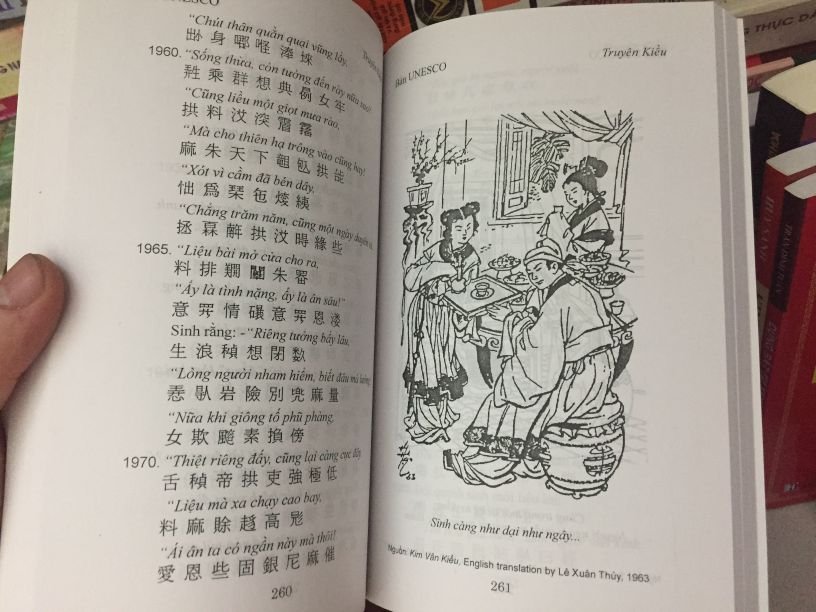
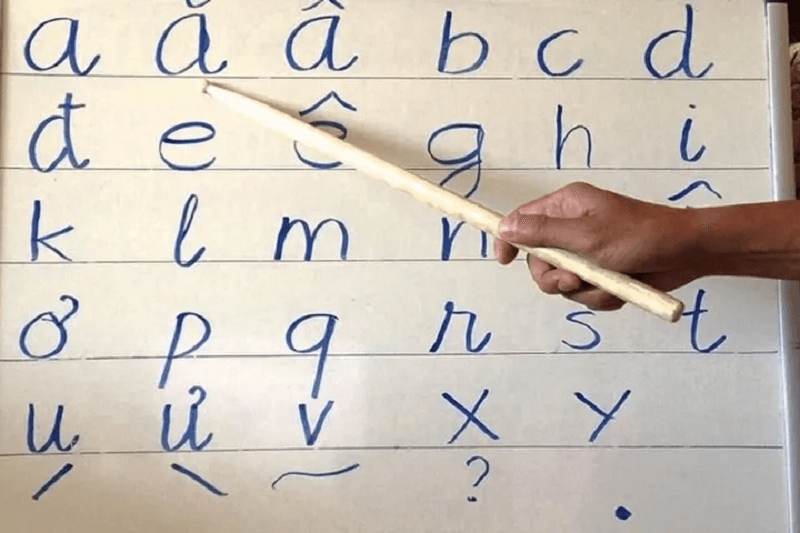
Vietnamese is written with the Latin alphabet, enriched with diacritics that indicate vowels and tones. This script, quốc ngữ, was developed in the 17th century by European missionaries and their Vietnamese collaborators; the dictionary published by the Jesuit Alexandre de Rhodes in 1651 is its best-known milestone. For centuries, however, scholars wrote in Chinese characters, then in chữ Nôm, a derived script. Quốc ngữ only prevailed in the 20th century.It is a stroke of luck for the traveller: you can read a sign, a menu or a street name without knowing the language, even if the pronunciation holds surprises. The marks above and below the letters are not decorative: “ma”, “má”, “mà”, “mả”, “mã” and “mạ” are six different words.
Learning a few words before you go
A few weeks before departure, a language app or a few videos are enough to learn greetings, numbers and polite phrases. What matters is not perfect tones, but the effort: a simple xin chào or cảm ơn, even badly pronounced, almost always brings a smile and sometimes an impromptu lesson.
Place names
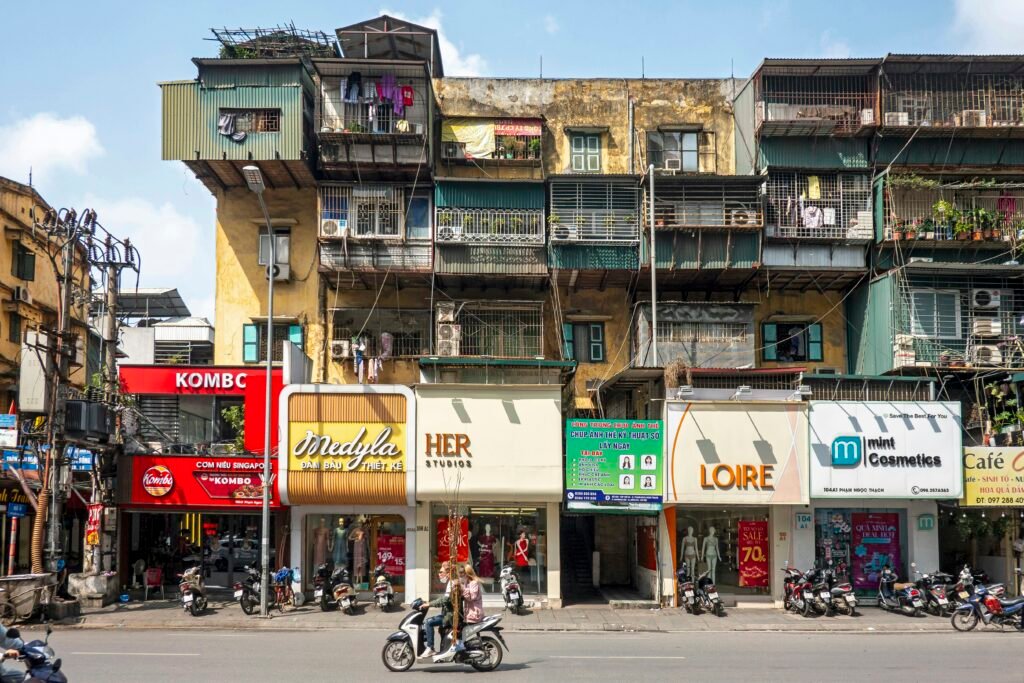
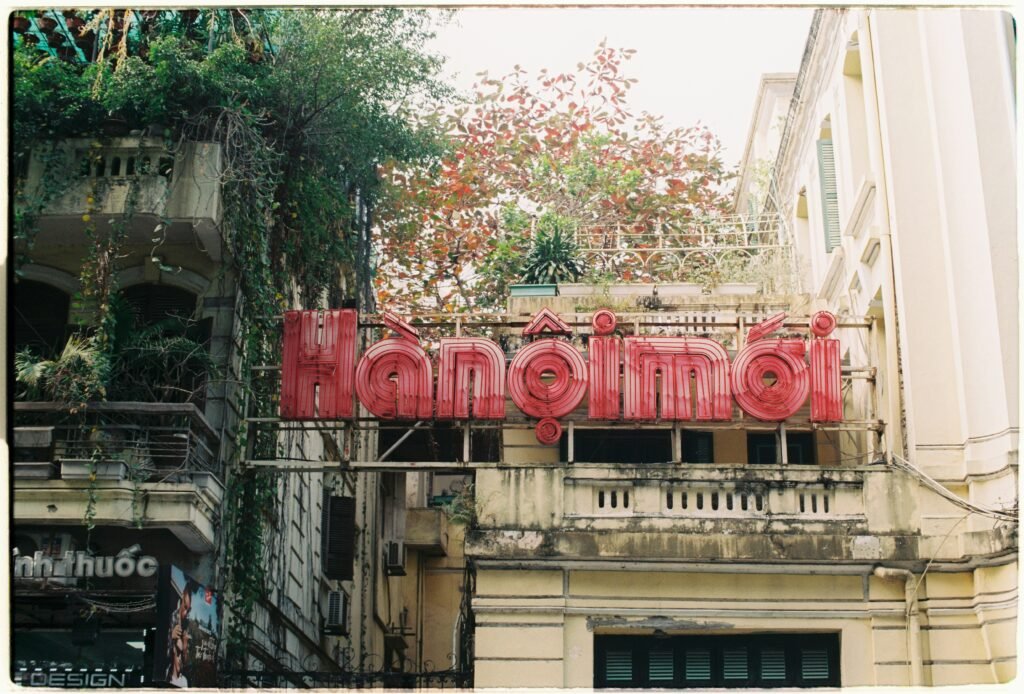
Place names are written in Vietnamese with their diacritics, such as Hà Nội or Hội An, and online maps recognise them better that way. Note the exact names of your hotels and the places you want to see: shown to a driver, they avoid many misunderstandings.
Because families adopted the name of the reigning dynasty, out of loyalty or caution. As the Nguyễn ruled from 1802 to 1945, their name spread massively: today it is borne by about a third of the population.
How do you address someone in Vietnam?
By their given name, always, even in formal settings. Nguyễn Văn Minh will be Mr Minh, never Mr Nguyễn — the surname doesn’t identify anyone.
Is Vietnamese difficult?
The grammar is remarkably simple: no conjugation, no gender, no plural, no article. The difficulty lies in the tones — six in the North, five in the South — which entirely change the meaning of the same syllable.
Should you learn a few words before leaving?
About ten are enough and really change the quality of exchanges. Your pronunciation will be wrong — inevitable with six tones — but the effort counts far more than the result, and context does the rest.
What is the difference between North and South?
The North distinguishes six tones; the South merges two and speaks faster. Everyday vocabulary differs too: the same fried roll is nem rán in Hanoi and chả giò in Saigon. The reference language is Hanoi’s.
Can you read Vietnamese without learning it?
Yes, and it is a huge advantage: the language has been written in Latin script since the 17th century. You can decipher signs, menus and street names from day one, unlike in Thailand or Japan.
Putting it into practice
The tours where you experience what this article is about
Audience measurement. We would like to know which pages are useful to you, using Google Analytics. Nothing is stored without your consent, and you can change your mind at any time. Learn more


 The essentialsVietnam in 15 daysHanoi — Pu Luong — Ninh Binh — Lan Ha Bay — Hue — Hoi An — Saigon — Mekong Delta15 days / 14 nightsfrom €2,070