Vietnamese crafts: a hundred villages, a hundred trades
In the Red River Delta, a village doesn’t do several things: it does one, sometimes for six centuries. Lacquer, silk, ceramics, bronze, paper. How to watch them work, what you can make yourself, and how not to bring home polyester.
One village, one trade
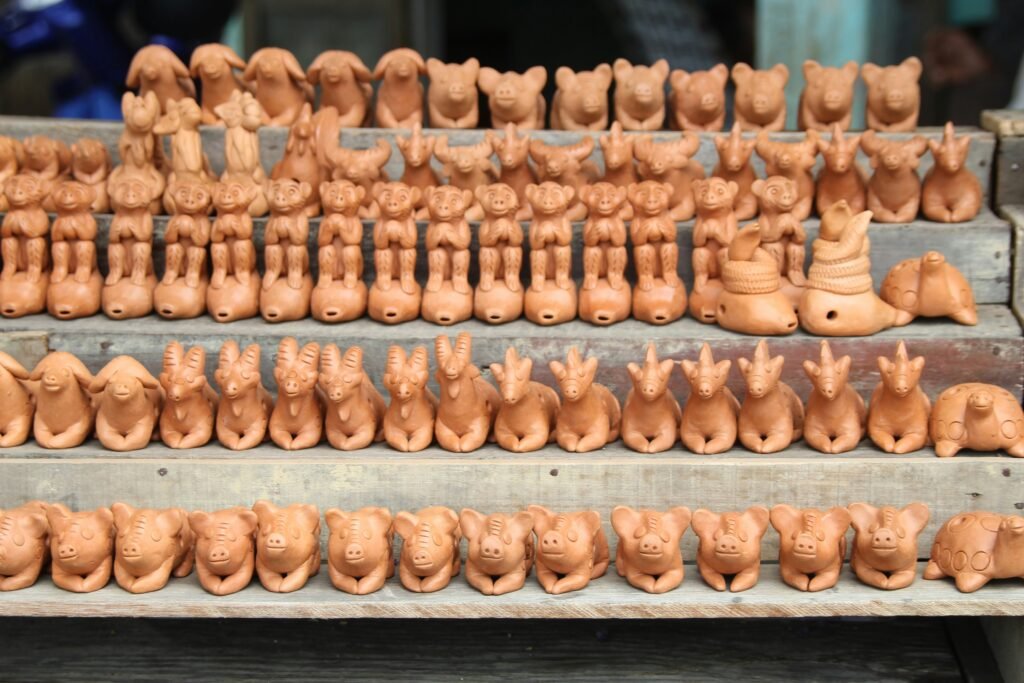
Around Hanoi, within a forty-kilometre radius, about a hundred villages each practise a single trade. Not mainly: exclusively. Bát Tràng makes ceramics, Vạn Phúc silk, Hạ Thái lacquer, Đại Bái bronze, Chương conical hats. Some date back to the 15th century.This organisation comes from the guilds of the delta: a village obtained the right to supply the court with a given product, and jealously guarded its technique. Skills were passed down within the family, never outside, often exclusively through men or through women depending on the trade.These are not open-air museums. They are working villages, with family workshops you enter through the courtyard, where people work all day. Tourism is marginal there, except in Bát Tràng; elsewhere, your presence is a curiosity rather than a transaction.
Lacquer, the slowest technique in Asia
The sơn mài lacquer stands apart from Chinese or Japanese lacquer for one reason: wet sanding. A layer of resin from the lacquer tree is applied, left to dry for several days in a humid room — lacquer hardens with humidity, not heat —, then sanded. And you start again.A serious piece needs twelve to twenty layers and two to four months. Eggshell inlay, a Vietnamese speciality, was used to obtain a white that the lacquer palette could not provide: the shell is broken, laid fragment by fragment, covered over, then sanded until it reappears.In the 1930s, teachers at the École des beaux-arts de l’Indochine pushed their students to use lacquer no longer to decorate objects but to paint pictures. That is how Vietnamese lacquer painting was born, today the country’s most sought-after art form on the international market.When buying, a simple test: real lacquer is heavy, cold to the touch, perfectly smooth, and its price has nothing to do with that of the varnished trays sold in airport shops.
Silk, brocade, ceramics
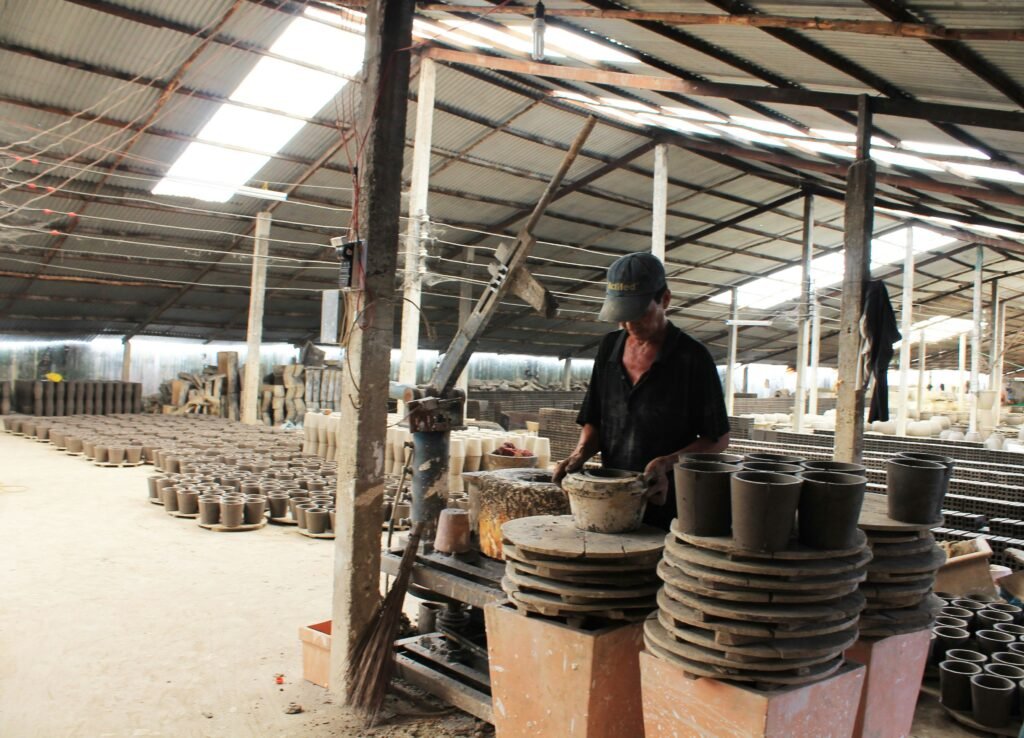
The silk of Vạn Phúc has been woven for more than a thousand years eight kilometres from central Hanoi. The trap is real: much of what is sold on the main street is imported polyester. The burnt-thread test is foolproof — silk smells of burnt horn and leaves a crumbly ash, synthetic fibre melts into a hard bead. Any serious seller will let you do it.The brocade of the minorities is another world: woven on a backstrap loom, in hemp or cotton, dyed with natural indigo. The motifs are not decorative but signs of identity — they tell the group, sometimes the village. Bought directly from the woman who wove it, a length of Hmong hemp costs little and is worth infinitely more than the industrial embroidery of Sa Pa.The ceramics of Bát Tràng, set on a bank of white Red River clay, were already exported to Japan and the East Indies in the 16th century. The traditional wood-fired kilns have almost disappeared, but the village has kept its glazes — cobalt blue, ivory crackle — and you can throw a piece yourself in an hour.
A living craft can be recognised by this: the workshop sells first to Vietnamese customers, and travellers are only a bonus.
What you can make with your own hands
Most of these villages will introduce a visitor to their craft, provided it is organised in advance rather than improvised. What we regularly put into itineraries:
Throwing a piece at Bát Tràng — one hour, accessible to children from six, the piece is fired and shipped afterwards.
Eggshell inlay at Hạ Thái — half a day on a small piece already prepared, because the twenty layers are out of reach.
Indigo dyeing with the Hmong, in Ha Giang or Pu Luong — your hands will stay blue for four days, so warn your colleagues.
Printing a Đông Hồ folk print — woodblock carving, dó paper coated with crushed mother-of-pearl, plant colours. Only two families still keep the technique alive.
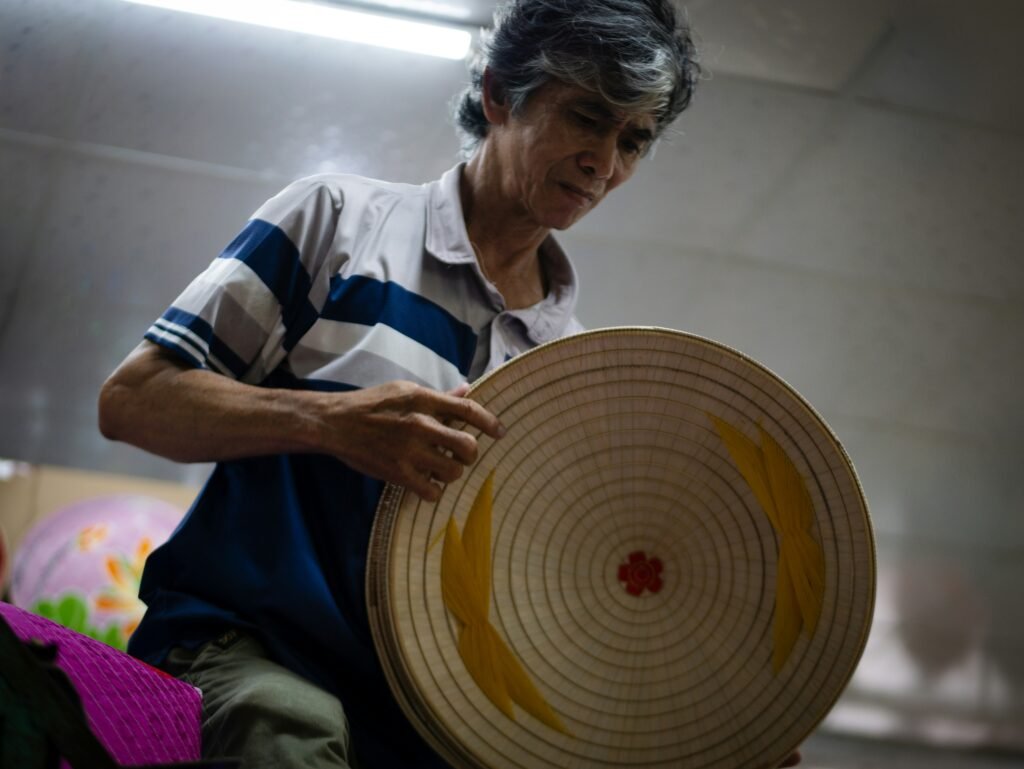
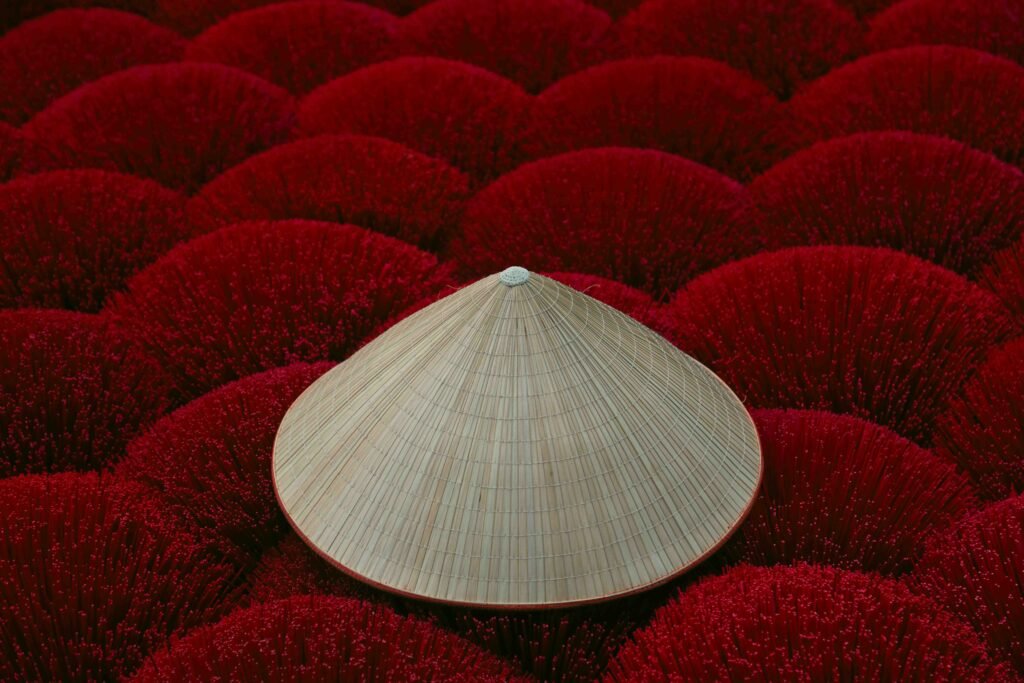
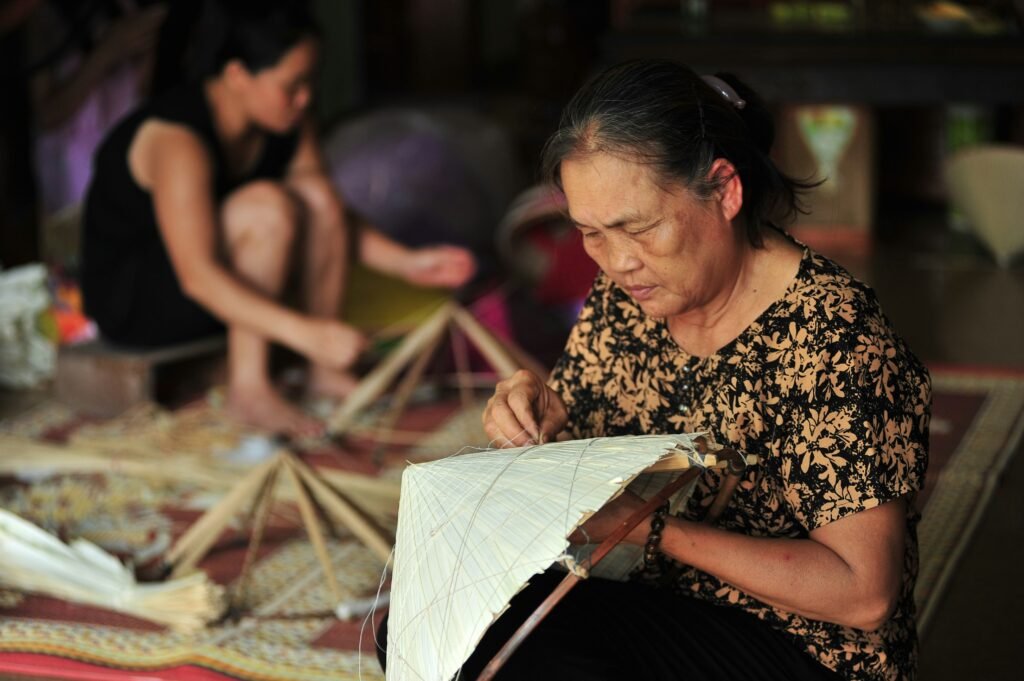
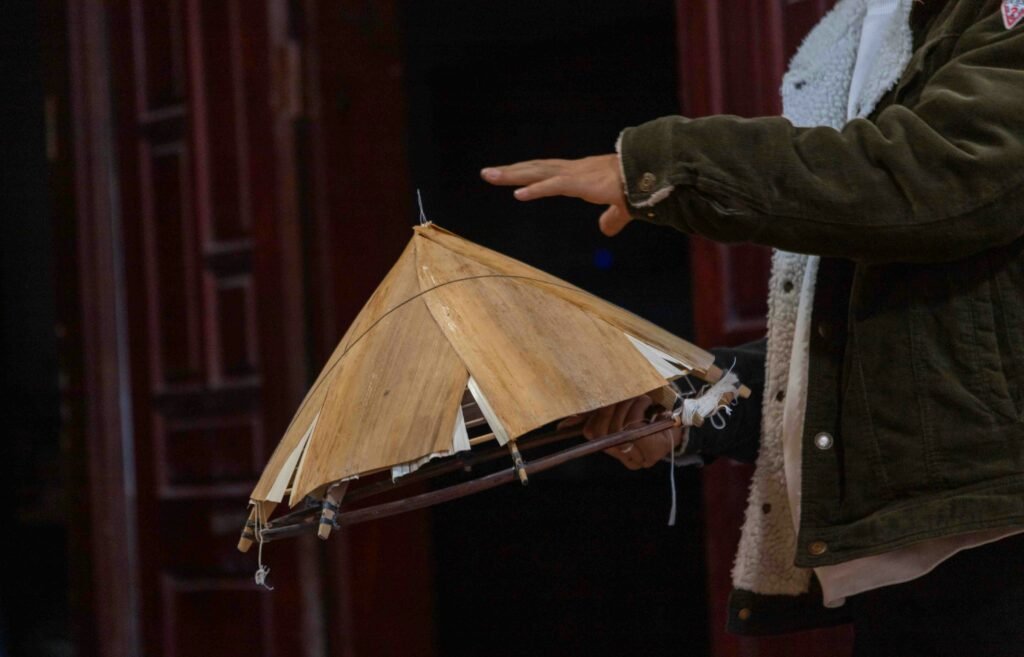
Making a conical hat at Chương — sixteen bamboo rings, palm leaves pressed with a hot iron, and stitching with nylon thread.
Three days by bike in the delta are enough to string together four or five of them, sleeping in homestays. It is flat, an hour from Hanoi, and it can be added to a classic tour without upsetting anything.
The craft villages around Hanoi
Hanoi is surrounded by specialised villages, some of which are very easy to visit. Bat Trang, half an hour away, has lived from ceramics for centuries: you can see the kilns and throw a bowl. Van Phuc, in the south-western suburbs, weaves silk and sells its fabrics by the metre. Further away, Dong Ho carves and prints folk woodblock pictures on bark paper, once hung in every home for Tết. Finally, Chuong makes conical hats by hand.
The lanterns of Hoi An
Hoi An’s silk lanterns have become the symbol of the town. They are made on a bamboo frame bent by hand, then covered with stretched, glued silk. Several workshops offer to make one yourself in an hour or two, an activity families greatly enjoy. Folding lanterns are easy to carry home in a suitcase.
Crafts in the face of industry
Many craft villages struggle against competition from industrial products, often imported. Some have turned to tourism and workshops, others to contemporary design, working with young designers. Buying directly from the workshop, even a small piece, is the best way to support these skills.
One last piece of advice
If crafts interest you, tell us when we build your trip: we will plan half a day in a craft village, with a workshop where you can try your own hand.
Buying without making a mistake
Buy at the workshop, not on the village’s shopping street — the quality gap is huge and the price gap small.
Ask to see the making. A workshop that refuses probably doesn’t make anything.
For silk, insist on the burnt-thread test. For lacquer, weigh it in your hand: weight can’t be faked.
Large pieces can be shipped by sea freight at a reasonable cost; serious workshops do it routinely and pack well.
Beware of “craft shops” where your driver drops you off without being asked: they pay a commission. Our drivers are strictly forbidden to do this.
Bargaining is practised in markets, not in workshops where you have been shown the work. The price given there is generally the fair price, and hard bargaining is frowned upon.
Which villages should you see if you only have one day?
Bát Tràng for ceramics and Vạn Phúc for silk, both less than twenty kilometres from Hanoi, can be done on the same day. If you have to choose, Bát Tràng is livelier and lets you get your hands into the clay.
How can you recognise real silk?
The burnt-thread test: silk smells of burnt horn and leaves an ash that crumbles, polyester melts into a small hard bead and smells of plastic. An honest seller will always let you take a thread.
How can you recognise real lacquer?
By weight and temperature: authentic lacquer is heavy, cold to the touch and perfectly smooth, with no grain or bubbles. Allow several tens of euros for a small piece — below that, it is varnish.
Can you do a workshop with children?
Yes. Pottery at Bát Tràng works from age six and remains one of the most popular activities on our family tours. Lacquer requires more patience, from around ten.
Can you have your purchases shipped home?
Yes, serious workshops do it routinely, by sea freight for heavy pieces. Allow six to ten weeks. We check the packaging and keep a record of the order.
Should you bargain?
In markets yes, with a smile and without stubbornness. In a workshop where you have been shown the work, no: the price given is generally fair, and hard bargaining is frowned upon.
Putting it into practice
The tours where you experience what this article is about
Audience measurement. We would like to know which pages are useful to you, using Google Analytics. Nothing is stored without your consent, and you can change your mind at any time. Learn more

 Culture & foodFlavours of Vietnam — 10 daysHanoi — Bat Trang — Hue — Hoi An — Saigon — Cai Be10 days / 9 nightsfrom €1,450