The scooter, the street and the art of crossing in Vietnam
Sixty-five million two-wheelers for a hundred million people. In Vietnam the scooter isn’t a means of transport, it is infrastructure, a shop, a living room and a dining room — and it explains the very shape of the cities.
A country on two wheels
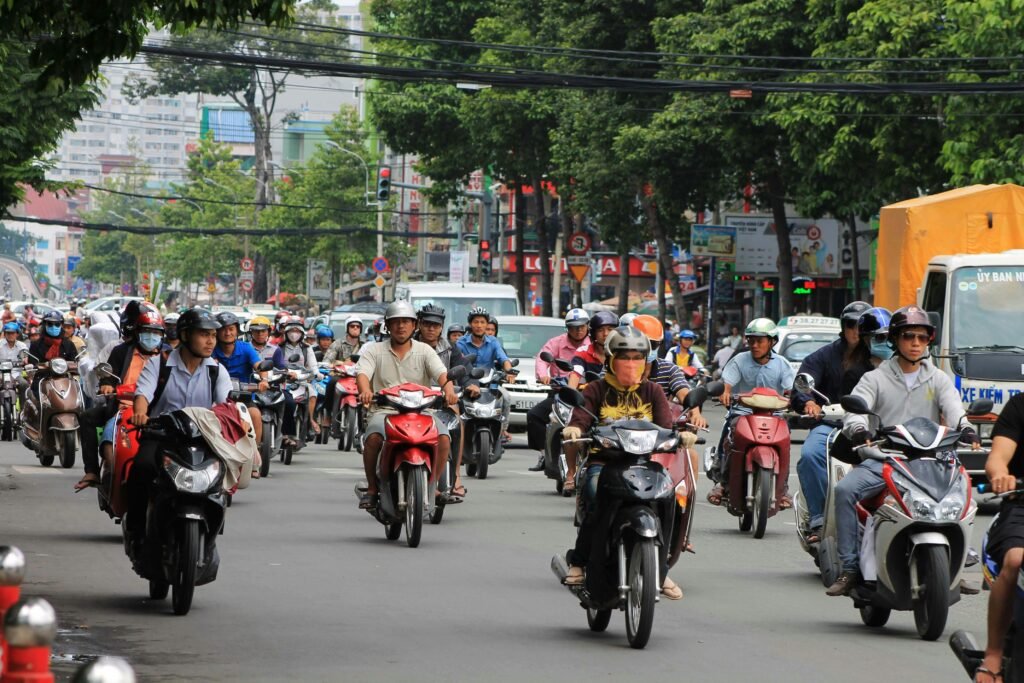
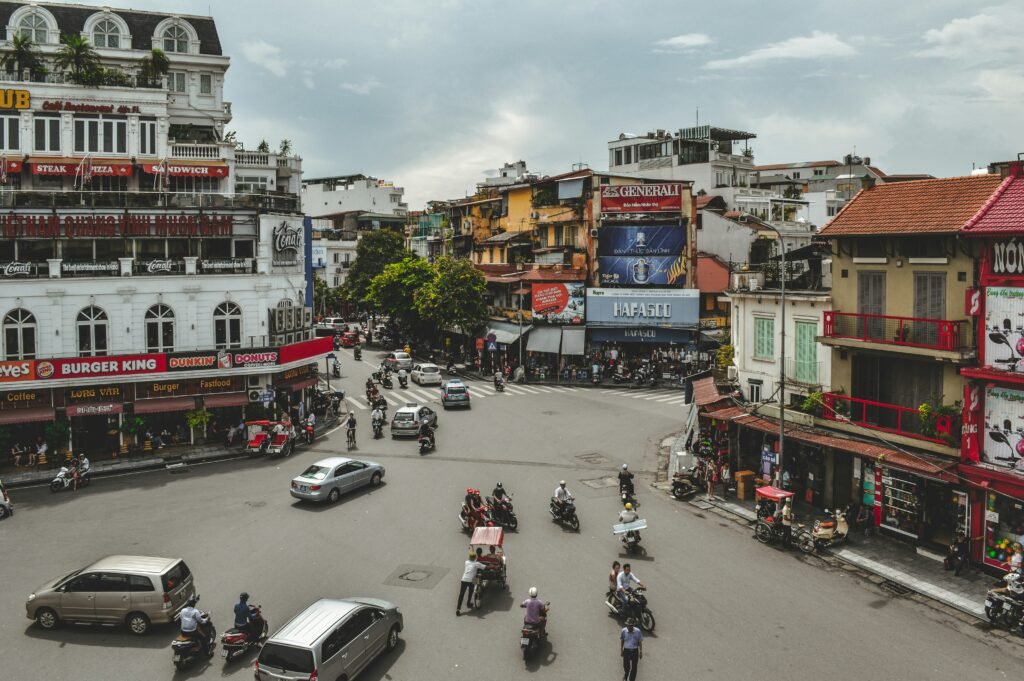
Vietnam has about sixty-five million registered motorbikes and scooters for a hundred million people: one of the highest rates in the world. In Hanoi as in Ho Chi Minh City, they account for more than eighty per cent of journeys.It isn’t just a question of income. The shape of the cities demands it: the Vietnamese urban fabric is made of alleys — the hẻm — two to three metres wide, where a considerable share of the population lives and no car can pass. The scooter is the only vehicle sized for that city.
The urban fabric is made of two-metre alleys where no car can pass. The scooter is the only vehicle sized for that city.
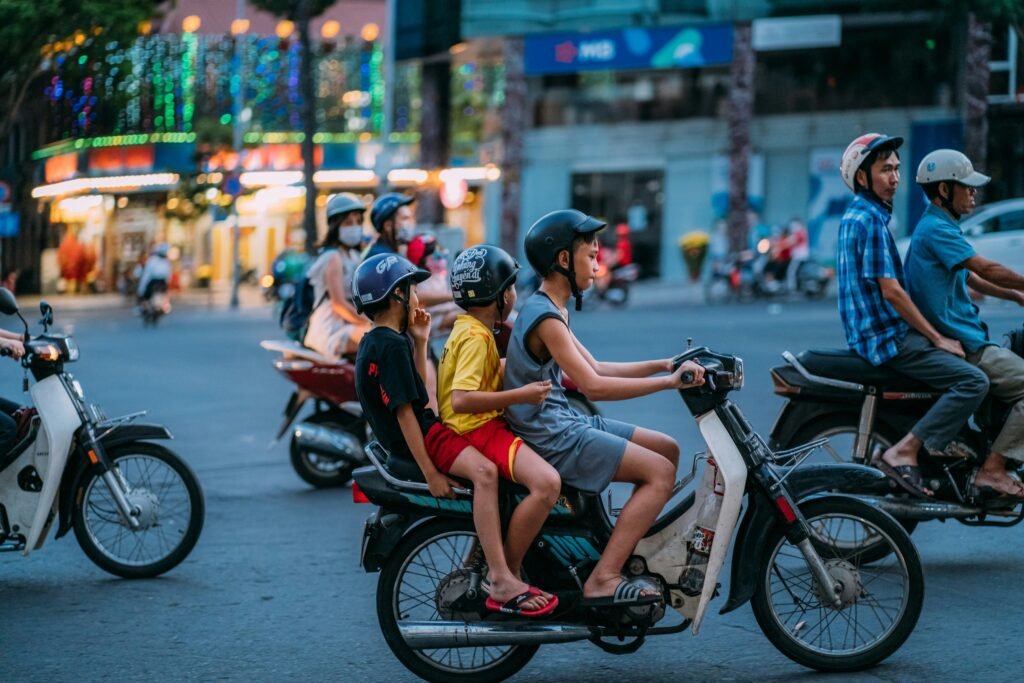
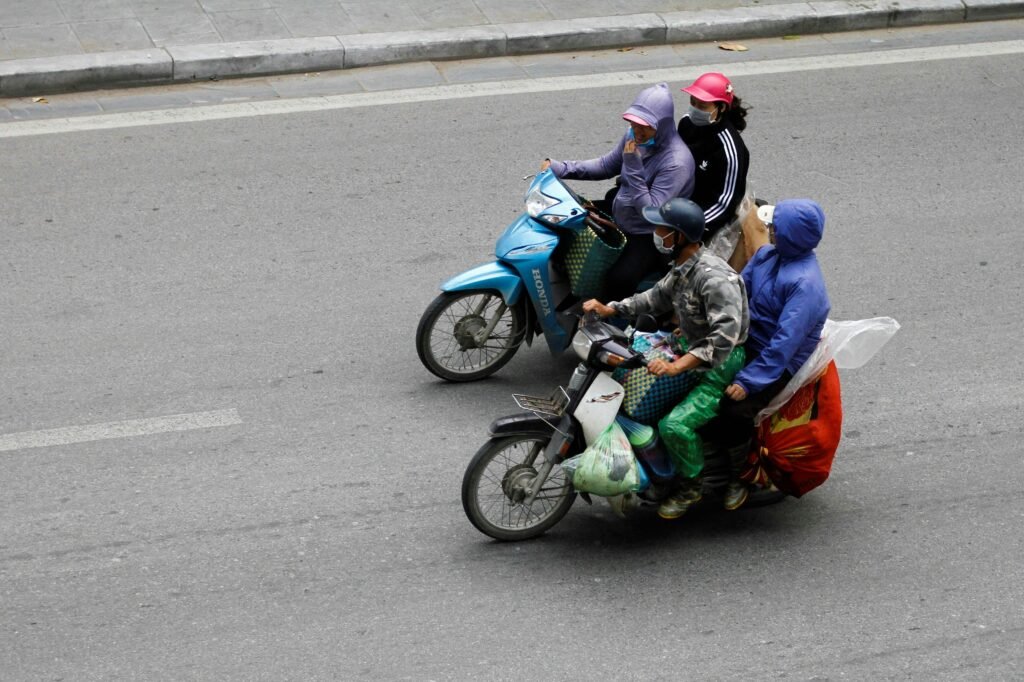
It is also a work tool. It carries poultry cages, panes of glass, bed bases, two-metre Tết trees, a fridge, a family of five. The photographs that circulate on this theme raise a smile; on the spot, you quickly understand that it is a skill, not recklessness.
From the Mobylette to the Honda
The story starts with the French: the Mobylette and the Solex equipped the colonial cities, and the word xe máy — “motor vehicle” — dates from that time. In the South of the 1960s, the Vespa and the Lambretta became social markers, then the Honda Cub, imported en masse, took over to the point that honda became the common word for a scooter in part of the country.The mass shift dates from Đổi mới, the economic liberalisation of 1986, and above all from the 1990s and 2000s: locally assembled models and Chinese imports brought prices down, and the number of vehicles exploded.The next generation is electric. Electric scooters and two-wheeled ride-hailing fleets are already transforming the soundscape of the cities, and both Hanoi and Ho Chi Minh City plan to restrict petrol two-wheelers in their centres. The country that rode most on petrol may be the first to give it up.
Crossing the street: the method
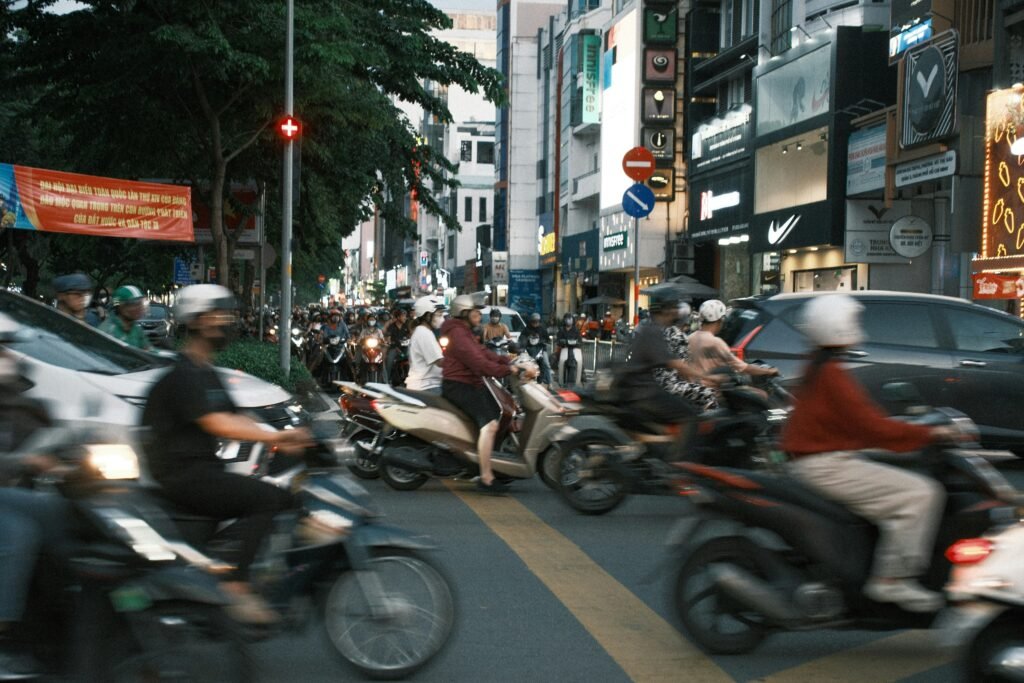
It is the first practical challenge of the trip, and it comes down to one sentence: walk slowly, steadily, without sudden moves, and never step back.The reasoning is simple. Two-wheeler riders calculate your path several seconds ahead and go round you in front or behind. As long as you are predictable, the calculation works. What is dangerous is stopping in the middle, running or taking a step back: the flow had organised itself around you, and you break its assumption.Two exceptions. Cars and buses don’t brake the same way: let them pass. And a green light guarantees nothing — right-turners keep going.Waiting for a gap in the traffic doesn’t work. There won’t be one.
The street as a living room
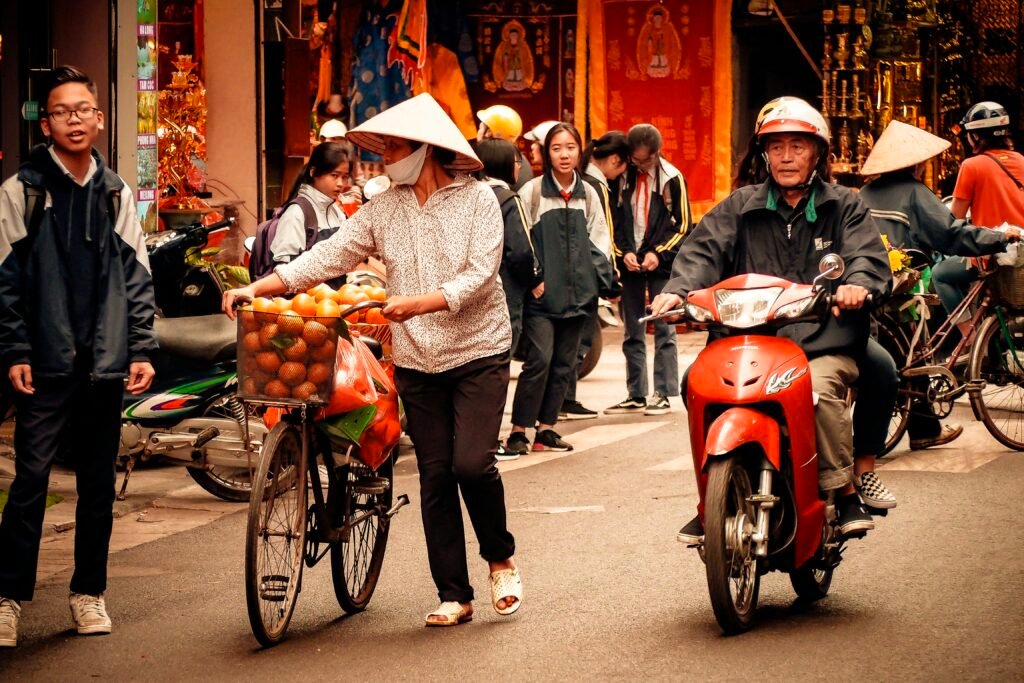
The Vietnamese tube house — two to three metres of frontage, thirty deep — has a direct consequence: the ground floor is taken up by the shop and parked scooters, and life spills onto the pavement. That is where people eat, get their hair cut, repair things, play Chinese chess and nap in a hammock strung between two posts.The thirty-centimetre plastic stool is the emblematic object of this arrangement. It stacks, comes out by the dozen at five in the afternoon, and vanishes before the municipal police come round. All of Vietnamese street food rests on this piece of furniture.A practical corollary: the pavement isn’t a pedestrian space. It holds parked scooters, kitchens and stalls, and pedestrians walk in the road. It isn’t disorder, it is a different allocation of space — and it works.
Should you rent a scooter?
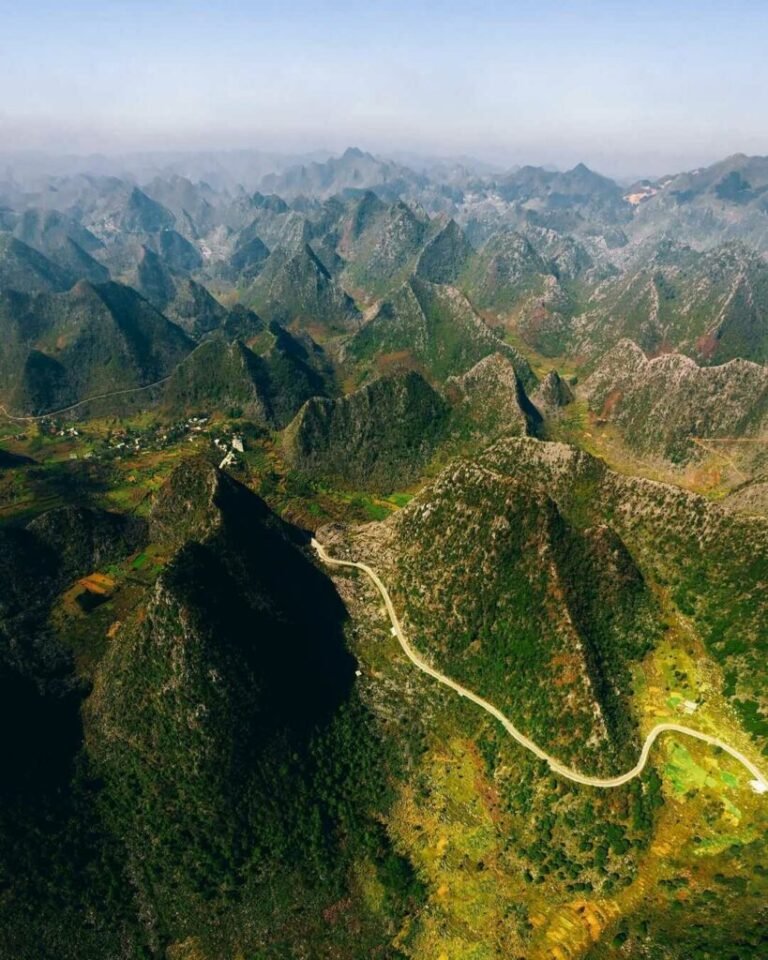
Our answer is no in almost every case, and it is better to say exactly why.First, insurance: riding a two-wheeler over 50cc requires a Vietnamese motorbike licence or a recognised international permit, and most travel insurance policies exclude injury or damage sustained while riding without one. A trivial fall can then become very expensive.Then, the conditions: narrow mountain roads without crash barriers in Ha Giang, fog on the passes, lorries, livestock on the road at night. Serious accidents involving foreign travellers on the Ha Giang loop are frequent and rarely talked about.We offer two alternatives. A local rider who drives while you ride pillion — this is what is known as easy rider, and it gives exactly the same experience. And a guided outing in town, with a guide on a scooter, for evening food tours in Saigon or Hanoi: it is the activity our travellers rate most highly, and it takes one evening.A helmet is compulsory for both rider and passenger, even for a hundred metres. Those supplied by rental shops are often decorative: ask for a proper one.
Helmets and the law
Since 2007, helmets have been compulsory for all two-wheeler riders and passengers, and the rule is widely respected in cities. Helmets sold in the street are often light and offer little protection; if you ride pillion with a driver, for example in Ha Giang, we provide a better-quality helmet.
Carrying everything by motorbike
The Vietnamese scooter carries everything: a family of four, chicken cages, a wardrobe, a Tết tree, dozens of water bottles. This constant spectacle is one of the most striking images for travellers, and it says a lot about the country’s ingenuity and economy of means.
Towards the electric scooter
Electric scooters are multiplying, driven by Vietnamese brands, and the big cities are preparing restrictions on petrol motorbikes in their centres to combat pollution. The soundscape of Hanoi and Saigon could change a great deal in the years to come.
One last piece of advice
To experience the Vietnamese street safely, ride pillion on a motorbike with a guide for a night tour of Hanoi or Saigon: it is one of our travellers’ favourite activities.
What the scooter says about the country
One last remark, and it isn’t trivial. Getting around on two wheels explains much of what strikes the traveller: the city that never sleeps, because it is easy to get home at midnight; ground-floor shops, because you can stop without parking; ubiquitous delivery, because a scooter goes everywhere; and a kind of individual autonomy that contrasts with the image of a tightly controlled society.When the cities switch to the metro and electric — Ho Chi Minh City’s first metro line opened in 2024, Hanoi’s in 2021 — it is this organisation of the street that will change. You are travelling in a country in the middle of that shift.
Walk slowly, steadily, without sudden moves, and never step back. Two-wheelers calculate your path and go round you as long as you are predictable. Do, however, let cars and buses pass.
Can you rent a scooter as a tourist?
It is possible but we advise against it. Over 50cc you need a recognised motorbike licence, otherwise travel insurance won’t cover the damage. We offer a local rider or a guided outing instead.
Is a helmet compulsory?
Yes, for both rider and passenger, on every journey. Helmets supplied by rental shops are often poor quality; ask for a proper one.
Why are there so many scooters?
About sixty-five million for a hundred million people. The main reason is urban: Vietnamese cities are made of two- to three-metre alleys where no car can pass.
Is it dangerous to ride a motorbike in Ha Giang?
For an inexperienced rider, yes. Narrow roads without barriers, fog, lorries, livestock at night: serious accidents involving foreign travellers are frequent there. We work with local riders.
What is a scooter food tour?
An evening of three to four hours, riding pillion behind a guide, with four to six stops in different neighbourhoods. It is the activity our travellers mention most often when they get home, in Saigon as in Hanoi.
Putting it into practice
The tours where you experience what this article is about
Audience measurement. We would like to know which pages are useful to you, using Google Analytics. Nothing is stored without your consent, and you can change your mind at any time. Learn more
 The essentialsVietnam in 15 daysHanoi — Pu Luong — Ninh Binh — Lan Ha Bay — Hue — Hoi An — Saigon — Mekong Delta15 days / 14 nightsfrom €2,070