Forty-five days without a visa until March 2028 for French citizens, a free pre-arrival form to fill in three days before, no compulsory vaccinations and no malaria where you will be going. Here is what you really need to prepare, and in what order.
In brief
Visa
None for French citizens up to 45 days (until 14 March 2028). Beyond that: online e-visa, 90 days
Passport
Valid 6 months after the date of entry, two blank pages
Vaccinations
Routine vaccinations up to date, hepatitis A recommended. No compulsory vaccinations
Insurance
Medical cover of at least €100,000 and unlimited repatriation
Pre-arrival
Free online form, within the 3 days before arrival, on prearrival.immigration.gov.vn
The visa: 45 days with no formalities
It is the first question in almost all our conversations, and the answer is simpler than you might think. French nationals are exempt from a visa for a stay of up to 45 days, days of entry and exit included, whatever the purpose of the trip.This measure, set by Resolution 44/NQ-CP, is in force from 15 March 2025 to 14 March 2028. It also applies to Germans, Italians, Spaniards, British citizens and nationals of the Nordic countries. Belgians, Swiss and Luxembourgers also benefit from 45 days without a visa, but under a different text (Resolution 229/NQ-CP): from 15 August 2025 to 14 August 2028, and for tourist stays only. Canadians, for their part, must apply for an e-visa.There is only one condition: your passport must be valid for at least six months from the date of entry into the country. There is nothing to pay and no visa to apply for — but since 2026, a free online form is recommended before landing: we explain it below.
When the e-visa becomes necessary
Two situations require you to apply: a stay of more than 45 days, or a nationality not covered by the exemption.A return trip to Cambodia or Laos during your journey is no longer one of them. The old thirty-day gap required between two visa-free entries was abolished by the 2023 immigration law: each new entry opens a new 45-day stay. The final decision always rests with the border officer, but in practice these round trips go smoothly.
Exemption
E-visa
Authorised length
45 days maximum
90 days maximum
Procedure
None
Online, before departure
Cost
Free
USD 25 single entry, USD 50 multiple entry
Processing time
—
Usually 3 working days
Entries
One per stay; each new entry reopens 45 days
Single or multiple, as you choose
Valid until
14 March 2028
No scheme expiry date
If you want zero uncertainty — a stay approaching 45 days, several border crossings, or a passport from a country not covered — the multiple-entry e-visa settles everything for USD 50.
Applying for your e-visa, step by step
The procedure is entirely online and needs neither an agency nor an intermediary. It takes about fifteen minutes.1. Go to the official portal of the Vietnamese immigration department, evisa.gov.vn. It is the only official site. The dozens of sites that appear before it in search results are private intermediaries charging two to three times the fee, sometimes more.2. Prepare two files: a digital passport photo on a white background, bareheaded and without glasses, and a scan of the passport’s main page, fully legible and without glare.3. Fill in the form. The two fields that cause problems are the port of entry and the port of exit : enter the airport you plan to use, but be aware that a mistake here is the main cause of refusal.4. Pay USD 25 for a single entry or USD 50 for multiple entries. The fees are not refunded if you are refused.5. Allow three working days, sometimes less. You receive a file number and then a PDF document to download. Print it twice and keep a copy on your phone.We can prepare this application for you if you prefer, but we would rather tell you honestly that it can be done alone in a quarter of an hour.
The only official site is evisa.gov.vn. All the others are intermediaries that charge two to three times the fee.
The pre-arrival form: what’s new in 2026
Since 15 April 2026, the Vietnamese immigration department has run an online declaration system before arrival, called Pre-Arrival Information (PAI). You enter your passport, your flight and your first accommodation; the system processes your entry in advance and sends you a QR code to show at the counter. The stated result: less waiting at immigration, especially at peak times.
Pre-arrival form (PAI)
Official address
prearrival.immigration.gov.vn — and nowhere else
Price
Free
When
Within the three days before your arrival
Language
Available in French and English
What to have to hand
Passport, flight number, airline booking reference, address of your first hotel
What you receive
A QR code to keep on your phone and, as a precaution, printed
Is it compulsory? When it was launched at Tan Son Nhat airport in Saigon, the Ministry of Public Security presented it as optional, with an extension planned to the other international airports. Within the first two weeks, about 70% of foreign travellers had filled it in. Our advice doesn’t depend on its status: fill it in. It is free, takes ten minutes, and saves you a queue after eleven hours on a plane.The two mistakes that make the declaration fail are, according to immigration itself, the flight number and the airline booking reference (the six-character code on your ticket). Copy them from your boarding pass or confirmation, not from memory. For a flight with a stopover, enter the flight that lands in Vietnam.
Beware of fake sites. Several pages imitate the official form and charge “processing fees”, or even harvest bank card numbers. The official form is free and never asks for payment.
This form does not replace a visa and is not one. If you enter with an e-visa, you declare it in the form; if you enter under the exemption, you simply fill it in with your passport. We give you the address of your first hotel with the trip confirmation — it is the only information you might not have to hand.
The passport, and the mistakes that cost dearly
Your passport must be valid six months after the date of entry — not after the return date, contrary to what you often read — and have at least two blank pages. A renewal takes three to six weeks in France, longer between May and July.Three mistakes come up every year. A passport with five and a half months of validity left: refused at boarding, before even leaving home. A compound name entered differently on the e-visa and the passport: refused on arrival. And a minor travelling with only one parent without the required travel authorisation, when the other parent is not with them.Check these three points as soon as you book your flights, not in the week of departure.
Health: vaccinations
No vaccination is compulsory to enter Vietnam from Europe. Several are recommended, and the recommendation depends on your itinerary far more than on the country.
Vaccine
Recommendation
For whom
Diphtheria-tetanus-polio
Update recommended
Everyone, as everywhere
Hepatitis A
Always recommended
Everyone
Typhoid
Recommended
Frequent street food, rural areas
Hepatitis B
Recommended
Long or repeated stays
Japanese encephalitis
Rarely needed
Extended rural stays in the rainy season
Rabies
To discuss
Long rural stays, cycling trips, young children
See your doctor two months before departure : that is the time needed for some boosters. A travel vaccination centre is useful if your tour includes extended rural stops.
Malaria and dengue: the real risk
You need to tell the two apart, because travellers usually worry about the wrong one.Malaria does not exist in the cities, on the coast, in the Red River Delta or in the Mekong Delta. In other words: not in Hanoi, not in Hoi An, not in Saigon, not in Lan Ha Bay. A residual risk remains in remote rural areas of the Centre and the highlands. The vast majority of our tours justify no preventive treatment — still, talk to your doctor, who will decide based on your itinerary.Dengue, on the other hand, is present everywhere, including in towns and in the middle of the dry season. There is no preventive treatment available to travellers. High-concentration mosquito repellent is your only real protection, and the mosquito that transmits it bites during the day, not at night.Two simple rules are enough in 99% of cases: repellent in the morning and late afternoon, and bottled or filtered water. We provide water on board the vehicles.
Travel insurance
It is not included in our tours and we strongly recommend it. Allow €40 to €90 for three weeks for proper cover.It must cover at least cancellation, medical costs, medical repatriation and loss of luggage. Check two points that are often excluded: kayaking and hiking if your tour includes them, and riding two-wheelers — which is excluded from almost all policies anyway.Premium bank cards offer cover, but often limited to three months and capped. Read the terms before relying on it. We check your cover on request and point you towards insurance suited to your itinerary.
Packing: what is really useful
Closed shoes that are already broken in: you will walk much more than planned.
A light raincoat, even in the dry season.
Clothes covering shoulders and knees for temples and pagodas.
A high-concentration mosquito repellent, hard to find on site.
A basic first-aid kit: anti-diarrhoea medicine, paracetamol, plasters, hand sanitiser.
A fleece if you go up to the North between November and February, or if you go through Da Lat.
An adapter: sockets are mostly European-type, but not all.
Room on the way back — you will come home with coffee, tea, spices and probably a lantern.
What you don’t need to bring: clothes for the whole length of the stay. Laundry costs a few euros a kilo everywhere, comes back within twenty-four hours, and travelling light changes everything when you switch hotels every two days.
The countdown
Six months before. Essential if you are travelling during Tết, during school holidays, or if your tour includes Mu Cang Chai in September, a junk with cabins or the lodges of Pu Luong. This accommodation is limited and goes early.Three months before. Check your passport’s validity. Book the international flights. Confirm your tour if you are travelling in high season, from October to April.Two months before. See your doctor for vaccinations and boosters. It is also the time to tell us about any dietary or medical constraints, so that we can adapt the stops.One month before. E-visa if needed. Take out travel insurance. Pay the balance of the tour.One week before. Photocopies of your passport, a digital copy in your mailbox. Tell your bank your travel dates. Download offline maps.Three days before. Fill in the pre-arrival form on prearrival.immigration.gov.vn, free of charge, and save the QR code on your phone. Not earlier: the system only accepts the declaration within the three days before arrival.
On the ground: useful habits
On arrival we give you the practical details of your tour and a French-speaking assistance number you can reach throughout your stay.Drink bottled or filtered water, including for brushing your teeth during the first few days. Eat street food without hesitation, but where there are plenty of people: a fast turnover of produce is worth all the hygiene certificates.Cross the streets slowly and never step back. Scooters go around you; they cannot anticipate a change of direction. It feels counter-intuitive for two days, then it becomes natural.And don’t ride a scooter. It is the only advice we never compromise on: your insurance doesn’t cover you, your foreign licence is not valid, and Vietnamese hospital emergency rooms see foreign travellers every day for this reason.
Official sources to check
Entry rules change by government resolution, sometimes with only a few weeks’ notice. Before booking, always check these three pages: the Entry and stay page of the French Ministry of Foreign Affairs, its Healthpage, and the official e-visa portal of the Vietnamese immigration department. These are the only addresses to use: sites that resell the form only fill it in for you.
No for a stay of up to 45 days, days of entry and exit included, until 14 March 2028. Beyond that, or for several entries, the 90-day e-visa is obtained online in three working days.
How much does the e-visa cost and where do I apply?
USD 25 for a single entry, USD 50 for multiple entries, on the official portal evisa.gov.vn only. Intermediary sites charge two to three times this fee.
Which vaccinations are compulsory?
None. Hepatitis A and an up-to-date diphtheria-tetanus-polio vaccination are always recommended, typhoid if you eat a lot of street food.
Is there malaria in Vietnam?
Not in the cities, on the coast or in the deltas — so not on almost any of our tours. Dengue, however, is present everywhere: repellent is the real protection.
What passport validity do I need?
Six months after the date of entry into Vietnam, and two blank pages. Check it as soon as you book your flights: it is the main cause of refusal at boarding.
What is the pre-arrival form?
A free online declaration, opened in 2026 by Vietnamese immigration, to be filled in within the three days before arrival on prearrival.immigration.gov.vn. It produces a QR code that speeds up passage at the counter. It is not a visa, and the official site never asks for payment.
Can I go to Cambodia and come back without a visa?
Yes. The thirty-day gap between two visa-free entries was abolished in 2023: each new entry opens a new 45-day stay. For zero uncertainty, the multiple-entry e-visa costs USD 50.
Putting it into practice
The tours where you experience what this article is about
Audience measurement. We would like to know which pages are useful to you, using Google Analytics. Nothing is stored without your consent, and you can change your mind at any time. Learn more
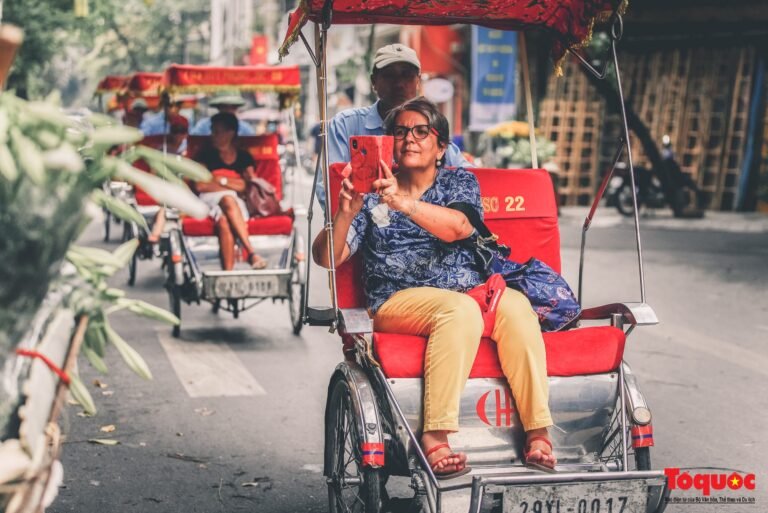



 The essentialsVietnam in 15 daysHanoi — Pu Luong — Ninh Binh — Lan Ha Bay — Hue — Hoi An — Saigon — Mekong Delta15 days / 14 nightsfrom €2,070