Vietnamese coffee: the world’s second-largest producer, and a way of drinking it all its own
Vietnam produces more coffee than any country except Brazil, and hardly anyone in Europe knows it — because most of it goes into industrial blends. On the ground, it is a whole other story: a slow filter, condensed milk, and a pavement culture.
A robusta country that produces excellent arabicas
Vietnam is the world’s second-largest coffee exporter and by far the largest producer of robusta. This position has a short history: missionaries introduced the coffee plant in 1857, but the boom dates from the 1990s, when economic liberalisation pushed hundreds of thousands of families towards the Central Highlands.Robusta grows low, resists disease, contains twice as much caffeine and gives a more bitter, stronger cup, with the notes of cocoa and roasted hazelnut you recognise instantly in a Vietnamese coffee. For a long time it served as cheap raw material for European industrial blends.What has changed in the last ten years is the arrival of a generation of growers working arabica at altitude — at Cầu Đất near Đà Lạt, on the Măng Đen plateau, in some valleys of Sơn La — with selective picking and controlled fermentation. These coffees are hardly exported. They are drunk on the spot, and they surprise.
The phin, and why slowness is the point
The phin is a small aluminium or stainless-steel filter set directly on the glass: a perforated chamber, a press disc, a lid. You put in the grounds, tamp lightly, pour in a little boiling water to let them bloom, then fill it up. Extraction takes four to five minutes, drop by drop.This slowness is not a technical flaw, it is the principle. It produces a very concentrated, almost syrupy coffee that can take sweetened condensed milk without disappearing under it. And it imposes a wait during which you do nothing but watch the street — which explains the place of coffee in Vietnamese social life far better than any statistic.Condensed milk is not an indulgence: in the tropics, without a cold chain, fresh milk was impossible to find. A tin of condensed milk, however, kept. Cà phê sữa đá — coffee, condensed milk, crushed ice — was born of this constraint, just as bánh mì was born of a lack of wheat.
What to order, and where
Cà phê đen đá — black, iced, no milk. The closest to what a European calls a coffee, but much stronger.
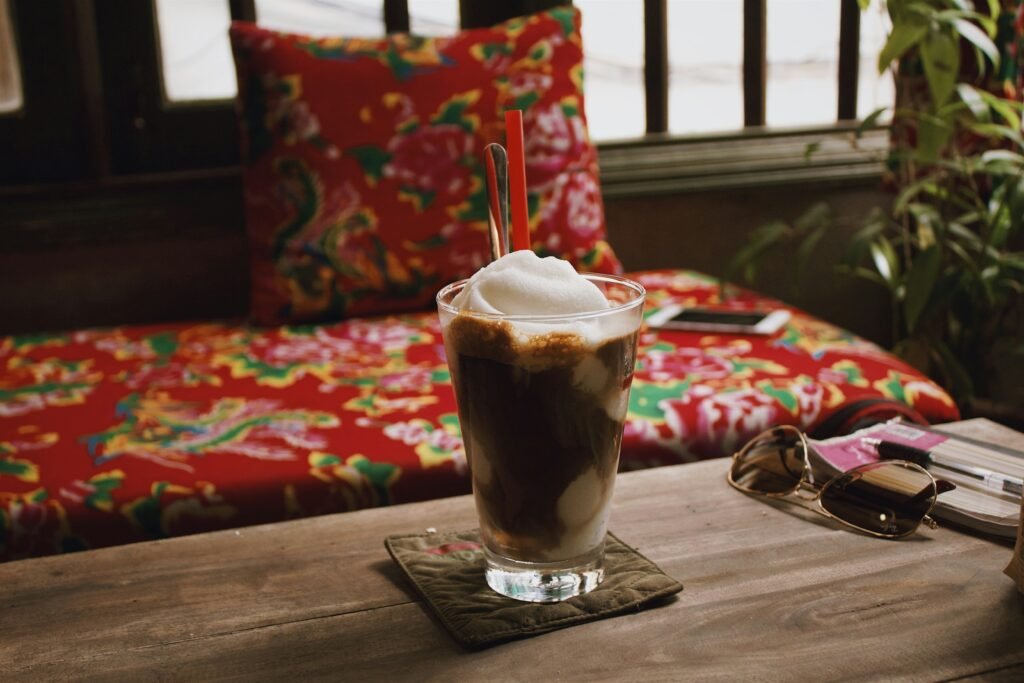
Cà phê sữa đá — the national drink. Ask for ít đường if you want it less sweet.
Cà phê trứng — Hanoi’s egg coffee, invented in 1946 during a milk shortage: a yolk whipped with sugar into a warm sabayon on top of piping-hot coffee. It looks like a mistake and it is a dessert.
Bạc xỉu — lots of milk, a little coffee. The name comes from Cantonese; it is what is given to children and tired foreigners.
Cà phê muối — Huế’s salt coffee, with a lightly salted cream that cuts the bitterness. Recent, and now the craze across the country.
Cà phê cốt dừa — with coconut milk, often iced like a granita. More dessert than coffee.
Steer clear of places advertising “weasel coffee” or civet coffee: real production is tiny, the vast majority of what is sold under that name is added flavouring, and keeping civets in cages raises a real animal-welfare problem. We take nobody to these farms.
You don’t order a Vietnamese coffee to drink it quickly. The filter takes five minutes, and that is exactly the time it takes to strike up a conversation.
The geography of coffee, city by city
In Hanoi, coffee is drunk sitting on a twenty-centimetre stool, on the pavement, facing the traffic. The historic addresses of the Old Quarter serve egg coffee in alleys you enter through a corridor. It is a city of slow coffee and long conversation.In Saigon, everything is faster and sweeter: coffee is taken standing or on a scooter, in a plastic bag with a straw, and the city invented most of the modern variations. It is also where the country’s most serious speciality roasters are.In Huế, salt coffee. In Đà Lạt, you visit the plantations: it is the only town where in one morning you can see the coffee plant, drying on raised beds and roasting. In Buôn Ma Thuột, capital of robusta, a coffee museum and a festival every two years.We are happy to add a half-day at a plantation to an itinerary passing through Đà Lạt: harvest depending on the season, roasting, a comparative robusta–arabica tasting. It is one of the visits our travellers talk about most, and one of the cheapest.
Visiting a plantation
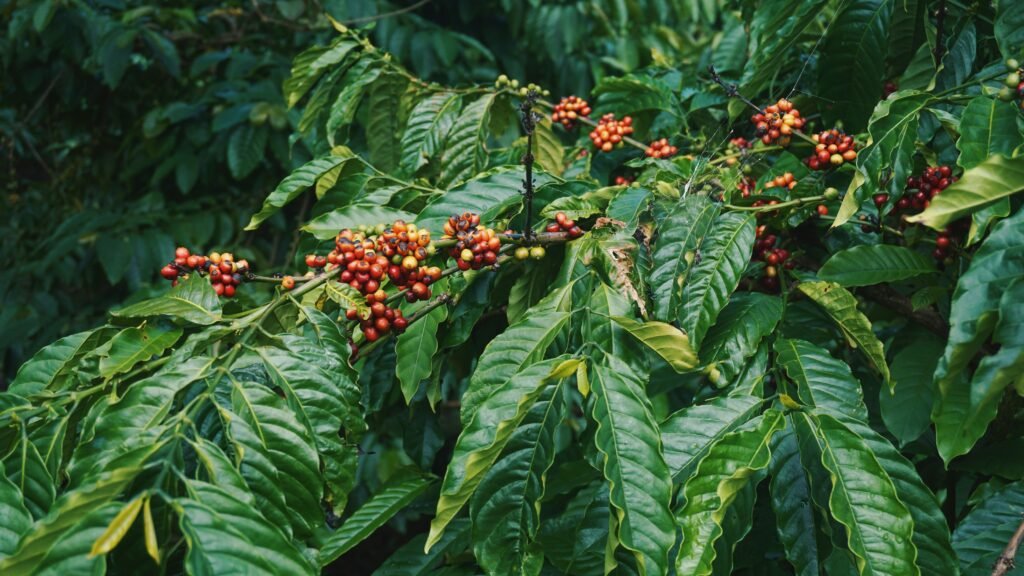
Vietnamese coffee grows mainly in the Central Highlands, around Buon Ma Thuot, and on the hills of Da Lat, where the altitude allows arabica to be grown. Several farms in Da Lat welcome visitors to show the growing, harvesting and roasting, with a tasting facing the hills. The harvest usually takes place from November to January, when the coffee cherries turn red on the trees.
The little pavement stools
Real Vietnamese coffee is often drunk sitting on a plastic stool at the edge of the pavement, watching the motorbikes go by. That is where locals meet in the morning before work, or in the afternoon for a chat. A coffee costs a few tens of thousands of dong, and nobody will hurry you to leave.
A very strong coffee
Robusta contains considerably more caffeine than arabica, and Vietnamese coffee is often very concentrated. If you are sensitive to it, start with an iced coffee with milk, which is milder, and avoid drinking it late in the day. For a less sweet coffee, ask for ít đường, little sugar.
In short
A phin coffee in the morning on a little stool, an egg coffee in Hanoi, a coconut coffee in Hoi An and a plantation in Da Lat: in two weeks, you understand why coffee has become a national passion.
Bringing it home
Vietnamese coffee is one of the few souvenirs that doesn’t disappoint once you are home, on three conditions. Buy it as beans rather than ground, as the phin grind is the wrong size for most European coffee makers. Check the roast date, not the best-before date: after two months, the interest drops.Above all, avoid coffees flavoured with butter or salt during roasting, very common in tourist markets: they are shiny, very fragrant in the bag, and practically undrinkable brewed any other way than with a phin.Bring home a phin too. It costs two euros, fits in a pocket, doesn’t break, and it is the only way to recreate at home the coffee you drank there.
Yes. Robusta contains about twice as much caffeine as arabica, and phin extraction is very concentrated. One Cà phê sữa đá is easily equivalent to two espressos. If you are sensitive, ask for a bạc xỉu, much lighter.
Can you find unsweetened coffee?
Yes, ask for cà phê đen (black), hot nóng or iced đá. Careful: even black coffee is sometimes lightly sweetened out of habit. Say không đường to be sure.
Is civet coffee worth it?
No, and we frankly advise against it. Genuine production is marginal, most of what is sold is artificially flavoured, and caged farming raises an animal-welfare problem. We never include these visits.
Can you visit a plantation?
Yes, mainly around Đà Lạt and Buôn Ma Thuột. Allow half a day: coffee plants, drying, roasting and a comparative tasting. The harvest takes place from October to January, but the visit is interesting all year round.
How much does a coffee cost?
Between 15,000 and 25,000 dong at a street stall, less than one euro. Allow 45,000 to 70,000 dong in a speciality coffee shop in Hanoi or Saigon.
Which coffee should you bring home, and in what form?
As beans rather than ground, with a recent roast date, and preferably a high-altitude arabica from Cầu Đất or a speciality robusta. Avoid butter-flavoured coffees sold in tourist markets. Add a phin filter: two euros, and nothing else reproduces the result.
Putting it into practice
The tours where you experience what this article is about
Audience measurement. We would like to know which pages are useful to you, using Google Analytics. Nothing is stored without your consent, and you can change your mind at any time. Learn more



 Culture & foodFlavours of Vietnam — 10 daysHanoi — Bat Trang — Hue — Hoi An — Saigon — Cai Be10 days / 9 nightsfrom €1,450