Day 01Arrival in HanoiD
French-speaking guide · Transfer 40 km · 45 min
Your adviser is waiting for you as you come out of customs. The drive to the Old Quarter crosses the Nhat Tan bridge then the Red River dyke, and it is already a geography lesson. Hanoi was born in a river bend, sheltered by a dyke begun in the 11th century and constantly raised ever since. In flood, the river flows two metres above the rooftops of the Phuc Tan quarter: the whole history of the city lies in this balance between water and embankment.
Its name says it all. Ha Noi means “inside the rivers”. Before that it was called Thang Long, “the rising dragon”, because Emperor Ly Thai To is said to have seen a dragon rise from the river in 1010, the year he moved the capital here. It has changed its name seven times in a thousand years, which says a lot about the hands it has passed through.
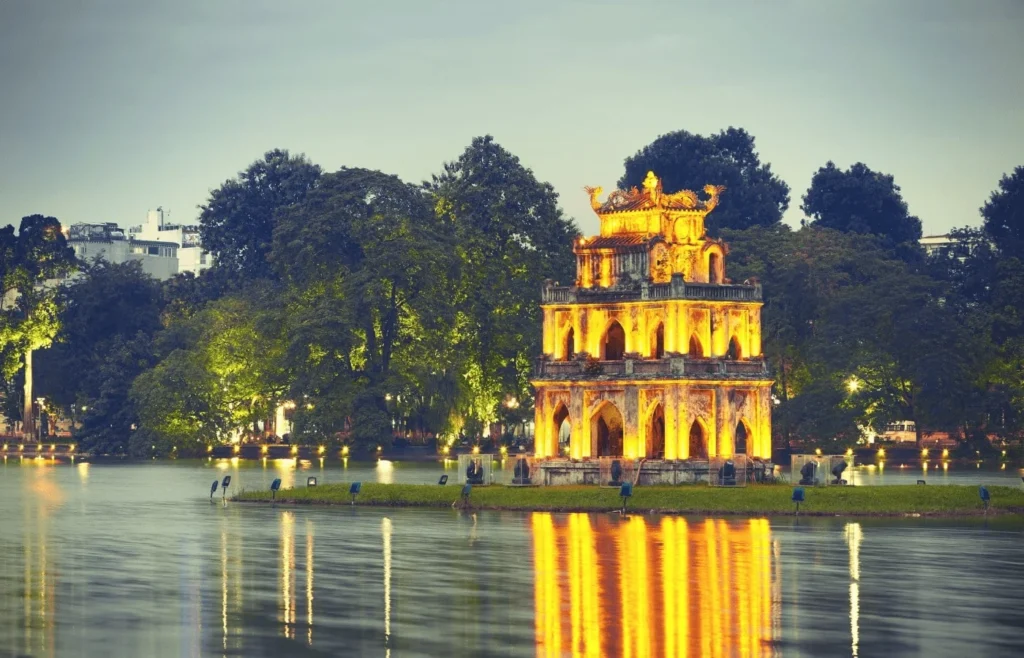
First stroll around Hoan Kiem Lake at nightfall, when Hanoians come out to walk. Legend has it that a giant turtle took back Emperor Le Loi’s magic sword here after his victory over the Ming, hence the name: Lake of the Returned Sword. Giant turtles really did live there; the last one died in 2016 and its remains are displayed in the temple on the islet.
Welcome dinner at a neighbourhood address: bún chả grilled over charcoal, served with a bowl of warm sweet-and-sour broth into which you dip noodles and herbs. Nothing ceremonious — it is Hanoians’ everyday lunch, eaten on a low stool, and one of the best dishes in the country.
Day 02Hanoi, the city of a thousand tradesB, L
French-speaking guide · About 5 km on foot
The Old Quarter is called “the thirty-six streets” and each one bears the name of a trade: Hang Bac the silversmiths, Hang Ma votive paper, Hang Thiec tinware, Lan Ong the Chinese herbalists. Guilds from the delta villages settled here by district from the 15th century, each with its temple and patron saint, each keeping the dialect and recipes of its home village. Several streets still practise their trade: you can hear tin being hammered from seven o’clock on Hang Thiec street.
You will notice that the houses are only two or three metres wide at the front but thirty or forty metres deep. Colonial, and before that imperial, tax was calculated on the width facing the street: for three centuries Hanoians built lengthwise, in a string of rooms separated by open-air courtyards that bring in air and light. The heritage house at 87 Ma May, open to visitors, shows exactly this layout.
Break for egg coffee, invented here in 1946: milk was impossible to find during the Indochina War, so a bartender at the Metropole whipped an egg yolk with condensed milk to replace it. It is drunk warm, with a spoon, in a second-floor café overlooking the street.
In the afternoon, the Museum of Ethnology. Fifty-four ethnic groups are presented seriously, with life-size houses rebuilt in the garden by craftsmen from their villages. It is the best possible preparation for the four days that follow: you will be able to tell a Tay house from a Hmong house, and read what a costume says, before sleeping in one.
Day 03Hanoi — Ninh BinhB, L, D
Road 100 km · 2 h · Boat 2 h
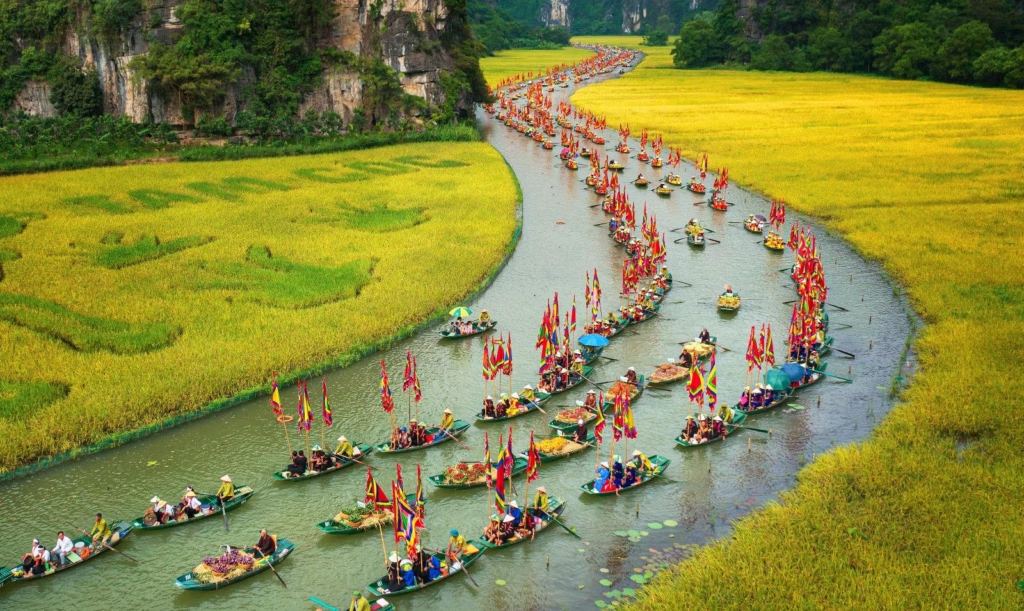
You leave the delta to the south and, in two hours, the landscape changes completely: the rice fields open up and limestone peaks rise out of the plain, vertical, isolated from one another. It is the same massif as Halong Bay, but above water. The sea covered this plain six thousand years ago, and the caves you will cross by boat were carved by it, at the sea level of the time. The region is nicknamed “Halong Bay on land”, which is geologically accurate.
Ninh Binh was the capital of Vietnam from 968 to 1010, under the Dinh and Early Lê dynasties. King Dinh Bo Linh, a former buffalo herder who unified the country, chose this amphitheatre of cliffs because it defended itself: a closed valley, a few passes to hold. Only two temples at the foot of the rock remain, rebuilt in the 17th century, but it is here that your guide tells the story of the founding of the country.
This history matters, because it explains the rest. Vietnam lived under Chinese domination for a thousand years, from 111 BC to 938, before regaining its independence at the battle of Bach Dang — won by planting iron-tipped stakes in the estuary to gut the enemy fleet as the tide went out. The country kept its script, Confucianism, mandarin administration, and a stubborn wariness.
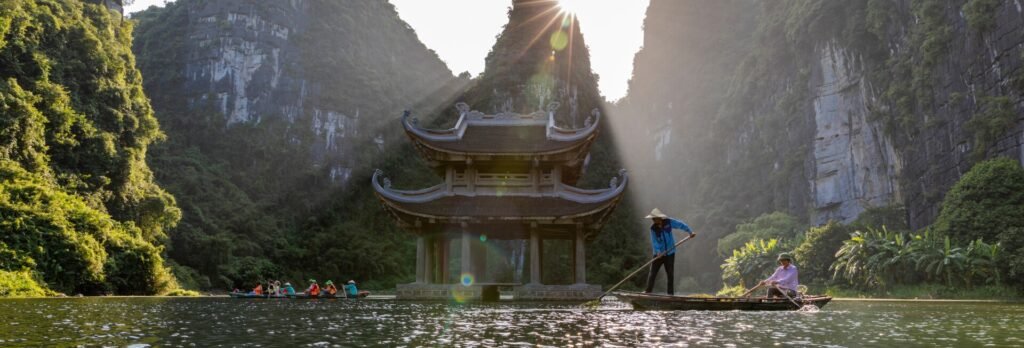
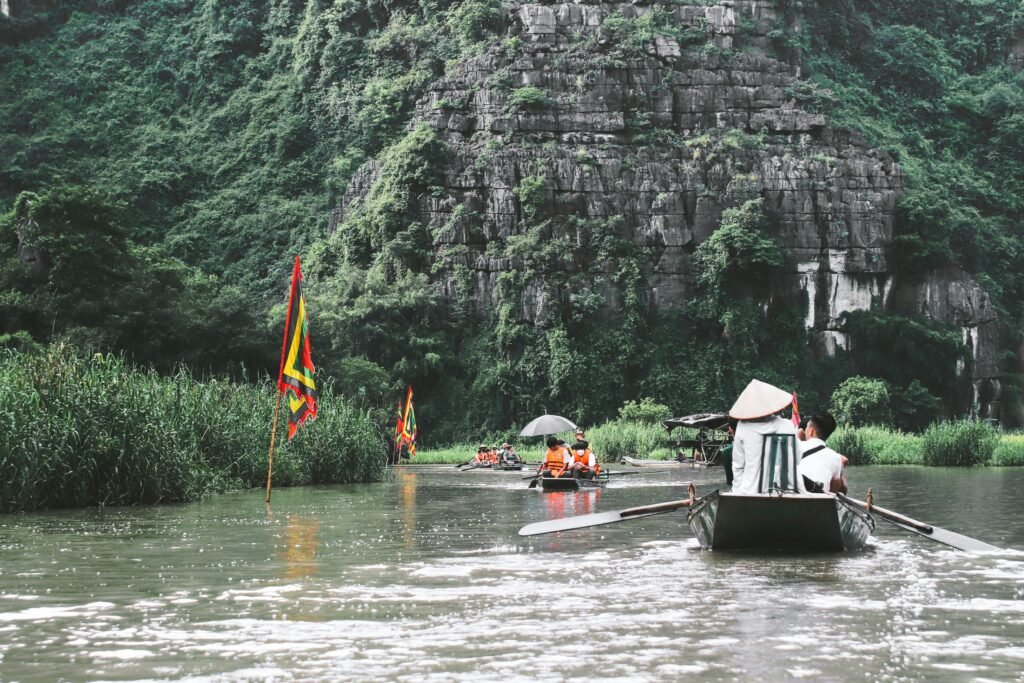
Rowing-boat outing after three in the afternoon, when the light becomes low and the groups have left. The rowers of Tam Coc row with their feet, a local speciality you won’t see anywhere else: sitting facing forward, they push the oars with the soles of their feet for two hours. They are paid a pittance by the site; a tip is not optional.
Day 04Ninh Binh — Pu LuongB, L, D
Road 100 km · 2 h 30 · Walk 2 h
Road west to the first real mountains. Pu Luong is a 175 km² nature reserve in Thanh Hoa province, home to ten thousand people, White Thai and Muong. It is not a park kept under glass but a cultivated valley you cross on foot, between terraces that give two harvests a year — unlike the far North, which gives only one.
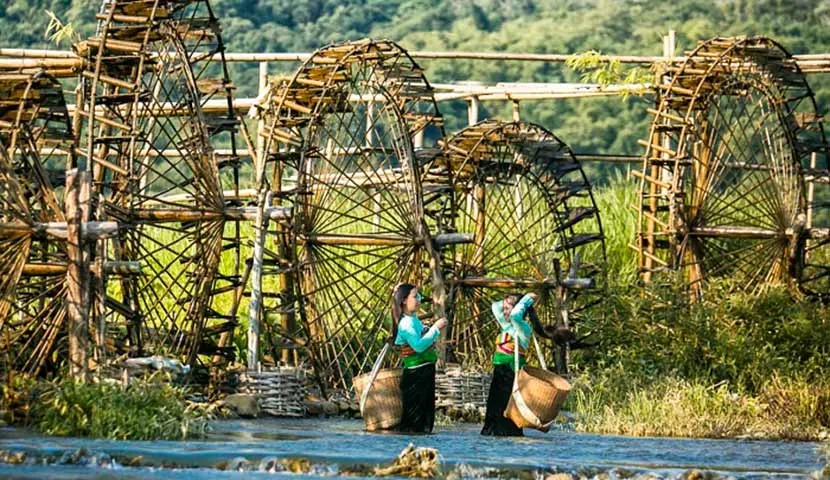
The afternoon walk links two hamlets along the paddy dykes. You will pass bamboo water wheels five to six metres in diameter, which lift water from the river to the upper terraces with no energy other than the current. Each wheel carries split-bamboo buckets that fill at the bottom and empty at the top into a chute. They are rebuilt every year, without nails or screws, by the village men — and are gradually being replaced by electric pumps, which is making the know-how disappear.
The White Thai have lived in these valleys since the 11th century, having come from Yunnan. Their language belongs to the same family as Thai and Lao, not Vietnamese; their script, derived from Sanskrit, is still taught in a few villages.
Night in a stilt house. The space underneath, once occupied by livestock, now serves as a common room. Dinner is eaten sitting on the floor around shared dishes — river fish grilled in a banana leaf, bamboo shoots, sticky rice cooked in a bamboo tube — with the rice spirit the family distils itself.
Day 05Pu Luong — Mai ChauB, L, D
Road 60 km · 2 h · Bike 12 km
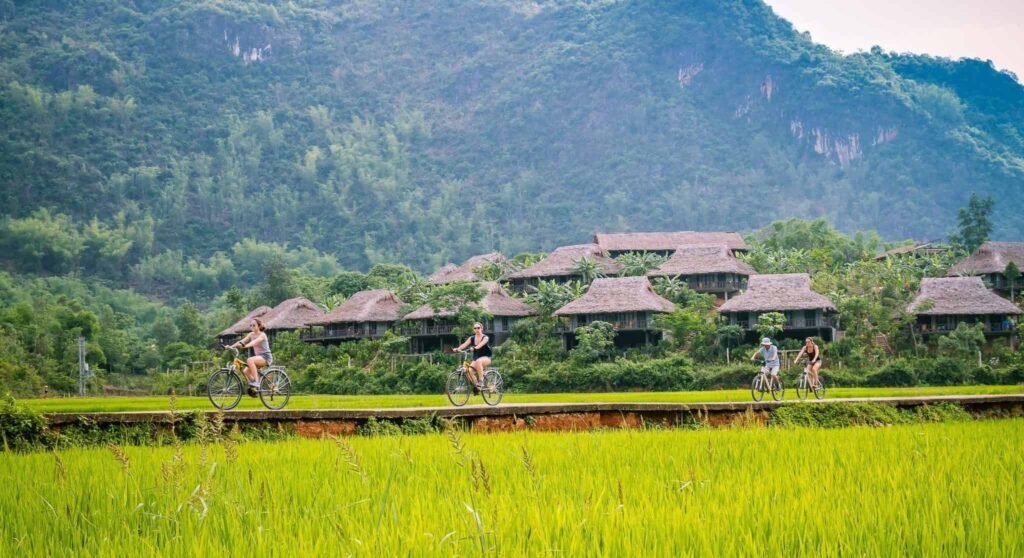
The Mai Chau valley is a perfectly flat floor ringed by limestone cliffs, farmed by the White Thai for centuries. You explore it by bike, on dirt tracks between the rice fields, from one village to the next: twelve kilometres without a single pass, which makes it one of the few valleys in the North accessible to all levels.
Women here weave on treadle looms set up under the houses. Thai brocade reads like a text: each geometric motif belongs to a village, sometimes to a family, and a bride’s blanket takes several months of work. The diamonds represent the scales of the water snake, the zigzags mountain ridges, the hooks ferns. You will see the difference from the industrial pieces sold in markets as soon as someone has shown you once: hand-spun cotton thread is irregular, the reverse side is clean, and plant dyes fade rather than change colour.
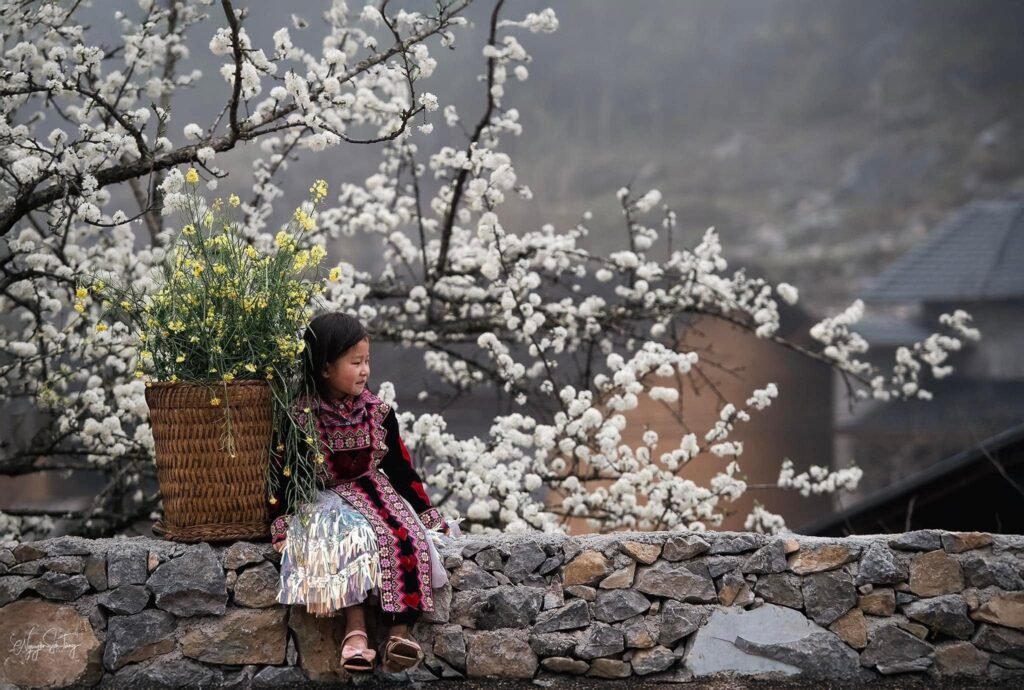
A word on indigo, since you will see it everywhere in the North. Dyeing is done cold in a vat of leaves fermented for weeks; the cloth has to be dipped and drained twenty times to obtain the blue-black of Hmong costumes. The dyers’ hands stay blue for several months a year, and it is a sign of skill, not dirt.
Free late afternoon. The best moment in Mai Chau happens without a programme: children cycle home from school, buffaloes come back up from the fields along the road, and mist falls on the valley around five o’clock.
Day 06Mai Chau — Lan Ha BayB, L, D
Road 250 km · 4 h 30 · Night on board
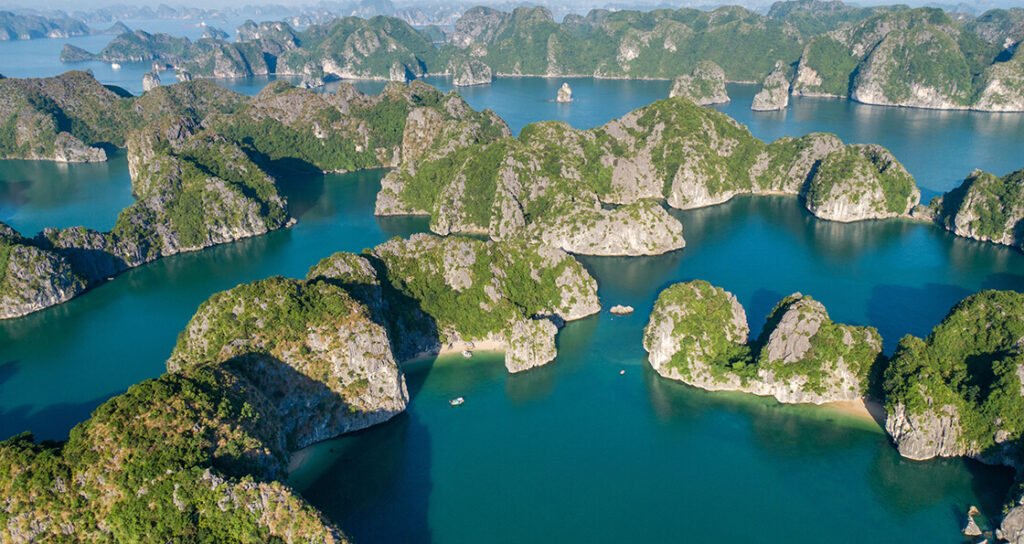
Crossing the delta towards the sea, then boarding a small junk in Lan Ha Bay in the early afternoon — the southern extension of Halong Bay. The same limestone, the same landscape, but a fraction of the traffic: Halong receives several million visitors a year, Lan Ha a small share, and it has sandy beaches in enclosed coves, which Halong hardly has.
These peaks are the remains of a limestone plateau formed three hundred million years ago at the bottom of a warm sea, from accumulated shells and corals. Slightly acidic tropical rain dissolved it over millions of years, carving caves and isolating towers; then the rise in sea level after the last ice age drowned the valleys. What you see sticking out of the water is only the top of a much higher relief, whose feet are a hundred metres below the surface.
Kayaking at the end of the day in an enclosed lagoon, reached through a sea tunnel that the tide opens for only a few hours a day. These inner lagoons shelter isolated ecosystems; some have their own species of crab or gecko, having had no exchange with the outside for millennia.
In the evening, the bay goes still. There is not a single engine; you hear fish jumping and ropes creaking. Night at anchor.
Day 07Lan Ha Bay — HanoiB, L
Morning cruise · Road 3 h
Early rise: the first hour of the day is the best of the cruise. The water is a mirror, mist still clings to the peaks, and the day boats have not yet arrived. Tai chi session on the upper deck for those who wish, breakfast at anchor.
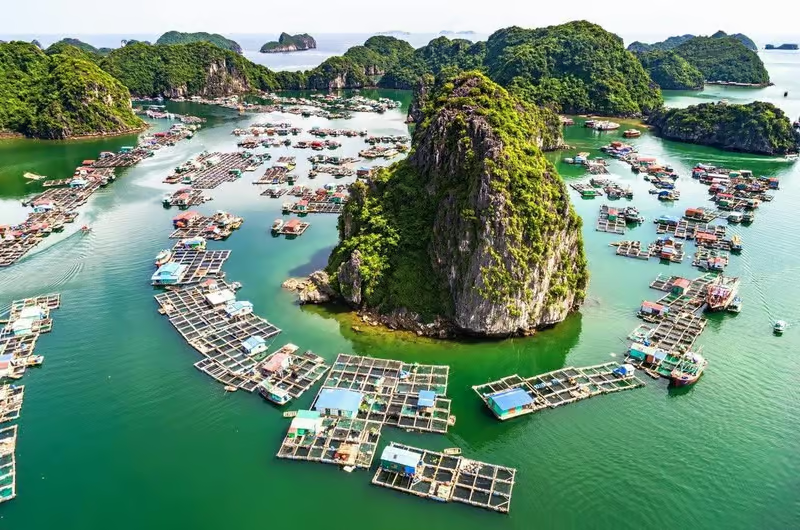
Sailing to the floating village of Cai Beo, one of the oldest in the country. Excavations there have uncovered a Neolithic culture seven thousand years old: fishermen already lived there when the sea had just risen. Today, a few dozen families live in houses set on floating drums, with the school, the grocery and the temple on neighbouring rafts. Many have never lived on land.
Raising fish and grouper in cages under the houses long kept the bay alive. The authorities have reduced the number of rafts since 2014 for water quality, and some of the fishermen have been rehoused on land, where many have no trade. It is one of the trade-offs that tourism imposes everywhere in the region — between preserving a landscape, preserving the water and preserving a way of life — and your guide will talk to you about it frankly rather than glossing over it.
Disembarkation around noon, return to Hanoi by motorway. Free evening in the Old Quarter: the right moment to go back to a place you spotted on the first day, now that you know how to order.
Day 08Hanoi — DepartureB
Transfer 40 km · 45 min
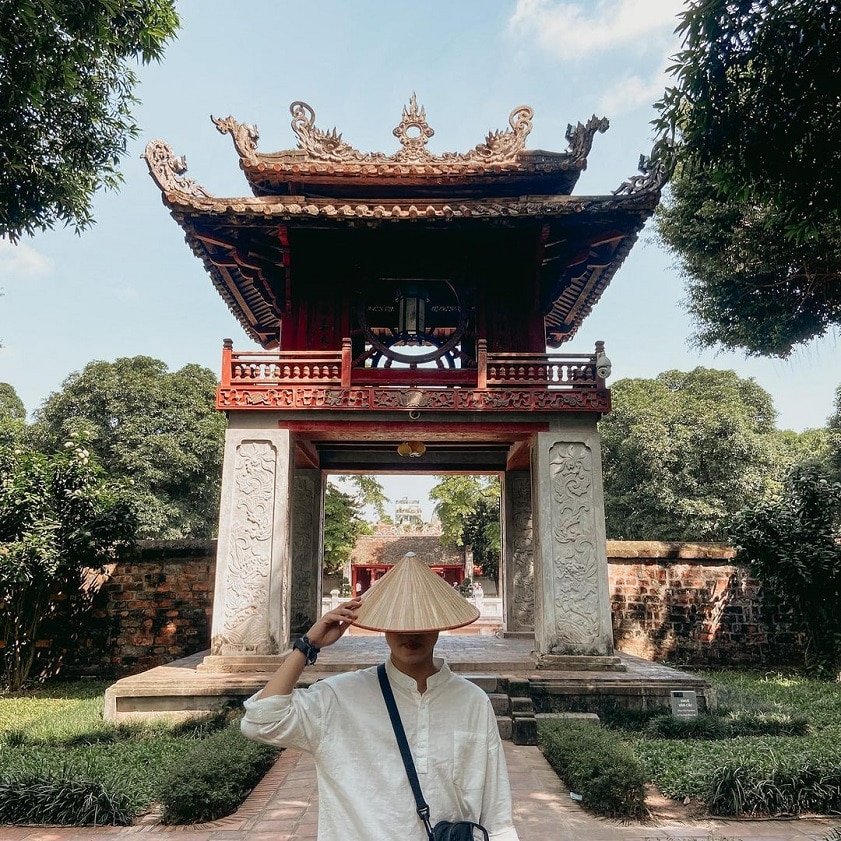
Depending on your flight time, a last morning in Hanoi. We suggest the Temple of Literature, founded in 1070 and in 1076 the country’s first university — the Quoc Tu Giam, “college for the sons of the nation”. Mandarins were trained there for seven centuries.
Eighty-two stone steles carried by turtles bear the names of those who passed the mandarin examinations between 1442 and 1779. The system was, in principle, open to all sons of peasants: you rose by examination and not by birth, and a family could change its station in a generation if one of its members succeeded. The exams lasted several days, in cells, under supervision; the pass rate was around one per cent.
That explains something you will have noticed during the trip: the place of school in Vietnamese families. It is nothing new. It comes from a thousand years of a system in which study was the only possible way up, and it has survived colonisation, war and communism.
It is the right way to close this tour. In eight days you will have seen a delta, an emerged limestone massif, two mountain valleys and a bay; the temple reminds you that this country was also built on examinations, scholars and poems.
Transfer to Noi Bai airport, three hours before the flight.
Continue
Other tours you might like
 The essentialsVietnam in 10 daysHanoi — Ninh Binh — Lan Ha Bay — Hue — Hoi An — Saigon10 days / 9 nightsfrom €1,500
 The essentialsEssential Vietnam — 12 daysHanoi — Ninh Binh — Lan Ha Bay — Hue — Hoi An — Saigon — Mekong Delta12 days / 11 nightsfrom €1,740
 The essentialsFrom the North to the Mekong, on to CambodiaHanoi — Ninh Binh — Lan Ha Bay — Hue — Hoi An — Saigon — Mekong Delta — Chau Doc14 days / 13 nightsfrom €1,990