A novel read before departure changes a trip more than three guidebooks. Here is what to read and watch — telling apart what Vietnam says about itself from what France has said about it.
Four Vietnamese voices
Bảo Ninh, The Sorrow of War (1990). A northern soldier goes back to collect the bodies where he fought, and the story unravels like his memory. It is the great Vietnamese novel about the war, written by a veteran, and there is nothing heroic about it — which earned it years of trouble with the censors. If you read only one book, read this one.Nguyễn Huy Thiệp, short stories. The driest and most biting prose in modern Vietnamese literature. His stories from the 1980s depict a countryside where money is arriving, elders are losing their grip and nobody is entirely honest. You understand post-war Vietnam better than in any essay.Dương Thu Hương. A former communist youth volunteer turned dissident, then exiled in Paris. Her novels look squarely at what victory cost women and families. An essential counterpoint to the official narrative you will hear in museums.Kim Thúy, Ru (2009). A hundred pages in fragments about fleeing by boat and arriving in Quebec, written in very pure French. It is the book to put in the hands of someone who knows nothing about Vietnam: it can be read in two hours and never quite closes.
The French view, and what it says about France
Marguerite Duras, The Sea Wall (1950) and The Lover (1984). Duras grew up in Indochina and lived the poverty of downwardly mobile whites there, which makes her view far more interesting than that of ordinary colonial literature. The Sea Wall is the harder of the two: a mother ruined by a land concession the administration sold her knowing it was liable to flood.These books should be read for what they are: great French literature, in which the Vietnamese almost always remain in the background. That is precisely why it is better to read them alongside Bảo Ninh rather than instead of him.Linda Lê and Anna Moï, both born in Vietnam and writing in French, take the opposite position: from inside the French language, they look at the country they left. And Việt Thanh Nguyễn, with The Sympathizer (Pulitzer 2016), does the same in American English, in the form of a spy novel.
Reading Duras before you go is useful. Reading only Duras is visiting Vietnam through the window of a colonial villa.
Films
Trần Anh Hùng is the director to know. The Scent of Green Papaya (1993) — Caméra d’Or at Cannes — is a sensory chamber piece about a young maid in a 1950s Saigon house: almost no dialogue, everything conveyed through gestures and sounds. Cyclo (1995), Golden Lion in Venice, is its exact opposite: violent, nocturnal Saigon. The Vertical Ray of the Sun (2000) shows three sisters in Hanoi, and it is the most beautiful filmed portrait of the city.Indochine (Régis Wargnier, 1992) remains the film most French people have seen. Superb, romantic, and best watched as a work about France rather than Vietnam. Many scenes were shot in Halong Bay and Huế, and you will recognise the settings on the spot.Đặng Nhật Minh, When the Tenth Month Comes (1984): a young widow hides her husband’s death from her dying father-in-law. Northern Vietnamese cinema, slow, rural, very beautiful, and rarely shown abroad.Finally, for the war seen from America, Ken Burns’s documentary series (2017) is the most complete synthesis available — ten episodes, with many Vietnamese testimonies from both sides, which sets it apart from Hollywood fiction.
What to read depending on where you are going
Hanoi — The Vertical Ray of the Sun for the atmosphere, Nguyễn Huy Thiệp for substance.
Huế and the Centre — The Sorrow of War : a large part of the novel takes place on these passes.
Saigon — Cyclo, then The Sympathizer for the fall of 1975 and exile.
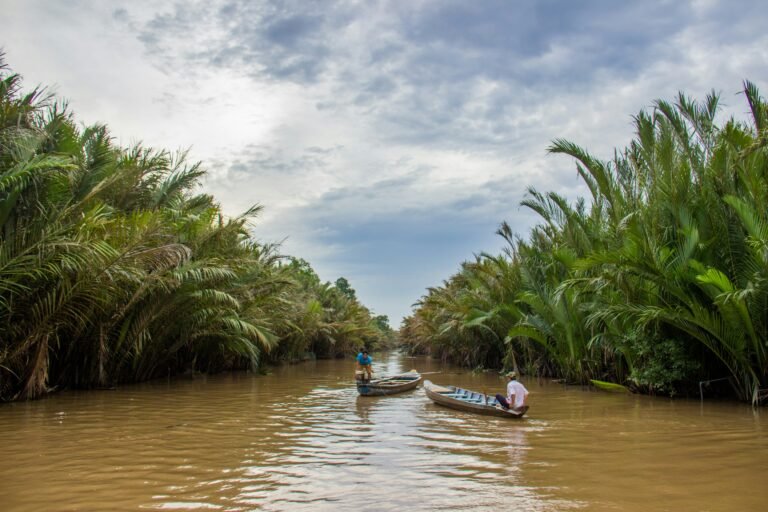
The Mekong Delta — the short stories of Nguyễn Ngọc Tư, whose world is entirely one of canals and boats.
The mountainous North — little translated literature; ethnography takes the place of the novel here.
A tip from the ground: read before, not during. The trip itself demands enough attention, and a book read beforehand transforms what you see without taking up your evenings.
The great classic: the Tale of Kiều
No book matters as much to Vietnamese people as the Tale of Kiều, the long poem by Nguyễn Du written at the beginning of the 19th century. It tells of the misfortunes of a young woman who sacrifices herself to save her family, and generations of Vietnamese know verses of it by heart. It is available in French translation. Reading it, even in part, opens a door onto the Vietnamese sensibility: the sense of duty, fate, loyalty to the family.
Comics, a good way in
French-language comics have talked a great deal about Vietnam in recent years, often written by authors of Vietnamese origin. Clément Baloup, in Quitter Saigon, tells the stories of the Viêt Kiều, Vietnamese people abroad. Marcelino Truong, in Une si jolie petite guerre, looks back on his childhood in Saigon in the early 1960s. They are excellent reads for teenagers and adults alike before departure.
Reading before, during and after
Before departure, a novel or a comic book whets the appetite and raises questions. During the trip, a book linked to the stage, read in the evening in Huế or Hanoi, gives depth to what you saw during the day. And on your return, it is often when you understand best: many of our travellers tell us they read about Vietnam mostly after going there.
Poetry in everyday life
In Vietnam, poetry is not confined to books. Ca dao, short folk poems passed on by word of mouth, are recited in families, sung as lullabies and quoted in conversation. Many follow the lục bát metre, alternating lines of six and eight syllables, the very metre of the Tale of Kiều. Ask your guide to recite one for you: it is often a lovely moment.
Where to find them
Most of these titles exist in paperback and are easy to find. On the spot, Hanoi and Saigon have a few bookshops with foreign-language shelves, and boutique hotels often keep a book-swap shelf.Avoid, however, the bound photocopies sold in the street: they are counterfeits, often with missing or jumbled pages, and the author gets nothing. The price of a real book in a Vietnamese bookshop remains modest.We are happy to slip two or three titles into the travel booklet we prepare before your departure, chosen according to your itinerary. Just tell us whether you prefer novels, history or travel writing.
Which book should I start with if I read only one?
The Sorrow of War by Bảo Ninh, if you can take a hard book. Ru by Kim Thúy if you prefer something short and luminous: a hundred pages, two hours of reading.
Do you need to have seen <em>Indochine</em>?
It is not essential, but it is enjoyable: you will recognise Halong Bay and Huế on the spot. Just keep in mind that it is a French film about colonial France, in which the Vietnamese characters remain in the background.
Are there recent Vietnamese films?
Yes, and the local industry has been very active for about ten years, especially in comedy and family films. Few are distributed abroad. Your guide will tell you what everyone is watching right now — it often makes for a good conversation.
Can you find books in French or English on the spot?
A few bookshops in Hanoi and Saigon have foreign-language shelves, and many boutique hotels keep a book-swap shelf. Don’t buy the bound photocopies sold in the street: missing pages are frequent, and nothing goes to the author.
What to read to children before the trip?
Translated Vietnamese folk tales work very well from age six, especially those of the legendary Lạc Long Quân and the fairy Âu Cơ — the story of the hundred eggs, which every Vietnamese child knows. It gives them a key to understanding the temples.
Do you prepare a personalised list?
Yes, in the travel booklet handed over before departure: two or three titles chosen according to your itinerary and tastes. Just tell us whether you prefer novels, history or travel writing.
Putting it into practice
The tours where you experience what this article is about
Audience measurement. We would like to know which pages are useful to you, using Google Analytics. Nothing is stored without your consent, and you can change your mind at any time. Learn more



 The essentialsVietnam in 15 daysHanoi — Pu Luong — Ninh Binh — Lan Ha Bay — Hue — Hoi An — Saigon — Mekong Delta15 days / 14 nightsfrom €2,070