The Mid-Autumn Festival: the night of children and lanterns
It is the second festival of the Vietnamese calendar after Tết, it falls at the full moon in September or October, and it belongs entirely to children. If your trip coincides with it, change your plans to be in town that evening.
When it falls, and why that evening
The Tết Trung Thu is celebrated on the fifteenth day of the eighth lunar month, in other words at the full moon nearest the autumn equinox. In the Gregorian calendar, that falls between mid-September and early October depending on the year.The date isn’t arbitrary. Originally it was a farming festival: the eighth-month rice harvest is in, work in the fields pauses, and the moon is at its highest and brightest of the year. Delta farmers watched the moon that night to predict the next harvest: bright yellow meant a good year, orange a drought, pale and veiled meant rain.
The harvest is in, the fields fall quiet, and the moon is at its brightest of the year.
Like Tết, the festival has equivalents throughout East Asia — China, Korea and Japan celebrate a version — but the Vietnamese one stands out on one point: it has become above all a children’s festival, which is the case nowhere else.
The lanterns, and what they used to be
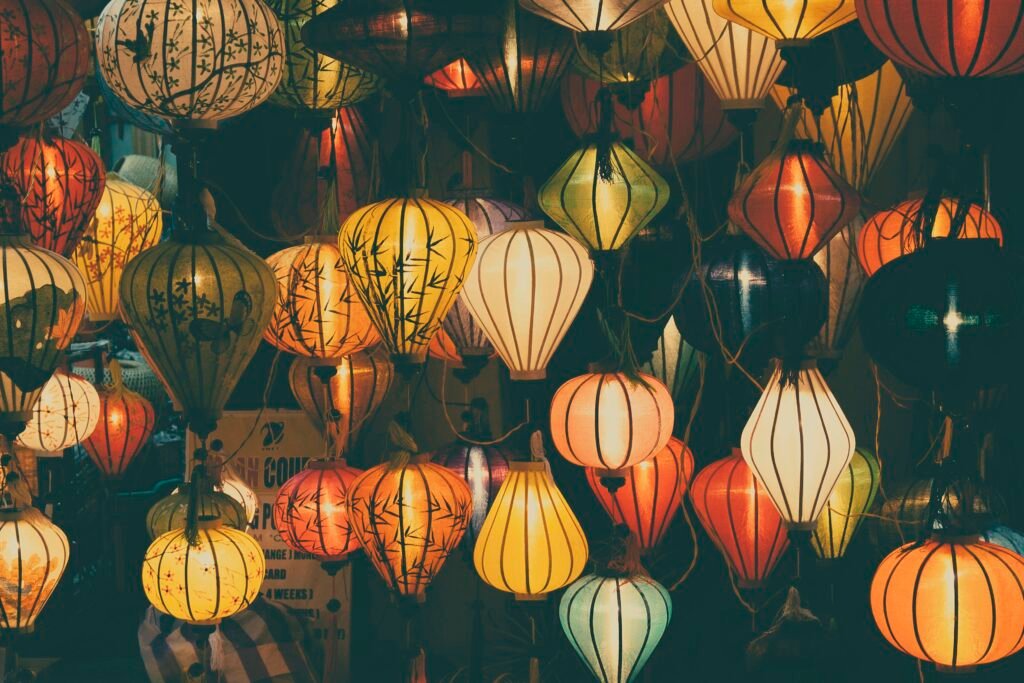
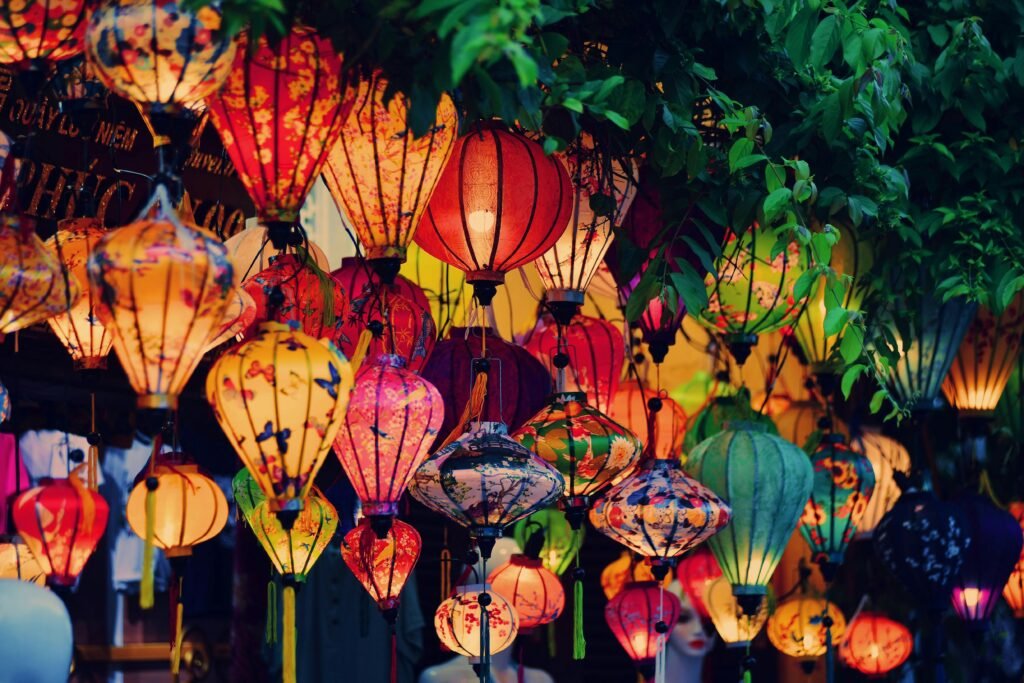
In the evening children parade with candle-lit lanterns. The traditional shapes have meaning: the five-pointed star, the carp, the butterfly, and above all the revolving lantern, the đèn kéo quân, in which an inner cylinder turned by the heat of the candle makes silhouettes of soldiers march across the sides.This revolving lantern is a remarkable object: it is an 11th-century heat engine, and also a teaching aid, since it showed historical scenes that parents would explain. It is rare today, replaced by battery-powered plastic lanterns; a few workshops in Hanoi and Hoi An still make it.The lantern-making villages are worth a detour. Bao Dap, in Nam Dinh province, has made lanterns for a century and works flat out six weeks a year; Hang Ma street in Hanoi becomes impassable in the days before the festival, covered in red and gold from the ground to the first floor.
The mooncake, and the trade war it started
The bánh trung thu comes in two forms: the bánh nướng, baked, with a golden crust pressed in a carved wooden mould, and the bánh dẻo, unbaked, made with white, translucent glutinous rice dough. The classic filling mixes lotus seeds, watermelon seeds, ham, Chinese sausage, kaffir lime leaves and a salted duck egg yolk at the centre — representing the full moon.It is rich, very sweet, and often puzzles Western palates. That doesn’t matter: its purpose is to be given more than eaten. In the weeks before the festival, boxes circulate between colleagues, clients and families, and the big brands compete with gift sets costing tens of euros. It has become a considerable market, and as much a social object as a culinary one.
The unicorn dance, which isn’t a dragon
Troupes of múa lân tour the streets in the days before the festival, stopping in front of the shops that call them over. Two dancers bring the animal to life — the one at the head carries all the weight and does the acrobatics, the one at the tail supports the leaps — accompanied by a drum, cymbals and a masked, broadly grinning character, Ông Địa, the spirit of the earth, who teases it with a fan.A useful clarification: it isn’t a dragon. The lân is the qilin, an auspicious creature with a lion’s head and a single horn. The dragon, rồng, is a much longer animal, handled by a dozen bearers, and appears mainly at Tết.The shopkeeper hands a red envelope to the troupe, which takes it in the animal’s mouth. The children follow. They are often neighbourhood teams, pupils who train for weeks and fund their club this way.
Where to experience it, and how
Three places stand out.
Hanoi, Hang Ma street and around Hoan Kiem lake. The street is closed to traffic on weekend evenings and becomes a corridor of lanterns. It is the densest and most photogenic version.
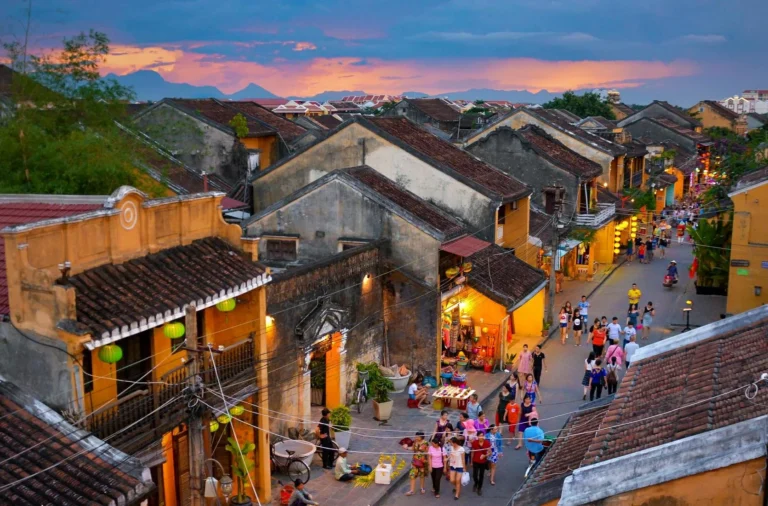
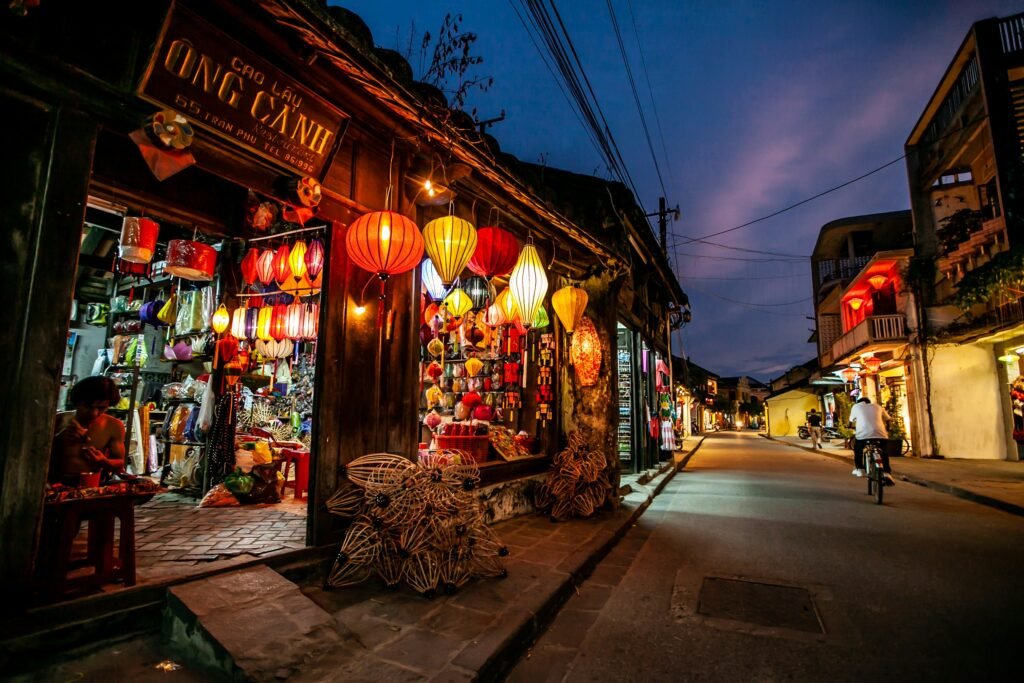
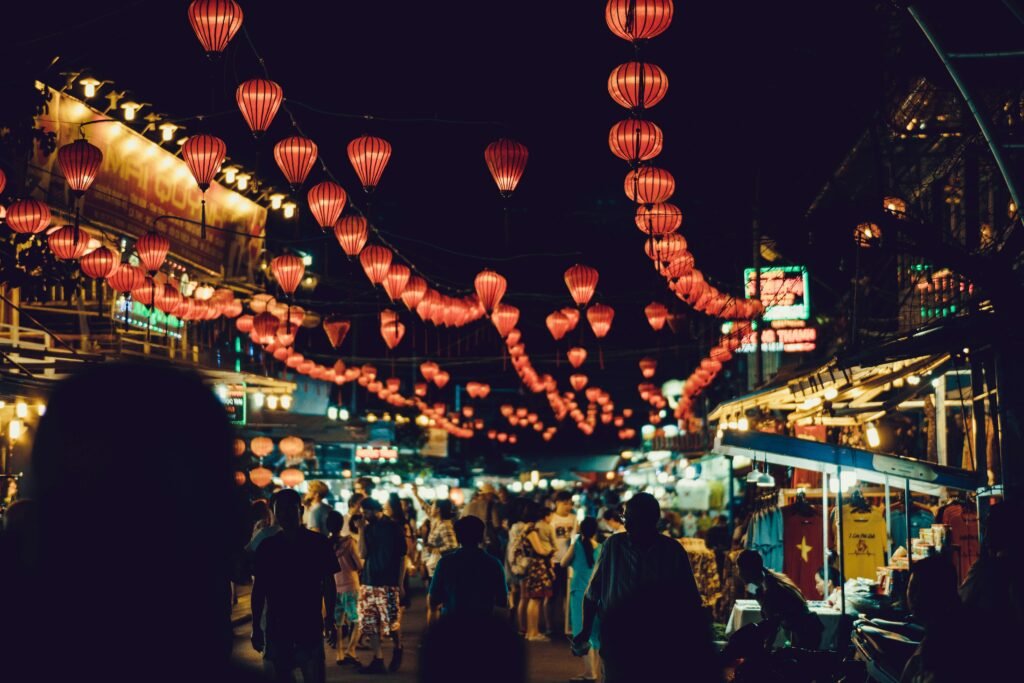
Hoi An, where the festival coincides with the full-moon night that already switches off the old town’s electric lighting. It is the most spectacular combination in the country, and also the busiest: book well in advance.
A village, if you are on tour at the time. The festival there is more modest and infinitely more real: the children parade down the main lane, mooncakes are shared on a mat in front of the communal house, and you will be asked to sit down.
If you are travelling with children, buy them a lantern as soon as you see one: they will join the parade without anyone batting an eyelid. It is one of the rare occasions when a traveller stops being a spectator.
Hang Ma Street in Hanoi
In the weeks before the festival, Hang Ma Street, in Hanoi’s Old Quarter, is covered with lanterns in the shape of stars, fish and rabbits, masks and toys. Families come to buy decorations and have their photos taken, and the crowds are considerable in the evening. It is one of the prettiest sights of the year in the capital.
Mooncakes
There are two main families of mooncakes: bánh nướng, baked and golden, filled with lotus seeds, beans, dried fruit or a salted egg yolk, and bánh dẻo, white and soft, made with sticky rice. They are given in boxes to family, friends and business partners, and enjoyed in thin slices with tea.
Hoi An, full moon night
In Hoi An, on every full moon night, the old town’s electric lighting is dimmed and lanterns take over. The night of the Mid-Autumn Festival is the high point, with unicorn dances and children parading with their lanterns along the river.
What the festival says about the country
A farming festival turned over to children is no small thing. The explanation given locally is simple and probably right: in the eighth lunar month, parents were finally free after the harvest, and devoted that evening to the children they had had little time for during the work in the fields.This place of the child is found everywhere in Vietnam, and it often surprises Western travellers: children are in restaurants late at night, taken to festivals, touched, complimented. The Mid-Autumn Festival is its expression in the calendar.If your trip falls on this date — mid-September to early October — let us know. It is also the best time of year for the North, with the golden rice terraces of Mu Cang Chai and Ha Giang, and a whole itinerary can be built around it.
The fifteenth day of the eighth lunar month, between mid-September and early October depending on the year. The date changes every year; ask us when you set your dates.
Is it a public holiday in Vietnam?
No. Unlike Tết, Mid-Autumn isn’t a public holiday: shops, museums and transport run normally. The festivities take place in the evening.
How is it different from Tết?
Tết is the lunar new year, in January or February, lasting a week; everything closes and the whole country travels. Mid-Autumn lasts one evening, nothing closes, and it belongs to the children.
What is a mooncake?
A cake pressed in a carved mould, filled with lotus seeds, dried fruit, sometimes ham, with a salted duck egg yolk at the centre representing the full moon. It comes in a baked version and an unbaked rice-dough version.
Where is the best place to spend it?
Hanoi for the sheer density, on Hang Ma street and around the lake. Hoi An for the combination with the night without electricity, but book well ahead. A village for authenticity.
Is it worthwhile with children?
It is probably the best evening of the year to be travelling in Vietnam with children. Buy them a lantern and they will join the parade; nobody will be surprised.
Putting it into practice
The tours where you experience what this article is about
Audience measurement. We would like to know which pages are useful to you, using Google Analytics. Nothing is stored without your consent, and you can change your mind at any time. Learn more


 Family holidaysVietnam with the family — 15 daysHanoi — Ninh Binh — Lan Ha Bay — Hoi An — Mekong Delta — Saigon15 days / 14 nightsdès 1 250 €