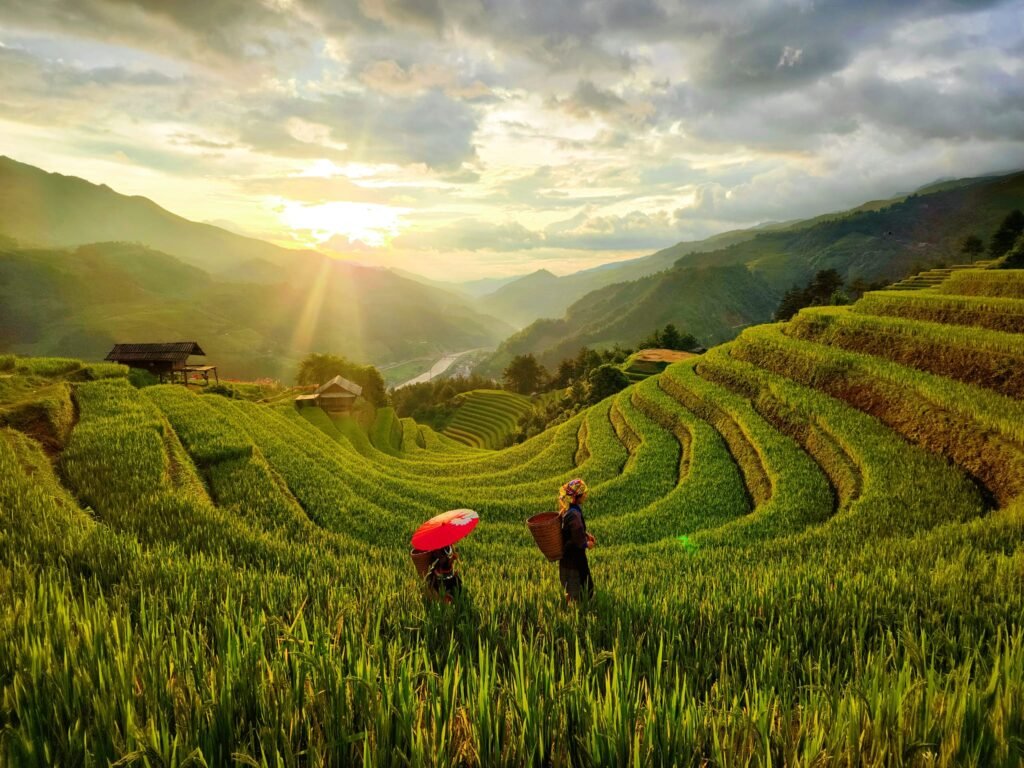
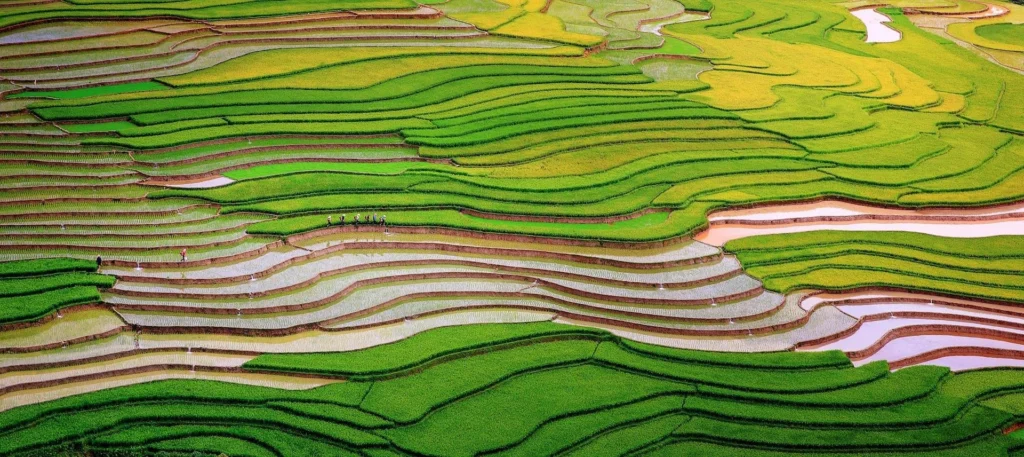
Whole hillsides sculpted into terraces over seven hundred metres of elevation, listed as national heritage. For three weeks a year, in September, they turn golden — and it is probably the most beautiful farming landscape in South-East Asia.
In brief
Best time
Mid-September to early October for the golden rice fields; May–June for the flooded terraces
Getting there
6 h from Hanoi by road, including 2 h of passes; no train or airport
How long
Two nights on site; one leaves only half a useful day
Combine with
Sa Pa over the O Quy Ho pass, Pu Luong on the way down, Nghia Lo on the way
What you come to see
Two thousand hectares of terraced rice fields, cut into forty-degree slopes by the Hmong for over a century. The three communes of La Pan Tan, Che Cu Nha and Ze Xu Phinh have been a national monument since 2007, and they are the ones people photograph.The difference from Sa Pa comes down to one word: scale. Here the terraces don’t line the road, they cover entire mountains, from the valley floor to the ridge line. You only see them properly from a pass or after an hour’s climb on foot.
Here the terraces don’t line the road: they cover entire mountains, from the valley floor to the ridge.
A three-week window
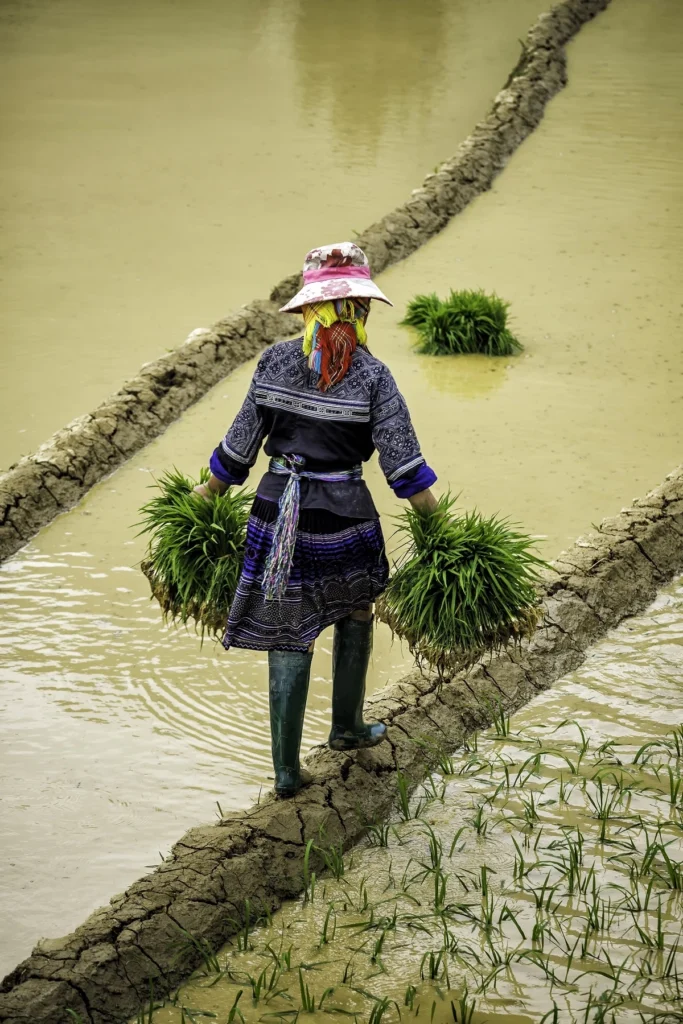
Mu Cang Chai’s rice gives only one harvest a year, and the colour everyone comes for doesn’t last long. Allow from mid-September to the first days of October: the rice is ripe, the terraces turn from green to yellow and then gold, and the harvest begins.The second window, less well known and just as beautiful, is May and June: the terraces are then filled with water before transplanting and reflect the sky, step after step. From November to April, the fields are bare and brown — the region remains beautiful, but it is no longer the same photograph.
The road, which is part of the trip
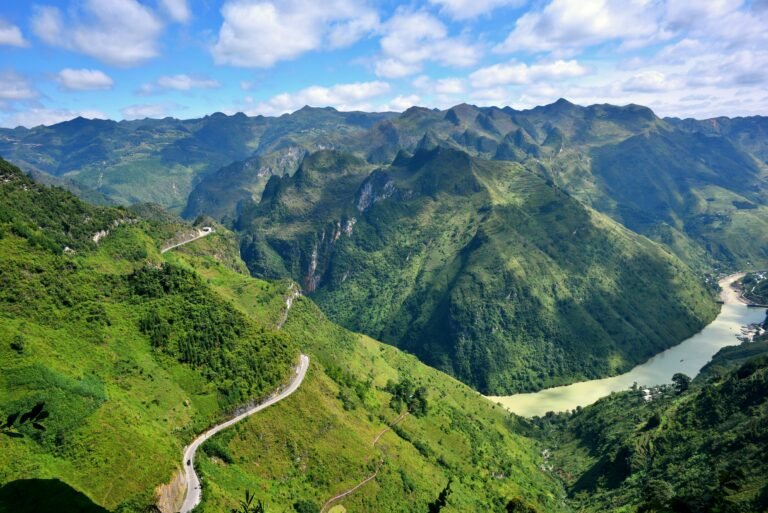
You arrive over the Khau Pha pass, one of the four great passes of the North, thirty kilometres of bends on the mountainside with the Tu Le valley below. Stop in Tu Le: a sticky rice famous throughout the country is grown there, and the village hot springs are used by the White Thai.From Hanoi, allow six hours, the last two entirely in the mountains. There is neither train nor airport, and that is good news: it is what keeps Mu Cang Chai away from mass tourism despite its photographic fame.
Walking between the terraces
The region must be earned on foot. Three routes recur in our programmes: the climb to La Pan Tan and its Mam Xoi, the hill shaped like an upturned bowl that has become the region’s image; the crossing from Che Cu Nha to Ze Xu Phinh, four hours from ridge to ridge; and the descent to the Hmong hamlets of the Nam Kat valley.Paths are narrow, often on the paddy dykes themselves, slippery after rain. Good shoes are enough, but a local guide is useful: the trails are not marked and change with the farm work.
Staying there
What is on offer is simple and will stay that way: Hmong and Thai guesthouses, a few wooden eco-lodges facing the terraces. Allow €20 to €40 a night in a homestay, €60 to €130 in a lodge. Heating doesn’t exist and October nights drop to twelve degrees at altitude: bring a fleece.Book well in advance for the golden season. The three weekends from mid-September to early October are stormed by Vietnamese photographers, and the number of beds on site is counted in hundreds, not thousands.
The mistakes we see most often
Coming in August thinking you will see golden rice: it is still green; the colour arrives in mid-September.
Staying only one night. Six hours on the road there, six back, for half a day on site.
Staying in the car. The best views are not from the road but an hour’s climb away.
Underestimating the cold of October nights, or the rain of July–August, which makes the paddy dykes impassable.
The calendar, and why the window is so narrow
Mu Cang Chai gives only one rice harvest a year. That is the essential difference from Pu Luong or Mai Chau, which give two, and it shrinks the golden period to three weeks.
Period
State of the terraces
Our view
Mid-September – early October
Golden, harvest
The window everyone is looking for. Book months ahead.
May – June
Flooding, mirrors
Just as beautiful, far less crowded. Our preference.
July – August
Intense green
Superb but very rainy; paddy dykes impassable, landslides.
October – November
Fields harvested
Dry air and crisp light for walking, but no more colour.
December – April
Bare earth
The region remains beautiful, but it is no longer the same photograph.
Compare with Sa Pa, a hundred kilometres away: the harvest there falls two to three weeks earlier, from late August to mid-September. If your dates are fixed for late September, this is where you should come, not there.
The three listed communes, and where to base yourself
La Pan Tan
This is where you find the Mam Xoi, the hill shaped like an upturned bowl that has become the region’s image. Thirty to forty minutes’ steep climb from the road, or ten minutes by motorbike taxi. The best time is the first hour of the day, before the mist lifts.
Che Cu Nha
The crossing from Che Cu Nha to Ze Xu Phinh takes four hours from ridge to ridge. It is the most beautiful walk in the region and you meet few people, even in high season.
Ze Xu Phinh
The highest of the three, the least accessible, with forty-degree slopes. Best kept for strong walkers.The three communes have been a national monument since 2007, which has frozen development: no new building can go up without authorisation, and that is what saved the landscape.
The road, and what it requires
Six hours from Hanoi, the last two entirely in the mountains, over the Khau Pha pass — thirty kilometres of bends on the mountainside, one of the four great passes of the North.There is neither train nor airport, and that is good news: it is what keeps Mu Cang Chai away from mass tourism despite its photographic fame. On the other hand, it means two nights minimum: six hours there and six back for half a day on site makes no sense.Stop at Tu Le, at the foot of the pass. A sticky rice famous throughout the country is grown there, and the village hot springs are used by the White Thai — open-air pools, a few thousand dong, and nobody but locals.
What a stay in Mu Cang Chai costs
Item
Indicative price
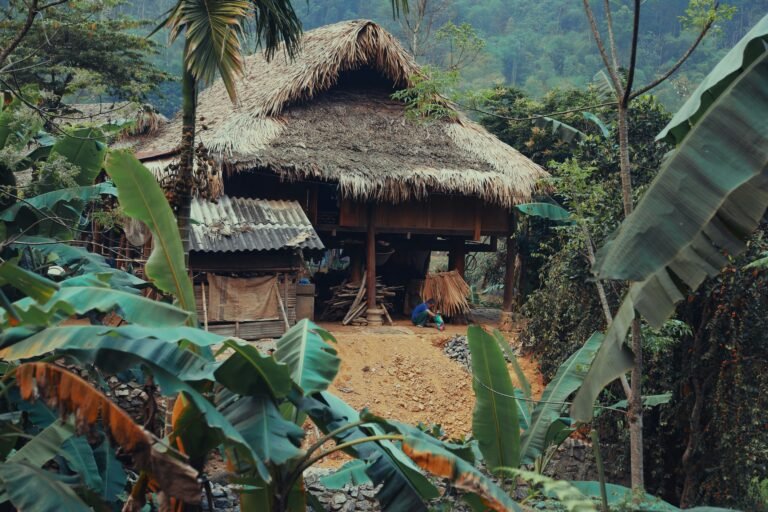
Night in a Hmong or Thai homestay
€20 – 40 for two
Night in an eco-lodge facing the terraces
60 – 130 €
Meal
3 – 7 €
Motorbike taxi to Mam Xoi
~ €3 return
Local guide for the day
20 – 35 €
Private car from Hanoi
€110 – 160 one way
Two precautions. Heating doesn’t exist and October nights drop to twelve degrees at altitude: bring a fleece. And book well in advance for the golden season — the number of beds on site is counted in hundreds, not thousands, and September weekends are stormed by Vietnamese photographers.
When exactly should you go for the golden rice fields?
Between 15 September and 5 October depending on the year and the altitude of the plots. We follow the ripening and adjust the order of the stops accordingly.
Can it be combined with Sa Pa?
Yes, the two are about four hours apart over the passes. It is the classic North-West loop, from five days.
Do you need to walk a lot?
No, most of it can be seen from the road. But going down into the terraces for an hour completely changes your perception of the place, and it is accessible to everyone.
Are there comfortable hotels?
Few. Accommodation is simple and must be booked well in advance for the rice season. If comfort is a priority, we will steer you towards Pu Luong instead.
Mu Cang Chai or Sa Pa for the golden rice fields?
It depends on your dates. Sa Pa harvests from late August to mid-September, Mu Cang Chai two to three weeks later, from mid-September to early October. Mu Cang Chai is also far less crowded.
How many nights in Mu Cang Chai?
Two at least. Six hours on the road there and six back for half a day on site makes no sense, and there is neither train nor airport.
Where can you see Mam Xoi?
In La Pan Tan, thirty to forty minutes’ steep climb from the road, or ten minutes by motorbike taxi for about three euros. Go at first light.
Audience measurement. We would like to know which pages are useful to you, using Google Analytics. Nothing is stored without your consent, and you can change your mind at any time. Learn more

 Off the beaten trackTrekking in the North-West — 11 daysHanoi — Mai Châu — Pu Luong — Nghia Lo — Mu Cang Chai — Thac Ba Lake — Hanoi11 days / 10 nightsfrom €1,650