People often ask whether Vietnam is Buddhist. The question misses the mark: the most widespread practice in the country is not a religion but ancestor worship, and the same person may pray to Buddha, honour Confucius and consult a geomancer without seeing the slightest contradiction.
Ancestor worship, before any religion
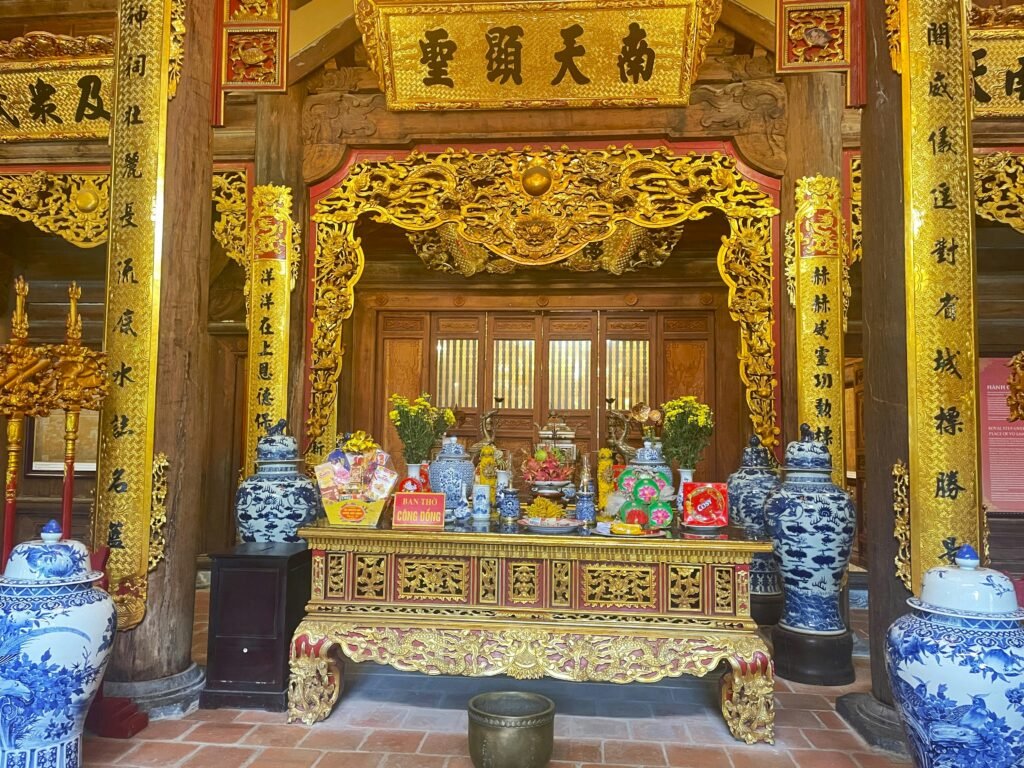
If you were to remember only one thing about Vietnamese spiritual life, it would be this: the most universal practice in the country is not a religion. It is ancestor worship, and it cuts across everything — Buddhists, Catholics, declared atheists.Every house, every shop, every office has an altar: a few photographs, an incense burner, fruit, sometimes a glass of alcohol and a lit cigarette if the deceased smoked. Incense is lit there in the morning, at the new and full moons, and on the giỗ — the anniversary of a death, which counts for more than a birthday.The logic is simple and nothing morbid: the dead remain part of the family and need to be looked after. In return they watch over the living. That is why they are told of a wedding, an exam, a house move — not to ask, but to inform.You will also see votive paper being burned: banknotes, houses, cars, cardboard phones, sent up in the smoke. The practice is massive in the seventh lunar month, the month of wandering souls, when the dead nobody claims are fed.
The three teachings, blended
Vietnam has not layered Buddhism, Confucianism and Taoism: it has fused them. This is called tam giáo, the three teachings, and it explains why the same person can pray to Buddha, respect a Confucian family hierarchy and consult a Taoist geomancer without seeing the slightest contradiction.Buddhism here is of the Mahayana tradition, from China, not Theravada as in Thailand or Cambodia — hence very different pagodas, monks in brown or grey robes rather than orange, and the presence of bodhisattvas, especially Quan Âm, the female figure of compassion found everywhere.Confucianism left the Temples of Literature, including Hanoi’s, founded in 1070, and above all a social structure: respect for elders, the value of study, a sense of family duty. It has no clergy and is not practised as such; it can be observed in the way a family talks at the table.To these add Catholicism — about seven per cent of the population, one of the highest proportions in Asia —, Caodaism, a syncretism born in 1926 in the South, and the worship of the Mother Goddesses, inscribed by UNESCO in 2016.
Telling a pagoda from a temple
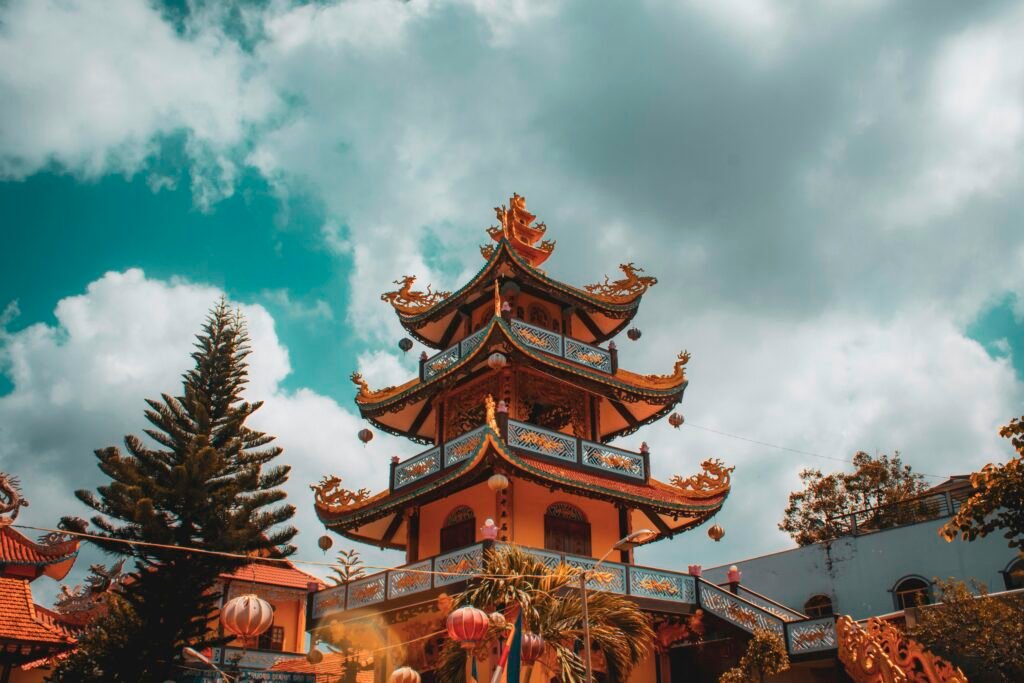
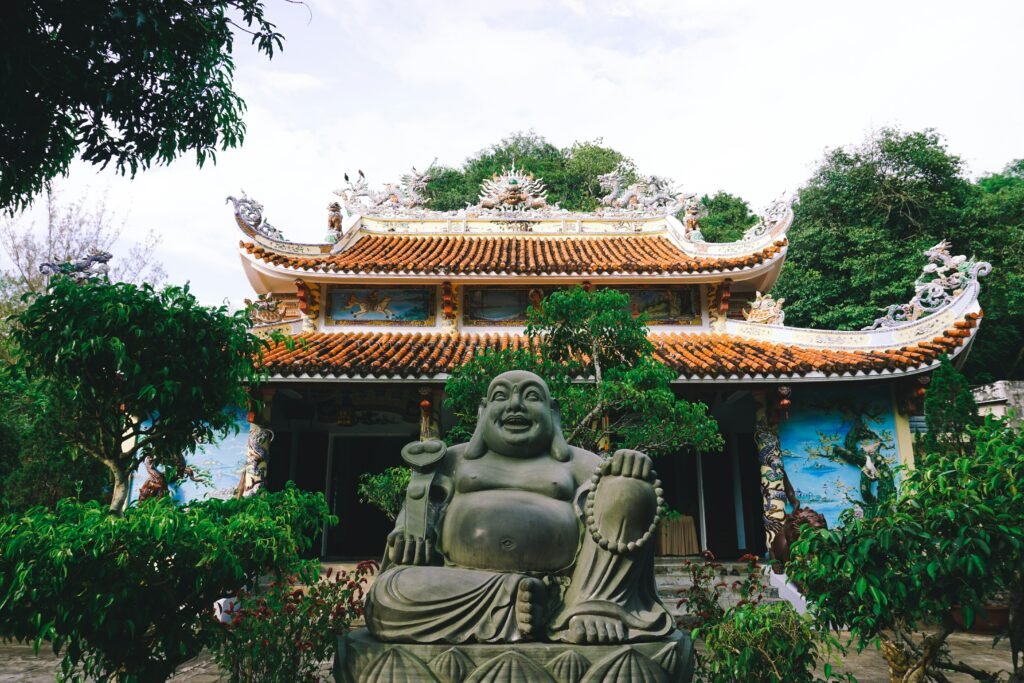
Travellers constantly confuse them, yet the distinction is clear. A pagoda (chùa) is Buddhist: you find statues of Buddha there, monks live there, people come to pray and eat vegetarian on moon days.A temple (đền) is dedicated to a historical figure or a popular deity — a general, a king, a goddess. There are no monks, only a caretaker. A communal house (đình) is the civic heart of the village: it houses the village’s guardian spirit and also served as town hall and court.A helpful detail: in a pagoda, the statues face the entrance and are arranged on tiers in order of hierarchy; in a temple, the main altar is single and often hidden behind a veil or a grille. And the Văn Miếu, the Temple of Literature, is Confucian: no Buddha, no deity, only Confucius and the steles of laureates.
You never ask a Vietnamese person what their religion is. You ask who is on their altar.
How to behave
Vietnamese places of worship are open, lively and welcoming. The rules are few, but they matter — and nobody will tell you them on site, out of politeness.
Shoulders and knees covered. A scarf in your bag is enough; some pagodas lend one at the entrance.
Take your shoes off before entering the main sanctuary, even if others don’t.
Never point your feet towards an altar or statue when you sit down. It is the most frequent blunder among Western visitors.
Three incense sticks, never an even number — even numbers are reserved for the dead. Hold them with both hands, at forehead level.
Don’t touch the head of a statue or of a child: the head is the most noble part of the body.
Photograph buildings freely, people praying and ceremonies never without consent. A monk will almost always agree if you ask.
The raised threshold of a pagoda door is stepped over, never stepped on: it is meant to stop evil spirits, who can’t lift their feet.
Offerings on the first and fifteenth days
On the first and fifteenth days of each lunar month, new moon and full moon, families and shopkeepers place offerings on their altars: fruit, flowers, incense, sometimes a full meal. On those days, pagodas are busier, and votive papers are burned in front of shops. Your guide will tell you if your visit coincides with one of these dates.
The small shop altars
Look down at floor level in shops and restaurants: you will often see a small altar dedicated to the earth spirit and the god of prosperity, with offerings, incense and sometimes a can of soda. It is greeted every morning when the shop opens. You should neither touch it nor put anything on it.
The worship of the Mother Goddesses
The worship of the Mother Goddesses, very much alive in the North, is celebrated through possession rituals, hầu đồng, inscribed on UNESCO’s intangible heritage list. To the sound of specific music, a medium successively embodies several spirits, changing costume for each one. Some ceremonies are open to respectful visitors accompanied by a guide.
What to see, and when
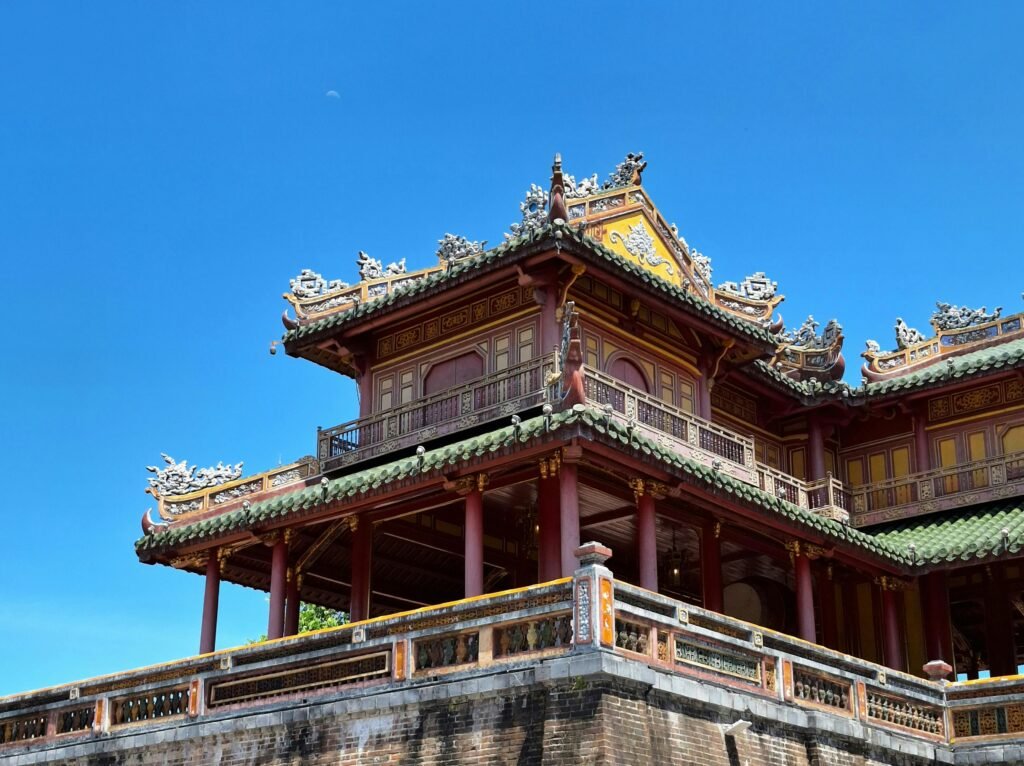
Days of new and full moon transform everything. The pagodas fill up, incense saturates the air, vegetarian kitchens run at full tilt. A visit on such a day has nothing in common with the same visit three days later, when you will only see a monument. We are happy to time a stop to these dates.In Hanoi, the One Pillar Pagoda and the Temple of Literature to understand the distinction, Ngọc Sơn temple on its islet for the atmosphere. In Huế, Thiên Mụ pagoda by the Perfume River, and the Buddhist cuisine of moon days, the most refined in the country.In the South, the great Caodaist temple of Tây Ninh holds four services a day in a setting like nothing else in the world — divine eye, dragon columns, worshippers in white, yellow and blue robes. The noon service can be watched from the upper gallery, in silence.And if the opportunity arises, attend a lên đồng ceremony of the Mother Goddess worship: a medium changes costume several times to embody different deities in turn, carried by an orchestra. It lasts for hours, nobody sells tickets, and it is one of the strangest and most beautiful things you can see in Vietnam.
Not exactly. Mahayana Buddhism is the dominant influence, but the most universal practice is ancestor worship, which is not a religion and is followed by Catholics as well as people who declare themselves non-religious. Official censuses therefore greatly underestimate the country’s real spiritual life.
What is the difference between a pagoda and a temple?
A pagoda (chùa) is Buddhist, with statues of Buddha and monks living there. A temple (đền) honours a historical figure or a popular deity and has no monastic community. The communal house (đình) houses the village’s guardian spirit.
How should you dress to visit a place of worship?
Shoulders and knees covered, and shoes that are easy to take off. A large scarf in your bag covers every case. Some very busy pagodas lend clothes at the entrance.
Can you offer incense yourself?
Yes, and the gesture is well received. Take three sticks — never an even number, reserved for the dead —, light them, hold them with both hands at forehead level, bow three times, then plant them in the incense burner.
Can you take photos in pagodas?
Buildings and courtyards, yes. People praying and ceremonies, only with consent — a glance is enough to ask. Never take a photo standing between a worshipper and the altar.
What is the best time to visit?
New-moon and full-moon days, when the pagodas are full and the vegetarian food at its best. We give you these dates when preparing the itinerary and can time a stop around them.
Putting it into practice
The tours where you experience what this article is about
Audience measurement. We would like to know which pages are useful to you, using Google Analytics. Nothing is stored without your consent, and you can change your mind at any time. Learn more


 The essentialsVietnam in 15 daysHanoi — Pu Luong — Ninh Binh — Lan Ha Bay — Hue — Hoi An — Saigon — Mekong Delta15 days / 14 nightsfrom €2,070