Vietnam and the sea: 3,260 kilometres of coastline and a life apart
No point in Vietnam is more than five hundred kilometres from the sea, and half the country lives less than a hundred away. Yet the Việt are historically a people of rice paddies, not seafaring — and that tension explains a lot, from the taste for fish sauce to the tensions in the South China Sea.
A rice-paddy people on the edge of the ocean
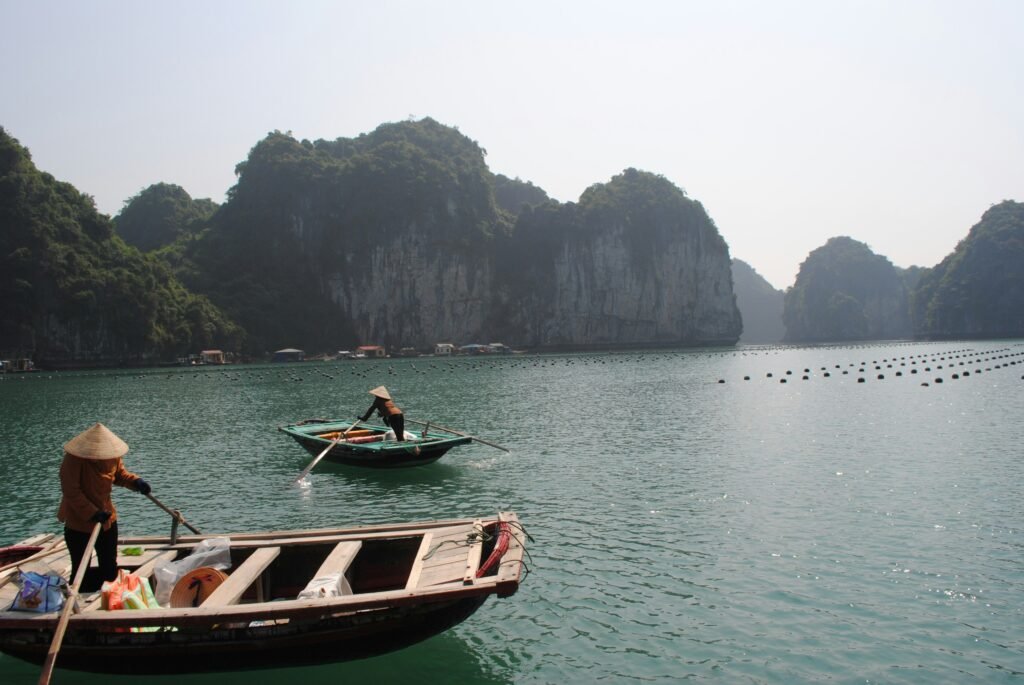
Vietnam has three thousand two hundred and sixty kilometres of coastline and more than three thousand islands. Its very shape — a narrow strip, fifty kilometres wide at Dong Hoi — means the sea is never far away.And yet Việt civilisation was built in the deltas, with its back to the ocean. Irrigated rice, dykes, the bamboo-ringed village: none of it looks out to sea. The great maritime powers of the region were the Cham, Hindu and mercantile, turned towards India and Java, whom the march south absorbed between the 15th and 17th centuries. Vietnam inherited their coastline without immediately inheriting their relationship with the sea.
Việt civilisation was built in the deltas, with its back to the ocean.
That has changed. Fishing and aquaculture now employ several million people and the country is among the world’s very top seafood exporters — shrimp, pangasius, tuna.
The round boat: invention or legend?
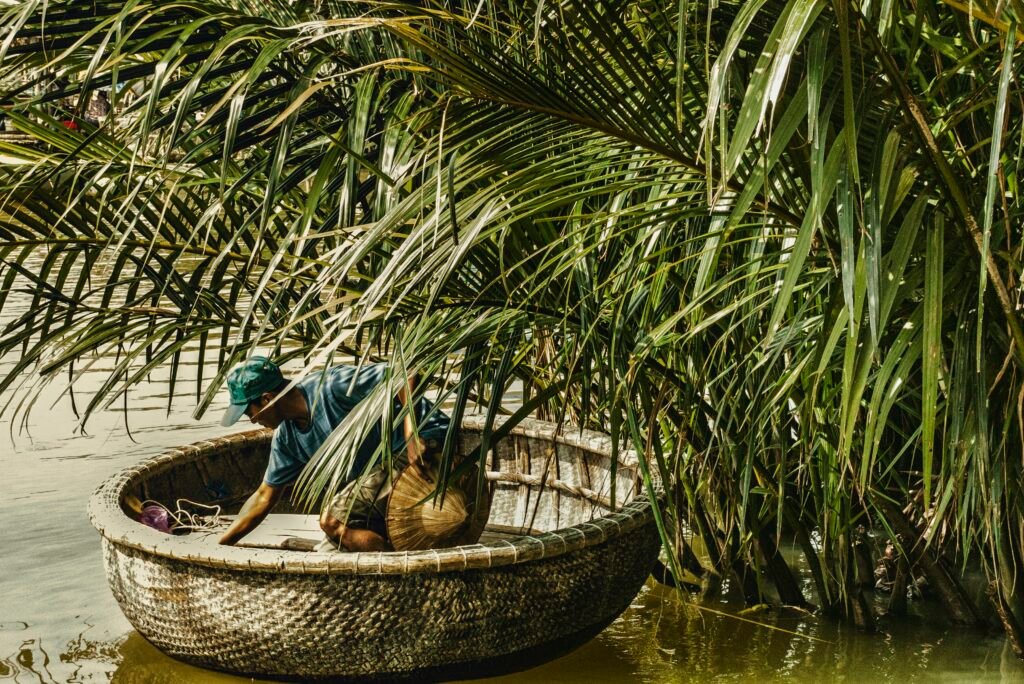
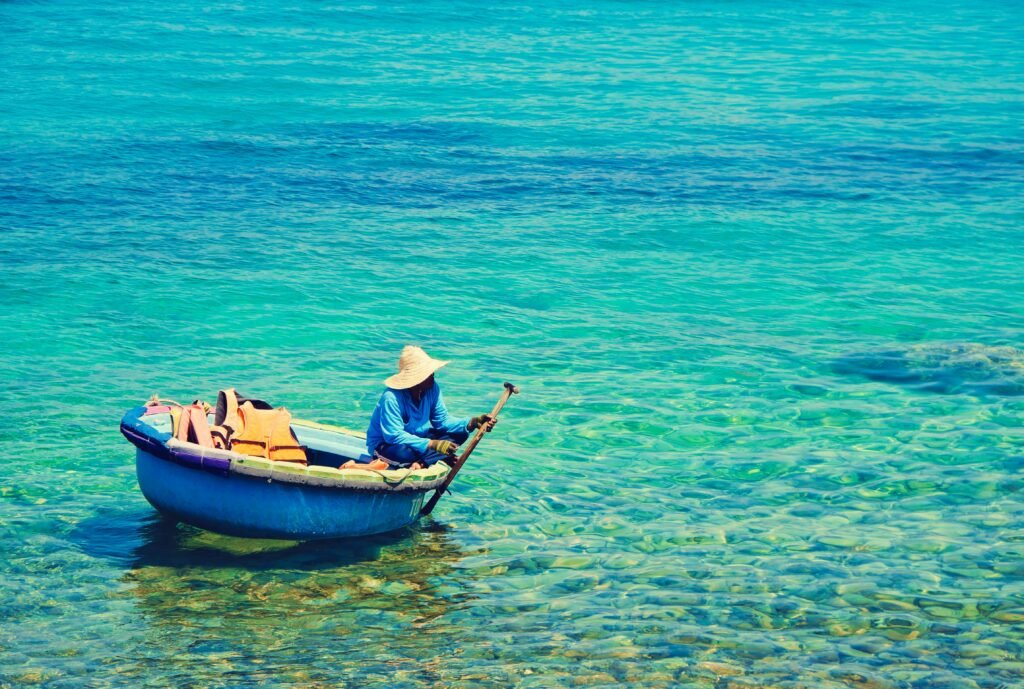
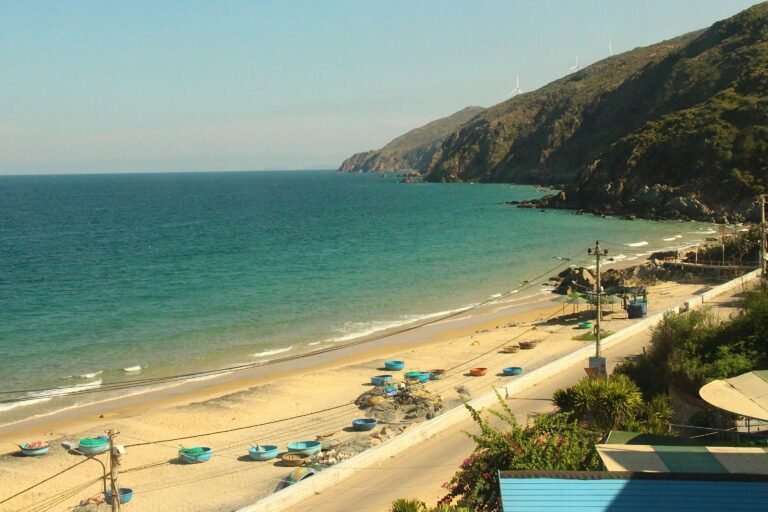
The thúng chai is the most surprising craft on the coast: a woven bamboo basket two to three metres across, waterproofed with resin, with no keel or bow. It is propelled by sculling with a single oar in a figure of eight; row it badly and it spins on the spot.Local legend has it that it was invented to dodge a French colonial tax on boats: it wasn’t a boat, it was a basket. The story is probably untrue — round wicker craft existed in Asia long before — but it is told everywhere, and it says something true about fishermen’s relationship with officialdom.Its real merit is practical: it crosses the surf without capsizing, two people can haul it up the sand, it is repaired with bamboo and resin, and it serves as a tender for the larger boats. It is used from Da Nang to Quy Nhon, and you will see hundreds lined up on the beaches at dawn.
Fish sauce, or the sea on your plate
Fish sauce isn’t a condiment, it is the basic seasoning of Vietnamese cooking — it plays the role salt plays in Europe and goes into nine dishes out of ten. Making it is utterly simple: anchovies, salt, a wooden barrel, twelve months in the shade, and drawing off from the bottom.Two capitals compete for the reputation. Phu Quoc, whose factories line up fifteen-tonne barrels and whose name has been protected in Europe since 2013. And Phan Thiet, older, on the south-east coast.Quality is measured in degrees of nitrogen: forty degrees for a first extraction, ten to fifteen for industrial sauces cut with water and sugar. It is the only thing to check on a label, and it completely changes what you will cook back home.
The whale, the fishermen’s deity
All along the central and southern coast, fishing villages maintain a temple dedicated to Cá Ông, “Mister Fish”: the whale. The belief comes from the Cham and was taken up by the Việt as they moved south; the Nguyen emperors gave it official status.The cult rests on a practical conviction: the whale saves shipwrecked sailors. When a whale is stranded, the village holds a full funeral — whoever finds the body mourns as for a father — then, after a few years, the bones are exhumed, washed and placed in the temple. Some shrines keep skeletons over twenty metres long, notably in Phan Thiet and on Ly Son island.The festival of Nghinh Ông, in spring, brings out the flag-decked boats to welcome the whale’s spirit. It is one of the most spectacular ceremonies on the coast, and one of the least known to travellers.
The islands, and why they make the news
Two archipelagos constantly come up in the Vietnamese news: the Paracels, Hoàng Sa, occupied by China since 1974, and the Spratlys, Trường Sa, whose reefs several countries dispute.You can’t understand contemporary Vietnam without this. The maritime question is one of the few subjects on which public opinion speaks out forcefully, and you will see maps displayed in schools, songs, entire museums — the one in Da Nang devoted to Hoàng Sa — dedicated to demonstrating Vietnamese sovereignty. Ly Son island, off Quang Ngai, has for centuries held a ceremony in memory of the sailors sent to the Paracels by the emperors.It isn’t a taboo subject, but it is a sensitive one. Better to listen than to take sides.
Fishing harbours at dawn
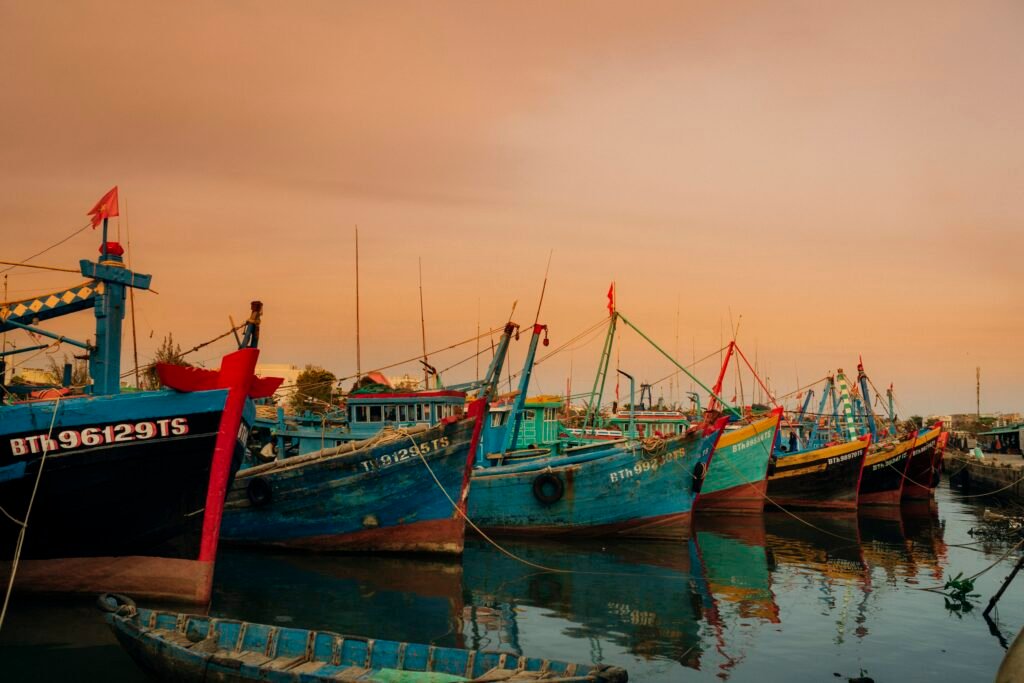
To see Vietnamese maritime life, you have to get up early. In Mui Ne, Quy Nhon or the fishing villages of the central coast, the boats come back at daybreak, and the beach turns into a market: fish are unloaded into round baskets, sorted and haggled over. An hour is enough to experience one of the country’s most powerful scenes.
The inhabited islands
Beyond Phu Quoc and Con Dao, Vietnam has many small islands inhabited by fishermen: the Cham Islands off Hoi An, Ly Son near Quang Ngai, known for its garlic fields on volcanic sand, or the islands of Nha Trang Bay. There you discover a pace of life very different from the mainland.
A changing coastline
The Vietnamese coast is changing very fast: large resort complexes, erosion of some beaches, as in Hoi An, and rising waters in the Delta. Choosing human-scale accommodation and villages that are still alive also means supporting a form of tourism that leaves room for fishermen’s lives.
Where to see Vietnam’s sea, and when
The coastline falls into three stretches, each with its own season.
The North — Lan Ha Bay, Cat Ba, Do Son: October to December for dry air and calm seas, March to May with a risk of mist. No swimming in January–February, when the water drops to eighteen degrees.
The Centre — Lang Co, Da Nang, Hoi An, Quy Nhon: February to August. Avoid October–November, the season of rains and typhoons.
The South — Phu Quoc, Con Dao, Mui Ne: November to March for the west coast, March to September for Con Dao. The south-west monsoon closes Phu Quoc from July to September.
A day on a fishing boat, from Nhon Ly near Quy Nhon or from a village on the Tam Giang lagoon, beats a week on a sun lounger: you leave at five, haul in the nets, and are back by nine. It is one of the outings we most like to include in a tour.
The round boat of woven bamboo and resin, used from Da Nang to Quy Nhon. It crosses the surf without capsizing, two people can haul it up the sand, and it serves as a tender for the larger boats. It is sculled in a figure of eight.
What is the best season for the beach in Vietnam?
It depends entirely on the region. North: October to December. Centre: February to August. South and Phu Quoc: November to March. There is no month when the whole coast is fine.
Why do fishermen worship the whale?
The belief, inherited from the Cham, holds that the whale saves shipwrecked sailors. Villages on the central and southern coast dedicate temples to it and sometimes keep entire skeletons.
How do you recognise good fish sauce?
By the degree of nitrogen shown on the label: forty degrees for a first extraction, ten to fifteen for industrial sauces cut with water and sugar. The colour should be amber, never brown or cloudy.
Can you go out to sea with fishermen?
Yes, from several villages, notably Nhon Ly near Quy Nhon and the hamlets of the Tam Giang lagoon. Departure around five, back around nine. We organise these outings with families we know.
Do the tensions in the South China Sea affect travel?
Not at all. The areas concerned are distant archipelagos, unconnected with the tourist coast. The subject does, however, often come up in conversation, and it is treated with a lot of emotion.
Putting it into practice
The tours where you experience what this article is about
Audience measurement. We would like to know which pages are useful to you, using Google Analytics. Nothing is stored without your consent, and you can change your mind at any time. Learn more

 Off the beaten trackThe secret Centre: Kon Tum, Quy Nhon and Phong Nha — 12 daysHanoi — Phong Nha — Huế — Kon Tum — Quy Nhon — Saigon12 days / 11 nightsfrom €1,690