Seventy Cham temples built between the 4th and 13th centuries in a jungle-ringed basin, listed by UNESCO. About twenty are still standing: the 1969 bombing did the rest. It is a site more moving than spectacular.
In brief
Best time
February to August, when the site is dry; avoid October–November, the Centre’s rainy season
Getting there
1 h by road from Hoi An, 1 h 15 from Da Nang; opens at 6 am
How long
Half a day, leaving at 5:30 am to have the site to yourself
Combine with
Hoi An as a base, Hue going north, Da Nang via the Hai Van Pass
Champa in three sentences
Before Vietnam pushed south, this coast belonged to Champa, a sea-facing Hindu kingdom that traded with India, Java and China. My Son was its sanctuary for more than a thousand years, from the 4th to the 13th century: neither a town nor a fortress, but a place of worship where each king added his tower.The kingdom faded slowly, absorbed by the Việt dynasties between the 15th and 17th centuries. Its descendants, the Cham, still live in Vietnam — about 180,000 people, today Muslim or Hindu, mainly in the South. Understanding this changes the visit: My Son is not an anonymous ruin, it is what remains of the national sanctuary of a people who still exist.
My Son is not an anonymous ruin: it is what remains of the national sanctuary of a people who still exist.
What remains, group by group
Seventy towers were built; about twenty are still standing. French archaeologists designated them by letters, and the usage has stuck.The B-C-D group is the heart of the site and the best preserved: this is where you find the kalan, the sanctuary towers, with their carved lintels and a lingam still in place. Group A was almost entirely destroyed in 1969. Group G, restored by an Italian mission, shows the consolidation work in detail. Allow two hours to go round without rushing.
Cham brick, an unsolved mystery
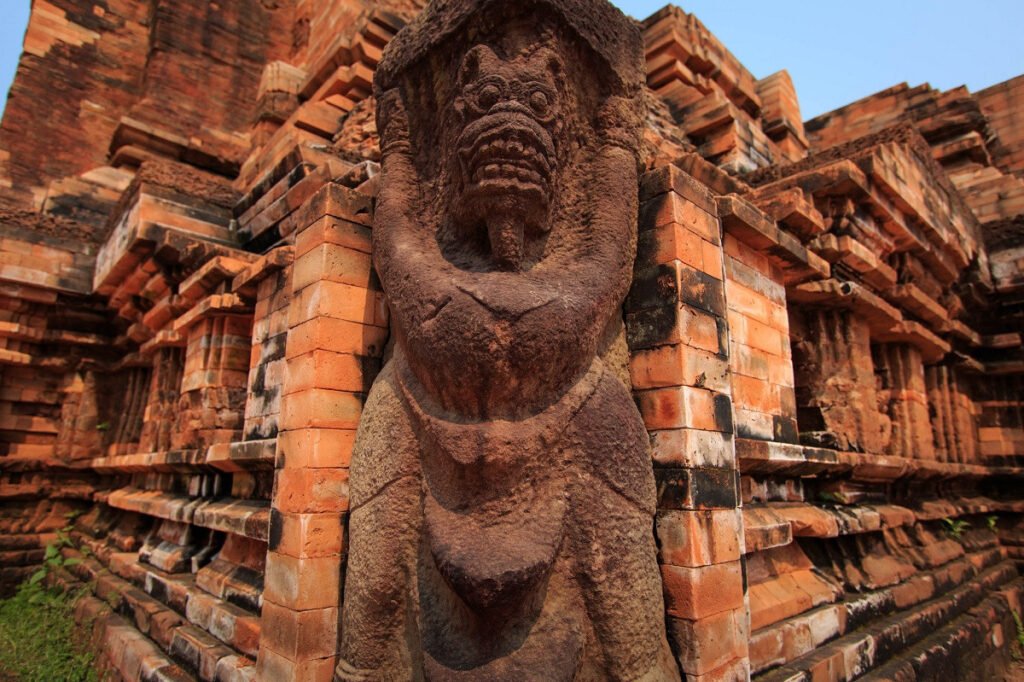
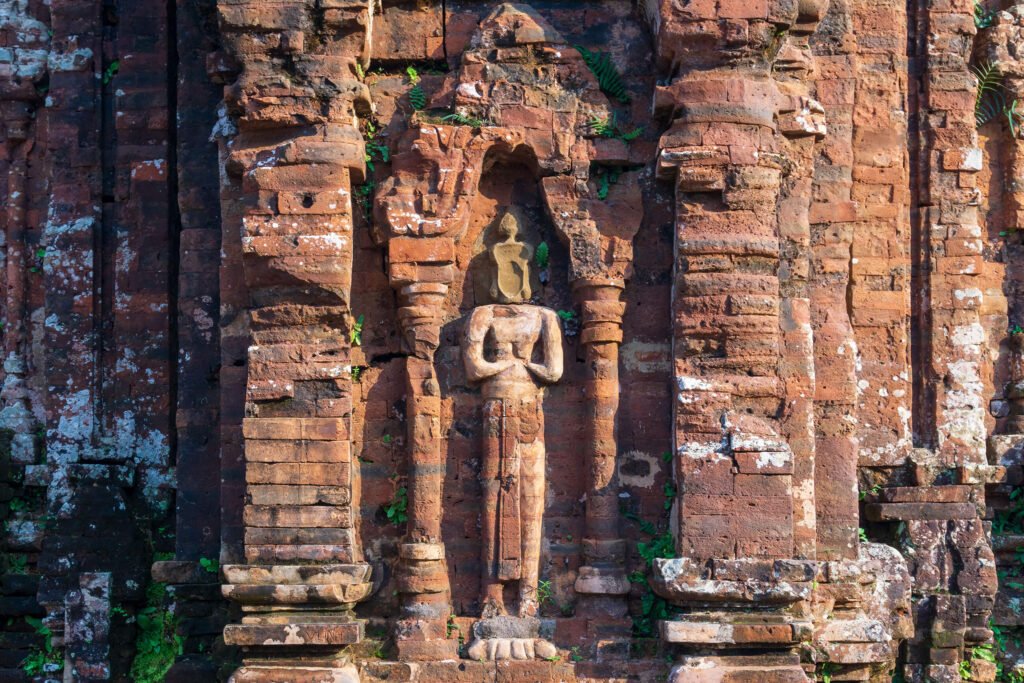
The towers are built of fired bricks, laid on top of one another without visible mortar, so tight you can’t slip a blade between them. The sculptures were carved directly into the wall once it was built, not added afterwards.Nobody yet knows how. Resin from the dau raitree, firing the whole building on site, a vanished plant-based binder: hypotheses have been piling up for a century. Modern restorations, on the other hand, are immediately visible — the grey cement of the 1980s stands out against the ochre. Your guide will show you the difference at a glance; it is the detail visitors remember.
The 1969 bombing
In August 1969, American aircraft bombed the valley, where the Viet Cong had set up. Group A, which housed the site’s tallest tower — twenty-four metres —, disappeared within a week. The craters are still visible between the buildings, filled with water after rain.Mines and unexploded ordnance were removed until the 2000s, which explains the marked paths: you don’t stray from the trails. The site has been UNESCO-listed since 1999.
What time to come
The site opens at six. Leave Hoi An at five-thirty: you arrive with the mist still clinging to the hills, the bricks red in the low light, and you have the B-C-D group to yourself. The first coaches arrive around nine.The second-best time is the last hour, around four in the afternoon: the groups have left, the light returns. Midday is to be avoided at all costs — there is no shade in the valley and the site reaches thirty degrees in the noon sun.
How to get there
My Son is forty kilometres from Hoi An, an hour by car, and fifty-five from Da Nang. We take you there by private car with a French-speaking guide, which is the only way to leave before dawn: group shuttles don’t start before eight.An electric cart links the car park to the temples, a kilometre further on. Bring good shoes, water, a hat, and covered shoulders: it is a place of worship.
The mistakes we see most often
Coming at ten with a group: maximum heat and a hundred people in a twenty-metre courtyard.
Expecting Angkor. My Son is a hundred times smaller — its interest is sculpture and history, not monumental scale.
Skipping the Cham museum in Da Nang. The finest pieces from My Son are displayed there; one can’t be understood without the other.
Visiting without a guide. Without commentary, they are brick towers; with it, they are a kingdom.
The temple groups, letter by letter
The French archaeologists of the École française d’Extrême-Orient designated the groups by letters in the early 20th century, and the usage has stuck. Here is what you will actually see.
Group
Period
Condition
To see
B – C – D
10th – 11th c.
Best preserved
The heart of the site. Lingam in place, carved lintels, long halls.
A
10th c.
Destroyed in 1969
Foundations and craters. The 24 m tower disappeared within a week.
E – F
8th – 9th c.
Under shelter
The oldest remains, protected by metal structures.
G
12th c.
Restored
Italian project: you see the consolidation work in detail.
H – K
Various
Ruined
Skip it if you are in a hurry.
Two hours are enough to see everything without rushing. If you only have one hour, concentrate on B-C-D and group G.
My Son or Angkor: what to know beforehand
Many travellers arrive here with Angkor in mind and leave disappointed. The comparison is misleading and it is better to defuse it beforehand.
My Son
Angkor
Area
2 km of valley
400 km²
Standing monuments
~ 20
Several hundred
Visit length
2 h
2 to 4 days
Main interest
Sculpture, brick, Cham history
Monumental scale
My Son is not a little Angkor: it is a sanctuary, not a capital. Its interest lies in the sculpture, the brick technique and the history of a vanished kingdom — not in size. With that expectation, the visit is a success; with the other, a disappointment.
Timing and price
Item
Detail
Opening
6 am
Entrance
~ €6, electric cart included
Best slot
6 am – 8 am, or after 4 pm
To avoid
10 am – 2 pm: no shade, over 30 °C
From Hoi An
1 h by road, 40 km
Private car with guide
€50 – 80 for half a day
Cham dance show
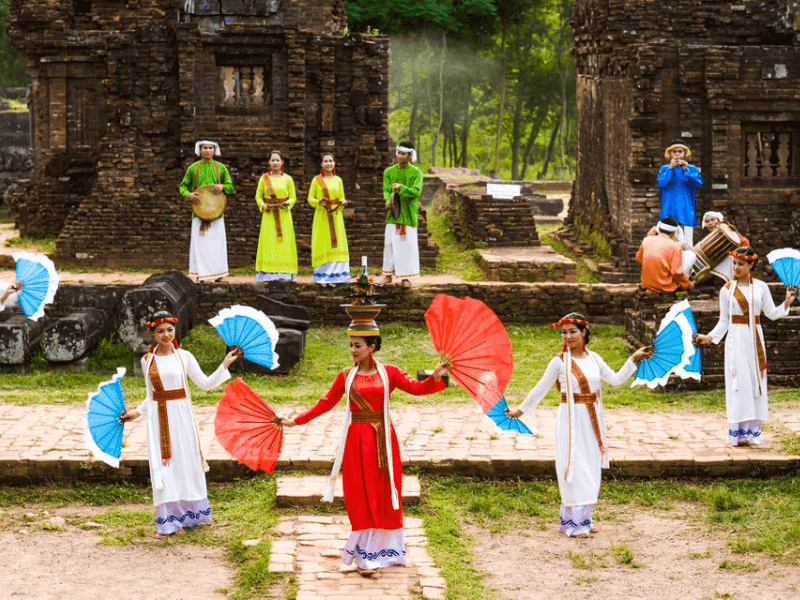
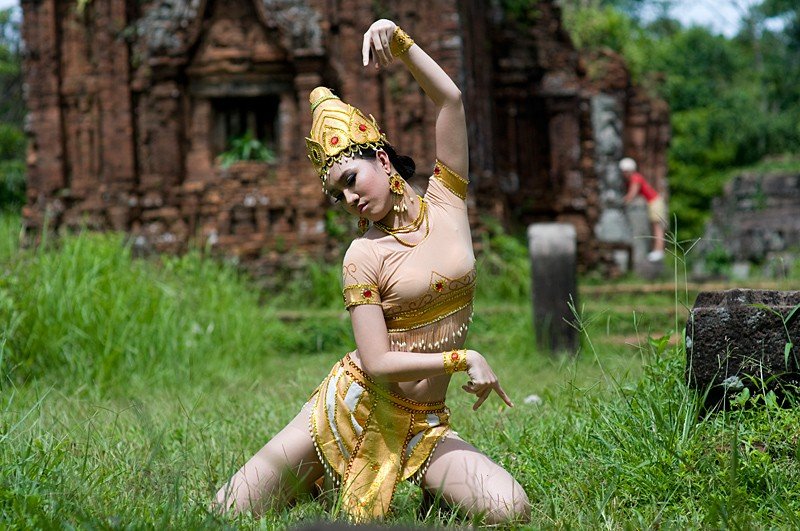
Included, at 9:30 am and 10:30 am
A private car is the only way to leave before dawn: group shuttles don’t start before eight, so they arrive at the worst moment. It is the difference between having the valley to yourself and sharing a twenty-metre courtyard with a hundred people.
Understanding the Cham today
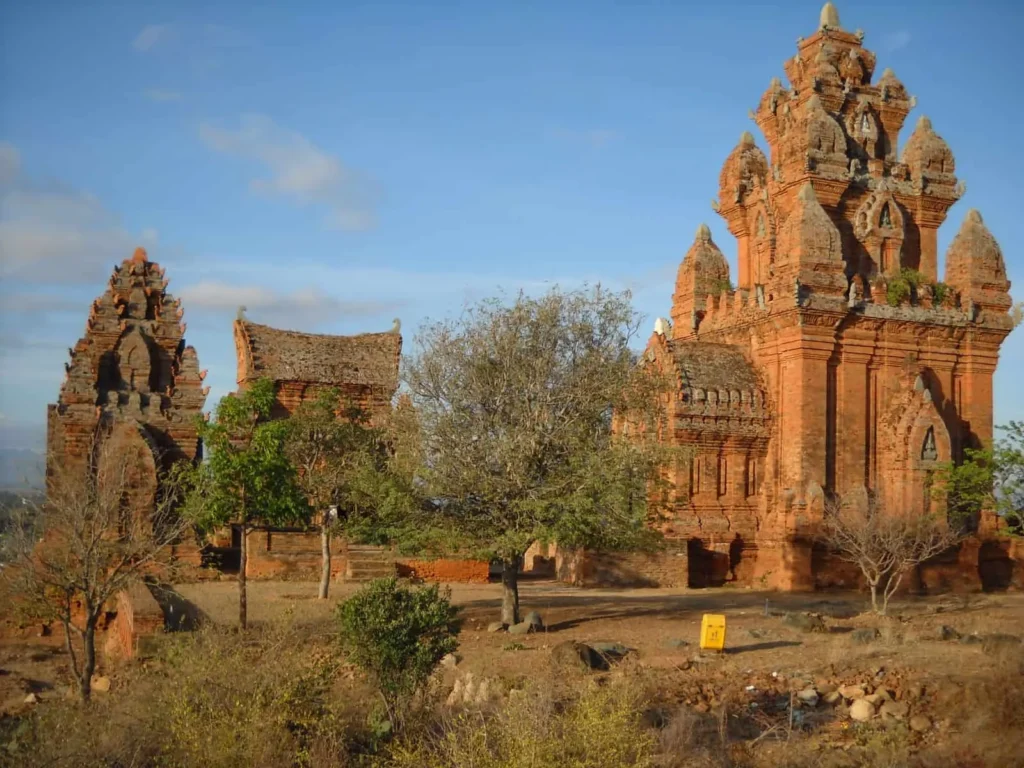
Champa did not disappear with its temples. About one hundred and eighty thousand Cham still live in Vietnam, mainly in the provinces of Ninh Thuan and Binh Thuan, further south, and in Chau Doc in the delta.Their religious situation is unique in Asia. The Cham of the Centre practise Balamon, a localised Hinduism with its own priests and calendar; those of the delta and Chau Doc have been Sunni Muslims since the 17th century; and a third group, the Bani, practise a very syncretic old form of Islam, with rites borrowed from both.The Po Klong Garai towers, near Phan Rang, are still used for worship: they are not ruins but living temples, where the Katefestival is held every autumn. If Cham history interests you, this stop is worth adding — it gives My Son a meaning the bricks alone don’t give.
Yes, provided you go early and with a guide. Without explanation, the ruins stay silent; with it, it is one of the most striking visits in the Centre.
How long should you allow?
Half a day from Hoi An, leaving around five-thirty to be there at opening time. Two hours are enough for the visit.
Is it accessible to everyone?
The ground is flat but the paths are dirt and uneven. Closed shoes are recommended, especially after rain.
Can it be combined with the Hai Van Pass?
Not on the same day without rushing: the pass is north of Da Nang, My Son south-west of Hoi An. We place them on two different days.
Is My Son comparable to Angkor?
No, and it is better to know that beforehand. My Son is a two-kilometre sanctuary with about twenty towers standing; Angkor covers four hundred square kilometres. My Son’s interest is sculpture and history, not size.
What time should you visit My Son?
At opening time, six o’clock, leaving Hoi An at five-thirty. Group shuttles don’t start before eight and arrive at the worst moment: maximum heat and no shade.
Are there still Cham people in Vietnam?
Yes, about one hundred and eighty thousand people, mostly in Ninh Thuan and Binh Thuan. Some practise a localised Hinduism, others Islam. The Po Klong Garai towers are still used for worship.
Audience measurement. We would like to know which pages are useful to you, using Google Analytics. Nothing is stored without your consent, and you can change your mind at any time. Learn more

 The essentialsVietnam in 15 daysHanoi — Pu Luong — Ninh Binh — Lan Ha Bay — Hue — Hoi An — Saigon — Mekong Delta15 days / 14 nightsfrom €2,070