The country is 1,650 kilometres long and three climates follow one another without ever agreeing. Here are the real averages month by month, region by region, and what we really answer when a traveller tells us their dates.
In brief
The best overall window
October to December and March–April: the only time when all three regions are mild together
To avoid
October–November in the Centre (rain and typhoons), July–September in Phu Quoc
Golden rice fields
Late August to mid-September in Sa Pa, mid-September to early October in Mu Cang Chai
Tết
Late January or February: the country empties, transport is saturated, many places close for a week
Vietnam measures sixteen hundred and fifty kilometres from north to south. That is the distance from Lille, in northern France, to Naples. Nobody would expect the same weather on the same day in those two cities, and yet the question that comes up most often in our conversations remains: when should you go to Vietnam?The honest answer fits in one sentence: there is no month when all three regions of the country are at their best at the same time. The North and the Centre run out of step with each other, and the South follows yet another rhythm. What matters, then, is not finding the perfect month, but knowing which stops to put in which order, according to the dates you have.That is exactly the work we do when you write to us with your dates: not choosing for you, but telling you what really happens at that time, region by region, and building the itinerary in the direction that keeps you out of the rain.
The table: temperatures and rainfall, month by month
Here are the 1991–2020 reference averages for the three cities that best represent each region: Hanoi for the North, Hue for the Centre, Saigon for the South. Temperatures are given as the month’s minimum and maximum, rainfall in millimetres.
Month
Hanoi °C
Hanoi mm
Hue °C
Hue mm
Saigon °C
Saigon mm
January
14 / 20
20
17 / 24
125
22 / 32
15
February
16 / 22
20
18 / 25
65
23 / 33
5
March
18 / 24
35
20 / 28
45
24 / 34
10
April
22 / 28
105
23 / 31
60
26 / 35
50
May
24 / 32
165
24 / 34
100
25 / 35
220
June
26 / 34
265
25 / 35
115
25 / 33
310
July
26 / 34
255
25 / 35
90
24 / 33
295
August
26 / 33
275
25 / 35
115
24 / 33
270
September
25 / 32
245
24 / 32
395
24 / 32
325
October
22 / 30
155
23 / 30
755
24 / 32
265
November
19 / 26
60
21 / 27
620
23 / 32
115
December
15 / 22
20
18 / 24
310
22 / 32
50
Year
21 / 28
1 610
22 / 30
2 800
24 / 33
1 930
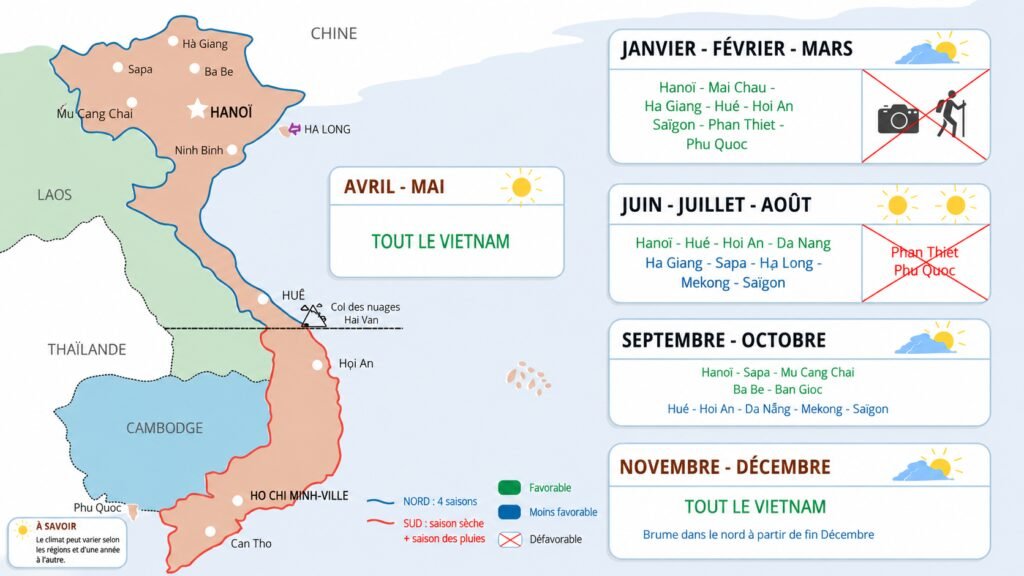
Three figures sum up the situation. Hanoi receives 1,610 mm of rain a year, mostly from May to September. Saigon receives 1,930, concentrated from May to October. Hue receives 2,800, of which 2,080 fall in just the four months from September to December. The Centre is not rainier than the rest of the country: it is rainy when the others are not.For detailed temperatures and rainfall city by city, see also our guide to the climate of Vietnam.
The North: four distinct seasons
Hanoi, Ninh Binh, Lan Ha Bay, Pu Luong, Ha Giang, Sa Pa. It is the only part of the country with a real winter, and the only one where you will need a jacket.October–November is the best window of the year. The air becomes dry, the light clear, temperatures are around 22 to 30 °C in October and 19 to 26 °C in November, and only 155 then 60 mm of rain fall. In the mountains, the rice fields are golden in early October.December to February is cool and often misty: 14 to 22 °C in Hanoi, less than 20 mm of rain a month, but grey skies and persistent drizzle. At altitude, in Sa Pa or Ha Giang, it can be 5 °C and fog can erase the landscapes for days. We don’t advise against this period, but we avoid making a mountain stop the only highlight of the trip.March–April is mild and pleasant, with morning mists over the bay that make for beautiful photos and spoil the sunsets. May to September is hot and heavy: 26 to 34 °C, between 165 and 275 mm of rain a month, with violent but short storms in the late afternoon.
The Centre: everything works the other way round
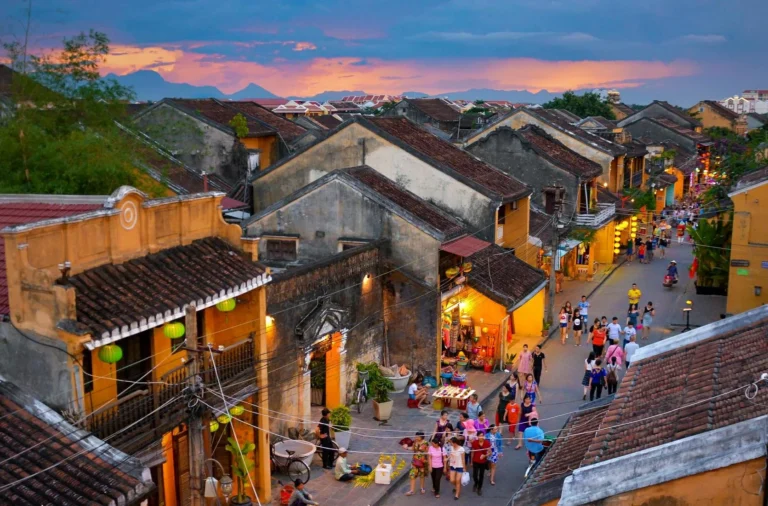
Hue, Da Nang, Hoi An, Quy Nhon and Phong Nha follow a calendar that is the reverse of the North’s. The dry season runs from February to August, with a peak of sunshine in July: eight hours of sun a day and only 90 mm of rain.Then everything tips over. The north-east monsoon arrives in September and hits this stretch of coast: 395 mm in September, 755 mm in October, 620 mm in November, 310 mm in December. These are not afternoon showers; these are whole days of rain. Hoi An floods almost every year in November, with streets in the centre passable only by boat.We don’t cancel the stop for all that — Hue and Hoi An in the rain have their own beauty, and museums, workshops and cooking classes don’t depend on the sky. But we reverse the direction of the tour, shorten the stay on the coast, and say so clearly before you book your flights.
The South: two seasons, and that’s it
Saigon, the Mekong Delta, Con Dao and Phu Quoc have neither winter nor any real variation in temperature: between 22 and 35 °C all year round, with only three degrees between the coolest and the hottest month.The dry season runs from November to April. In February, 5 mm of rain falls over the whole month, and the sun shines nine hours a day. It is the ideal period, by far.From May to October, the monsoon brings 220 to 325 mm a month, but in a very particular form: a violent downpour, often between three and five in the afternoon, which lasts an hour and stops dead. Mornings remain entirely usable, the vegetation is superb, the delta canals are high and prices drop. Many travellers underestimate this season, wrongly.
There is no bad time to see Vietnam, only bad itineraries for a given time.
The two windows for crossing the whole country
If your trip goes from North to South, two periods bring the three regions roughly into agreement.March–April. Our number one recommendation. The North warms up without being stifling, the Centre is in the middle of its dry season, the South is still dry. It is the only period when no region is really at a disadvantage. Drawback: the Easter holidays push up flight prices.October–November. The light is perfect in the North, the dry season begins in the South, but the Centre gets its heaviest rains of the year. We work around the problem by cutting the coastal stop to two nights, replacing Phong Nha with an inland stop, or placing the Centre at the very start of the trip, before the monsoon sets in.Two other periods work, provided you accept a compromise. December–January is excellent in the South and fair in the North, but still wet in the Centre. June–July is the best time for the Centre and the coast, but hot and rainy everywhere else.
The rice fields: three weeks that decide a trip
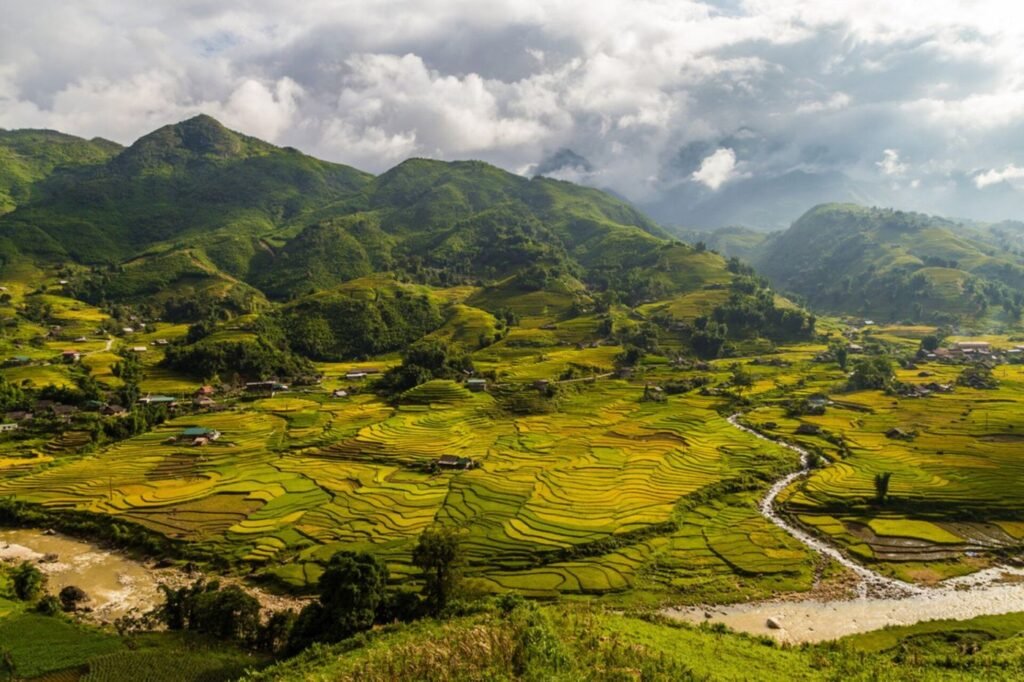
For many travellers, the image that started the whole project is one of golden terraces. You should know that they are golden for only three weeks a year, and that the date varies with altitude and region.In the North-West — Mu Cang Chai, Sa Pa, Y Ty — the harvest takes place between 15 September and 5 October. A week too early, the terraces are green; a week too late, they have been cut. In Ha Giang, the same thing happens about ten days earlier.The second window, less well known and much quieter, is mid-May to early June : the terraces are flooded and reflect the sky like mirrors. Pu Luong is the exception, producing two harvests a year, golden in late May and then in late September.
Tết: the only period that changes everything
The lunar new year falls between late January and mid-February depending on the year. During the week around it, the whole country goes home: domestic flights and trains are full, many shops close for three days, hotel rates climb and sites receive huge Vietnamese crowds.We don’t advise against this period. The hospitality is exceptional, altars are covered with peach blossom in the North and apricot blossom in the South, and the streets of Hanoi fall silent for the only time in the year. But it requires booking six months ahead and accepting reduced services.The week immediately after Tết, on the other hand, is one of the best of the year: everything has reopened, the country is still celebrating, and foreign travellers are rare.
Typhoons and rain: what to worry about, and what not to
Typhoons affect Vietnam from July to November, peaking in September and October on the north-central coast. They are not reason enough to give up a trip, but they demand flexibility: the harbour authority can close Lan Ha Bay for twenty-four to forty-eight hours, and domestic flights are sometimes cancelled.In that case, we reschedule the stop at no extra cost. It is the kind of situation where an agency on the ground makes a real difference: the decision is made the evening before, in Vietnamese, with the captain.Monsoon rain in the South, on the other hand, is not a problem. A one-hour shower in the late afternoon spoils no day of sightseeing, and the light that follows is often the most beautiful of the trip.
Month by month, our verdict
This table sums up what we really answer when a traveller tells us their dates.
Month
North
Centre
South
Our verdict
January
Dry and cool, misty
End of the rains, still grey
Perfect
Good, except Tết week
February
Cool, mists
The dry season begins
Perfect
Very good
March
Mild, pleasant
Dry and bright
Hot and dry
Excellent
April
Hot, first showers
Hot and dry
Very hot
Excellent
May
Hot and heavy
Hot, warm sea
Start of the monsoon
Fair
June
Hot, rain
Hot, dry
Monsoon
Average
July
Rain, possible typhoons
The driest in the Centre
Monsoon
Average
August
The rainiest
Hot, dry
Monsoon
Average
September
Golden rice fields in the North-West
The rains arrive
The rainiest
Good in the North only
October
The best month
Avoid, 755 mm
End of the monsoon
Good, by working around the Centre
November
Crystal-clear light
Avoid, 620 mm
Dry season
Good, by working around the Centre
December
Cool and dry
Still rainy
Perfect
Fair
One last thing: we have never told anyone not to come. There is no bad time to see Vietnam, only bad itineraries for a given time. Give us your dates before you book your flights, and we will tell you frankly what is possible and what is not.
The month that interests you, in detail
This guide gives the overview. For each month, we have written a full page: the weather region by region, sea temperature and hours of sunshine, where to go and what to avoid, the recommended direction of travel, what to pack, a typical week, and the prices charged at that time.
March and April if you are crossing the whole country: it is the only period when none of the three regions is at a disadvantage. October and November are superb in the North but very rainy in the Centre.
Can you travel during the rainy season?
In the South, yes without hesitation: the downpour lasts an hour in the late afternoon and the morning remains usable. In the Centre between September and December, it is another matter: 755 mm fall on Hue in October alone.
When are the rice fields golden?
Between 15 September and 5 October in the North-West, about ten days earlier in Ha Giang. Pu Luong is the exception with two harvests, late May and late September.
Should you avoid Tết?
Not necessarily. The hospitality is exceptional, but you need to book six months ahead and accept reduced services for three days. The week after Tết is excellent.
Are typhoons a serious risk?
From July to November, on the north-central coast. They call for flexibility rather than giving up: we reschedule a stop at no cost if the bay closes.
Putting it into practice
The tours where you experience what this article is about
Audience measurement. We would like to know which pages are useful to you, using Google Analytics. Nothing is stored without your consent, and you can change your mind at any time. Learn more


 The essentialsVietnam in 15 daysHanoi — Pu Luong — Ninh Binh — Lan Ha Bay — Hue — Hoi An — Saigon — Mekong Delta15 days / 14 nightsfrom €2,070