Seven days of clothes are enough for three weeks, and half of what people pack is never used. What really needs to come from home, what is better and cheaper to buy locally, and what changes from region to region.
In brief
Recommended weight
12 to 15 kg: laundry is done locally for €1 a kilo, in 24 h
The most common mistake
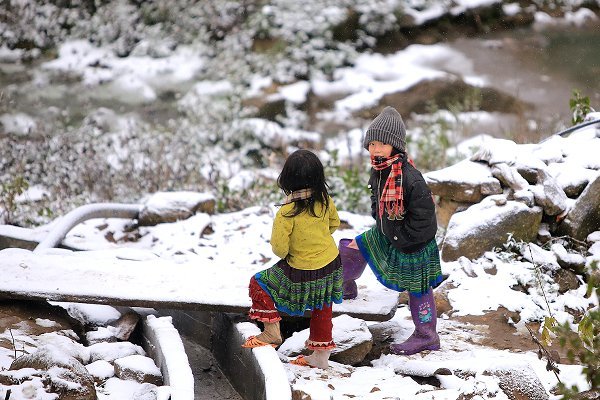
Underestimating the cold in the North from December to February: 10 °C with no heating
A sleeping bag, a full first-aid kit, technical clothing
The rule: pack less
It is the most useful and least followed advice. Vietnam is one of the easiest countries in the world in which to buy what you are missing: clothes, pharmacy items, cosmetics, travel gear, everything can be found everywhere for a fraction of European prices. Laundry costs a few euros a kilo and is done within twenty-four hours in any town.The consequence: seven days of clothes are enough for three weeks. Domestic flights often limit checked baggage to twenty kilos, and the real constraints are not weight but the stairs of a mini-hotel without a lift and the boot of a shared car.Our recommendation: a soft backpack or a medium-sized suitcase, plus a small day bag. Avoid the large hard suitcase, unmanageable on scooter-filled pavements and in boats.
The list, by season and region
Vietnam stretches sixteen hundred kilometres and the North has a real winter. A single list won’t do.
North, Oct. – Apr.
North, May – Sept.
Centre and South
Tops
4 T-shirts, 2 long sleeves, 1 fleece
6 light T-shirts
6 T-shirts, 1 long sleeve
Jacket
Lined windbreaker
Light windbreaker
Light windbreaker
Low
2 pairs of trousers, 1 light
1 pair of trousers, 2 shorts
1 pair of trousers, 2 shorts
Shoes
Closed walking shoes + sandals
Closed walking shoes + sandals
Sandals + one closed pair
Rain
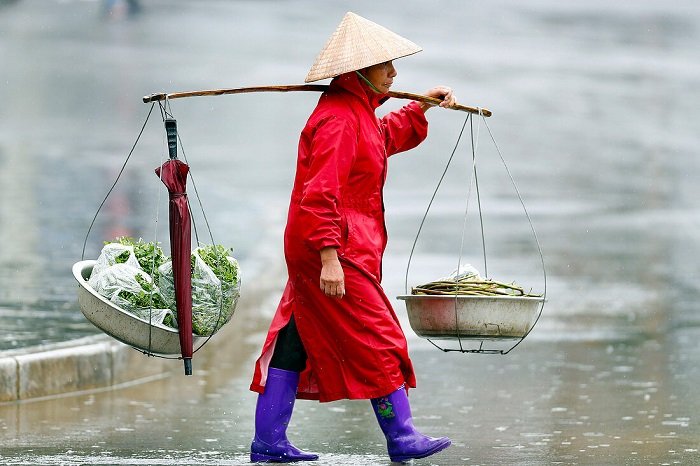
Poncho
Poncho essential
Poncho from June to Nov.
Night
Warm pyjamas
Light
Light
The fleece for the North in winter is the most common thing to forget, and the most costly in comfort. In Sa Pa and Ha Giang, it is zero to ten degrees from December to February, and no accommodation is heated — neither guesthouses nor most hotels. You sleep in your clothes.Conversely, from May to September, humidity exceeds eighty per cent: cotton doesn’t dry and laundry goes mouldy in the bag. Prefer linen and light fabrics, and have things washed as you go.
Shoes: the only choice that matters
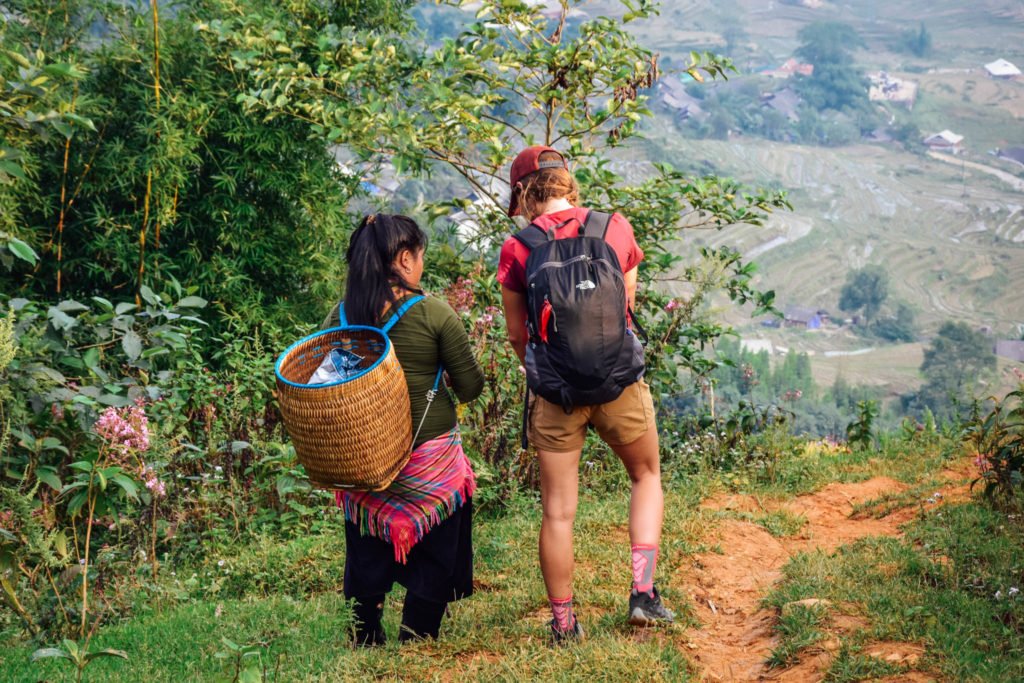
One closed pair for walking, broken in before departure, with a sole that grips. This is non-negotiable if your tour passes through rice fields: the paddy dykes are narrow, made of earth, and become slippery as soon as it has rained — which is often.One pair of sturdy sandals for town, temples and the beach. Nothing else. High hiking boots are excessive for the classic itineraries, and smooth-soled city trainers are a bad choice.A practical detail: you take off your shoes in temples, in homestays and in some tea houses. Shoes that are easy to remove save about a hundred fiddly moments on a fifteen-day trip.
First-aid kit and products hard to find
Product
Bring?
Available locally
Repellent 30 – 50% DEET or icaridin
Yes
Weak locally
SPF 50 sunscreen
Yes
Expensive, rare outside big cities
Anti-diarrhoea medicine and rehydration salts
Yes
Yes
Paracetamol
Yes
Yes
Personal medication + translated prescription
Yes
Variable
Spare glasses
Yes
Decent lenses, cheap frames
Sanitary products
According to habit
Pads everywhere, tampons rare
Shampoo, toothpaste
No
Everywhere, cheap
Vietnamese cosmetics very often contain a whitening agent: check the label if you buy a cream locally.
Papers and precautions
Passport valid six months after the return date, with at least two blank pages. Bring photocopies and scans stored online, as well as a few passport photos: they come in handy for unexpected formalities.Two bank cards, kept separately, and a small reserve of euros in new notes. Your bank’s card-cancellation number written down somewhere other than your phone.For details of entry formalities — visa, exemptions, authorised lengths of stay — see our dedicated guide, which covers the subject in detail and which we keep up to date.
What is useless
Item
Why leave it behind
Sleeping bag
Sheets and blankets provided everywhere, including in homestays
Mosquito net
Provided where it is needed
Universal adapter
Round-pin European sockets, 220 V. Nothing to plan for European plugs
Technical hiking clothing
Walks are short and easy
Too many clothes
Laundry at €1 a kilo, returned in 24 h, everywhere
Towel
Provided even in simple accommodation
Food supplies
The food is excellent, safe and at every price
Laundry deserves emphasis: it costs about a euro a kilo, comes back within twenty-four hours, and can be found on every street of every town. Leaving with fifteen kilos of luggage for two weeks is a choice, not a necessity — and you always bring back more than you take.
The day bag
What you actually carry during visits, which matters more than the contents of your suitcase.Water, two to three litres a day in the hot season. A hat or a parasol — the Vietnamese use parasols, men included, and it is more effective. Sunscreen, repellent to reapply in the late afternoon, and a poncho that folds up, from June to November: a tropical downpour lasts an hour and soaks you in thirty seconds.A light scarf, finally, which serves four purposes: covering your shoulders in a temple, protecting you from the sun, filtering dust on a scooter, and keeping you warm on a bus air-conditioned to eighteen degrees.
Also plan how to get connected as soon as you arrive. A local SIM card can be bought at the airport for a few euros, and an eSIM can be activated before you even take off.
The type of luggage
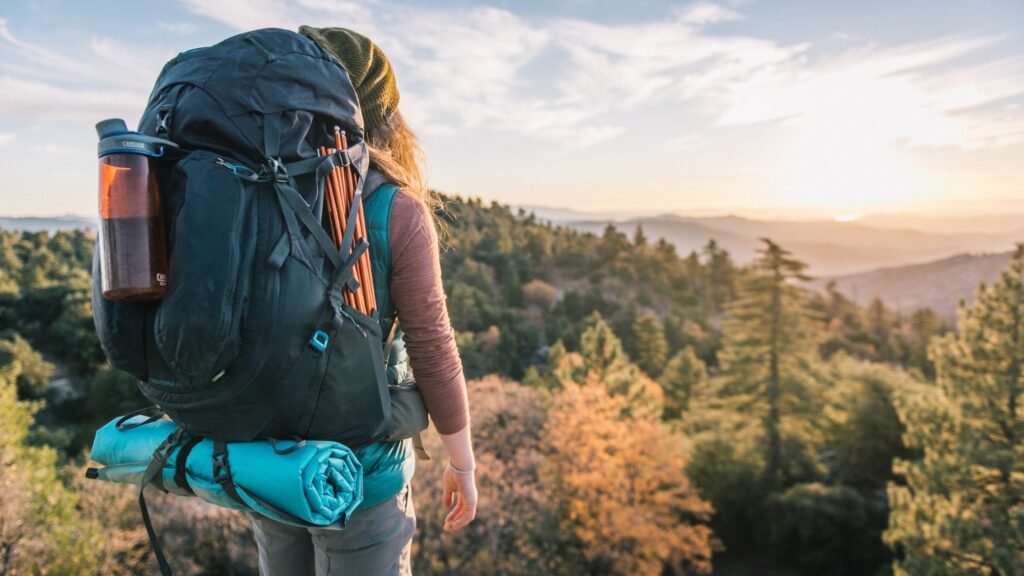
Choose a backpack or soft suitcase over a hard suitcase. Three reasons: stilt houses are reached by dirt paths and bamboo footbridges; hotels in Hanoi’s old quarters have steep stairs and not always a lift; and junks have no room for a hard case in the cabins.A small extra backpack is useful for nights when the big bag stays at the hotel: on a junk, trekking in Pu Luong, or for a homestay night.
The toiletry bag
Most products can be found locally, but some are harder to find or more expensive: very high-factor sun cream, effective mosquito repellent, deodorant without whitening agents, contact lenses and lens solution. Take them in your usual brands, in travel sizes for your hand luggage.
Laundry on the way
There is no need to pack clothes for three weeks: hotels and neighbourhood laundries wash, dry and fold your clothes within twenty-four hours for a modest price, often by weight. Simply plan a two-night stop to take advantage of it.
An outfit for temples
Keep a garment that covers shoulders and knees in your day bag; a scarf or a light shirt is enough. The Hô Chi Minh Mausoleum, the Imperial City of Huế and many pagodas refuse entry in shorts or vest tops.
A soft backpack or a medium suitcase, plus a small day bag. Avoid the large hard suitcase: pavements taken over by scooters, mini-hotel stairs without a lift, shared car boots and boats.
How many clothes should you bring?
Seven days’ worth is enough, even for three weeks. Laundry costs a few euros a kilo and comes back within twenty-four hours in every town. Bringing more adds nothing and complicates everything.
Do you need warm clothes?
Yes if you are going to the North between November and March: a proper light down jacket, because accommodation isn’t heated and the humidity makes seventeen degrees feel much colder. In the mountains, add a hat and warm socks.
Which shoes?
One comfortable closed pair that is easy to take off — you remove your shoes several times a day — plus sandals. Walking shoes only if you are hiking, and bring them from home: large sizes are hard to find.
What must you not forget?
Your personal medication with its prescription, a high-factor sunscreen from home, a repellent, a power bank and a water bottle. Everything else can be bought locally, often better and cheaper.
Can you buy clothes locally?
Easily and for next to nothing, including made-to-measure in Hoi An within twenty-four hours. Only large clothing and shoe sizes are a problem: above European size 42–43 for shoes, bring them from home.
Do you need warm clothes for Vietnam?
Yes for the North from December to February: it is zero to ten degrees in Sa Pa and Ha Giang, and no accommodation is heated. It is the most common thing forgotten by travellers who think they are heading to the tropics.
How much luggage weight should you plan for?
Twelve to fifteen kilos are enough for two weeks. Laundry costs about a euro a kilo and comes back within twenty-four hours on every street. Leave room for the return.
Do you need a plug adapter?
No, if your plugs are European. Vietnam uses 220 V with round European-type sockets, so continental European devices plug straight in; UK and other plugs need an adapter.
Putting it into practice
The tours where you experience what this article is about
Audience measurement. We would like to know which pages are useful to you, using Google Analytics. Nothing is stored without your consent, and you can change your mind at any time. Learn more
 The essentialsVietnam in 15 daysHanoi — Pu Luong — Ninh Binh — Lan Ha Bay — Hue — Hoi An — Saigon — Mekong Delta15 days / 14 nightsfrom €2,070