The vast majority of travellers who arrive in Vietnam follow the same line: Hanoi, Halong Bay, Hue, Hoi An, Saigon, the Mekong. It is a magnificent trip. It is not the only one.
In brief
In the North
Ha Giang, Cao Bang, Pu Luong
In the Centre
The Kon Tum plateau and Quy Nhon
In the South
Con Dao and the craft villages of the delta
The real criterion
Travel time: every detour is paid for by another stop
The Ha Giang loop
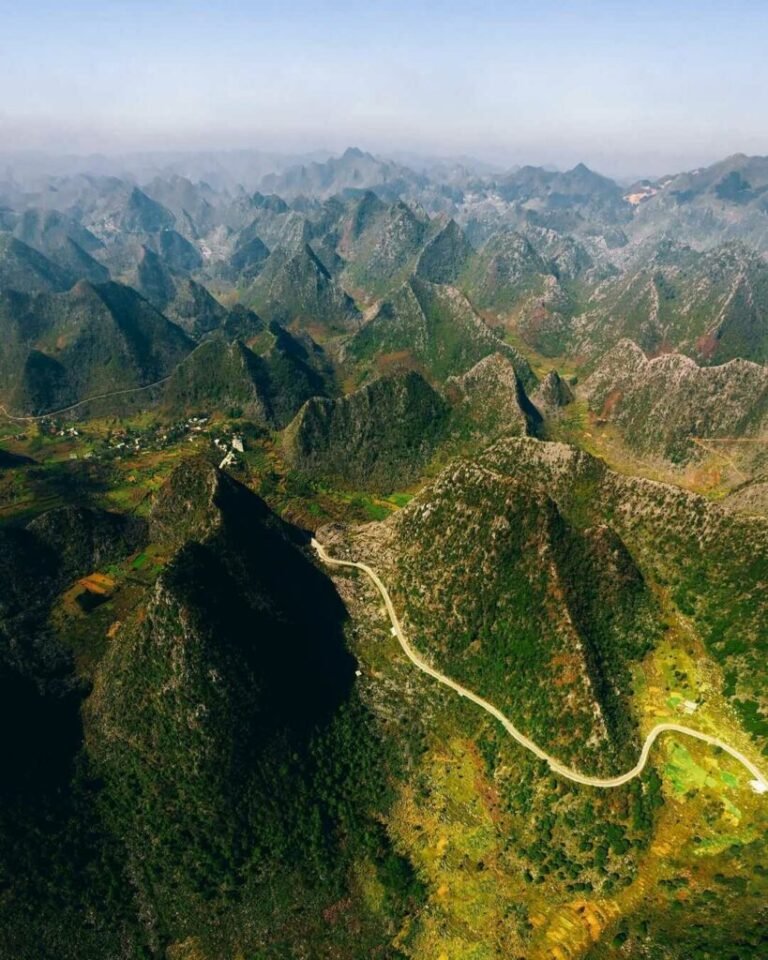
The country’s northernmost province is also its most vertical. Over three hundred and fifty kilometres, the road clings to limestone cliffs, crosses the Mã Pí Lèng pass above the Tử Sản canyon — a seven-hundred-metre drop, the deepest in South-East Asia — then descends into valleys where maize is grown between the rocks, for lack of soil.The Đồng Văn karst plateau has been a UNESCO Global Geopark since 2010. You visit the palace of the Hmong kings, a Sino-French residence built in 1902 by a family that controlled the opium trade, and above all you stop at the Sunday markets of Mèo Vạc and Đồng Văn, where buffaloes and horses are still sold by auction.The trade-off is real and we prefer to say so: five to seven hours of winding road a day, rustic accommodation above a thousand metres, a climate that changes within an hour. Since June 2026, a border-zone permit has been required for foreign travellers in four districts. It is not a hard trip to organise — we take care of it — but it is a trip you have to earn.Read our full page on Ha Giang →
Pu Luong
Only four hours from Hanoi, a seventeen-thousand-hectare nature reserve where the terraced rice fields rival those of Sa Pa without the buses. The difference comes down to one thing: Pu Luong never had a railway station. The line built by the French stops elsewhere, and mass tourism followed the rails.You walk from one Thái hamlet to the next, between bamboo water wheels that lift water to the upper terraces — an engine-free irrigation system still in use. You sleep on stilts, in family homes that have become comfortable without ceasing to be homes: hot water, mosquito nets, sometimes an infinity pool facing the valley.Two harvests a year is the decisive advantage: the terraces are golden in late May–early June, then again in late September. Most regions of the North offer this light only once a year, which makes their dates tyrannical. Here, two windows instead of one.Read our full page on Pu Luong →
The Kon Tum plateau
The Central Highlands remain the least visited region of the country, and Kon Tum is their heart. People come for the rông communal houses of the Bahnar villages, whose thatched roof on stilts sometimes reaches twenty metres: an architecture without nails, rebuilt collectively every fifteen or twenty years.The town itself has a wooden church from 1913, built by French missionaries in the style of Bahnar houses rather than that of French churches — an architectural blend found nowhere else in Asia. The mountain Catholicism born of it is still alive, and it resembles nothing you know.All around are the highland plantations. Vietnam is the world’s second-largest coffee exporter and the leading producer of robusta; most of it comes from here. The best arabicas of Măng Đen, grown above a thousand metres, are hardly exported at all: they are drunk on the spot.
Quy Nhon
The coast that Nha Trang was thirty years ago. Quy Nhon is a real fishing town of three hundred thousand people, not a beach resort, and that changes everything: the harbour works at dawn, the beaches of Kỳ Co and Eo Gió are reached by boat or along a cliff road, and you dine on seafood in stalls where nobody speaks English.Bình Định province was the heart of the Cham kingdom. The Bánh Ít towers and the Twin Towers have stood on the hills since the 11th century, in red brick assembled without visible mortar — a technique still debated today. They are almost always empty of visitors.It is also the cradle of Vietnamese martial arts and the birthplace of Emperor Quang Trung. Two or three nights are enough to grow attached to it, and Quy Nhon has the rare advantage of fitting into a North–South route without forcing a detour.
Going off the beaten track doesn’t mean giving up comfort. It means accepting to arrive somewhere without knowing exactly what you will find.
Con Dao
Sixteen islands off the Mekong Delta, only one of them inhabited. The archipelago was first a penal colony: the prison opened by the colonial administration in 1862, then taken over by the regimes that followed, held generations of political prisoners until 1975. The “tiger cages” can be visited, and every night Hàng Dương cemetery receives visitors who come to lay flowers on the grave of Võ Thị Sáu.It is a page of Franco-Vietnamese history that few French travellers know, and it is told without complacency or indictment — that is how our guides treat it.The rest of the archipelago is a national park. Green turtles come to lay their eggs on the beaches of Bảy Cạnh between June and September, and you can watch a night-time laying, accompanied by park rangers. People go for that, and for a silence that no longer exists anywhere else on the Vietnamese coast. Allow a flight from Saigon and at least three nights.Read our full page on Con Dao →
The craft villages of the Red River Delta
The easiest outing to add to a classic tour, and the most underestimated. Within a forty-kilometre radius of Hanoi, around a hundred villages each practise a single trade, often since the 15th century: ceramics in Bát Tràng, silk in Vạn Phúc, lacquer in Hạ Thái, bronze in Đại Bái, dópaper, the folk prints of Đông Hồ, the conical hats of Chương.These are not open-air museums. They are working villages, with family workshops you enter through the courtyard, where they will put your hands in clay or lacquer if you ask.Three days by bike are enough to string together four or five of them, sleeping in homestays. It is flat, it is close, and it is the only “off the beaten track” that costs neither a day on the road nor comfort — the ideal gateway for a first trip that wants to leave the standard route without upending it.
Cao Bang
Bản Giốc waterfall drops over three tiers, three hundred metres wide, exactly on the Chinese border: the left half belongs to China, the right to Vietnam, and you approach it on a bamboo raft right up to the line. It is the largest border waterfall in Asia and one of the rare images of Vietnam that photographs cannot exaggerate.Nearby, Ngườm Ngao cave runs for more than two kilometres of passages, and the Thăng Hen lakes change level with the seasons through a network of underground channels. The whole area has been a UNESCO Global Geopark since 2018 — the country’s second after Đồng Văn.Cao Bang follows on naturally from Ha Giang, in three extra days, along a mountain road that avoids returning to Hanoi. It is our best recommendation for a second trip to Vietnam: close enough to the classic North to feel familiar, far enough to have almost nothing in common with it.
How to choose
First trip, wanting a measured detour : the craft villages of the delta, or Pu Luong. Three days, no sacrifice of comfort.
Second trip : Ha Giang, or Cao Bang if you have already done Ha Giang. Allow five to six days.
With children : Pu Luong and Mai Châu, never Ha Giang — the mountain roads there are too long.
To finish by the sea : Quy Nhon if you are crossing the country, Con Dao if you accept a flight and three nights.
Season : September to November and March–April for the northern mountains. Avoid July–August, when landslides regularly cut the roads.
Just tell us how many days you can free up beyond the classic route. Two days already change a trip; five make it a different one.
Yes, for foreign travellers. A border-zone permit is required in the districts of Quản Bạ, Yên Minh, Đồng Văn and Mèo Vạc, which is most of the loop. It costs about 250,000 ₫ (€10). Since June 2026 checks have been frequent, especially at the start of the Mã Pí Lèng pass, and having no permit means a fine or being turned back to Hà Giang. We obtain it for you before you arrive.
Do you have to ride these roads by motorbike?
No. The Ha Giang loop has built a reputation as a motorbike trip, but it is very easy to do by private car with a driver, €60 to €110 a day to share between you. It is even the only reasonable choice if you are travelling with children, if you have no experience riding in the mountains, or if you prefer looking at the scenery rather than the road.
What level of comfort should you expect?
Variable, and that is the real trade-off. In Pu Luong and Mai Châu, the stilt houses are comfortable: hot water, mosquito nets, sometimes a pool. In the highlands of Ha Giang and Cao Bang, it is more rustic — a simple room, rarely any heating, and it is cold from December to February. Allow €15 to €25 a night in a homestay.
How many days should you add to a classic tour?
It depends on the region. The craft villages of the Red River Delta can be added in two or three days from Hanoi, without upsetting anything. Pu Luong needs three days, Ha Giang five to six, Cao Bang three more if you combine it. Kon Tum and Quy Nhon fit into a North–South route without a detour. Con Dao, on the other hand, requires a flight and at least three nights.
Is it feasible with children or elderly parents?
Some regions yes, others no, and we prefer to say so beforehand. Pu Luong, Mai Châu and the craft villages are very suitable: short journeys, easy walks, comfortable accommodation. Ha Giang and Cao Bang involve five to seven hours of winding mountain roads a day — that is gruelling for a child under ten and for anyone prone to motion sickness.
What is the best season for these regions?
For the northern mountains — Ha Giang, Cao Bang, Pu Luong — September to November, and March–April. Avoid July–August, the rainy season, when landslides regularly cut the roads, and December–February when it can freeze at 1,400 metres. Con Dao is best from March to July, and green turtles lay their eggs there between June and September. Quy Nhon and Kon Tum follow the Centre’s calendar, offset from the rest of the country.
Putting it into practice
The tours where you experience what this article is about
Audience measurement. We would like to know which pages are useful to you, using Google Analytics. Nothing is stored without your consent, and you can change your mind at any time. Learn more



 Off the beaten trackHa Giang off the beaten track — 9 daysHanoi — Ha Giang — Dong Van — Cao Bang — Ban Gioc — Hanoi9 days / 8 nightsfrom €1,390