Hoi An is the stop everyone loves, and that is precisely its risk: the old town fills up every evening. The good news is that you only need to shift your timing and step three streets away to find what makes it beautiful.
In brief
Best time
February to May, dry and mild; avoid October–November, the season of rain and floods
Getting there
30 min by road from Da Nang airport, 2 h 30 from Hue via the Hai Van Pass
How long
Three nights, four if you add the beach or a cooking class
Combine with
My Son 1 h away, Da Nang 30 min, Hue via the pass; An Bang beach by bike
A trading port frozen by luck
From the 15th to the 19th century, Hoi An was one of the great ports of South-East Asia. Japanese and Chinese junks waited there for the monsoon to change, sometimes for several months, and what remains is a merchant town: narrow, deep shophouses, Chinese assembly halls by province of origin, a 16th-century Japanese covered bridge.The town owes its preservation to its decline: the Thu Bon river silted up, trade moved to Da Nang, and Hoi An fell asleep for a century and a half. It has been UNESCO-listed since 1999. That also makes it the most visited town in Vietnam, which can be managed — with timing.
Hoi An owes its preservation to its decline: the river silted up and the town slept for a century and a half.
The old town, at the right time
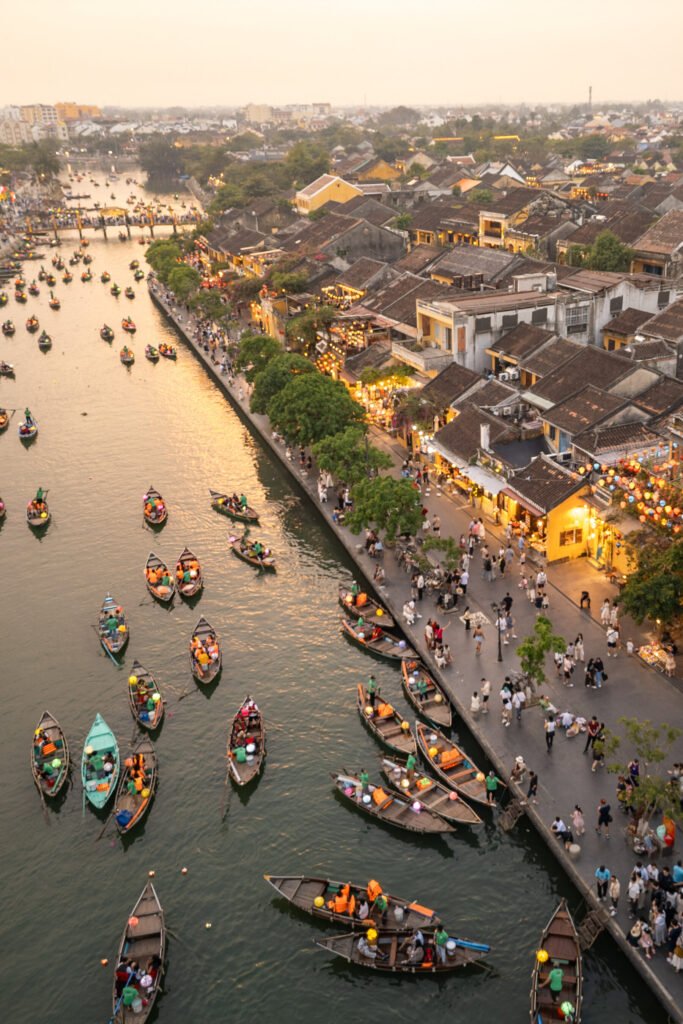
Between ten in the morning and five in the afternoon, the old town is saturated. Before seven and after nine at night, it becomes what you came for again: empty lanes, lanterns lit, the fish market on the quay at dawn. Our advice comes down to this: get up early, sleep in the afternoon, go out again in the evening.The single ticket gives access to five sites out of about twenty. Choose the Tan Ky house, the Phuc Kien assembly hall, the Japanese bridge and a family chapel. The central market and Tran Phu street can be explored freely.
Craft villages and rice fields by bike
Hoi An is best explored by bike, and that is where the town becomes interesting. Three kilometres away, the market-garden village of Tra Que grows herbs for the whole region on beds fertilised with river algae. Five kilometres away, Thanh Ha has been throwing pottery for five centuries; seven away, Kim Bong works structural timber.The water-coconut grove of Cam Thanh, where you get around by round boat among the nipa palms, was a Viet Cong base. It has become very touristy — boats with music, basket races — but is still pleasant early in the morning, with the crab fishermen.
Cooking classes, tailors and fishermen
Hoi An is the capital of made-to-measure: several hundred tailoring workshops deliver within twenty-four to forty-eight hours. The rule is simple — allow two fittings, never pay everything up front, and be wary of prices that seem too low: they mean synthetic linings and subcontracted stitching.Cooking classes start at the market and continue in a garden: cao lau — the Hoi An noodle, made with water from one particular Cham well —, banh xeo, fresh rolls. It is the activity our travellers mention most often when they get back.
The beach, and how many days to stay
An Bang, twenty minutes away by bike, is Hoi An’s beach: pale sand, seafood shacks, sunbeds. Cua Dai, further south, has suffered badly from erosion and shrinks year after year despite the rock defences.Three nights is the right format: one for the old town, one for the villages and My Son, one for the beach or cooking. Many travellers extend; it is the stop where people linger.
When to come
February to May, dry and mild, is the best window. June to August are hot but manageable, with the beach to compensate. October and November concentrate the Centre’s rainy season: the old town is regularly flooded, sometimes by a metre, and people then get around the streets by boat. It is spectacular, but it is not a holiday.The lantern festival, on the fourteenth day of each lunar month, switches off the electric lighting in the old town. Check the date: it is worth organising a night around it.
The mistakes we see most often
Visiting the old town at two in the afternoon, in the full heat and the full crowd.
Ordering three garments from a tailor the day before departure.
Staying inside the listed area without ever taking a bike.
Scheduling Hoi An in November without knowing that the town may be under water.
Hoi An’s calendar, month by month
Hoi An is the town in Vietnam where the season changes the experience most radically — to the point of making the old town navigable by boat.
Period
Weather
What you need to know
February – April
22 to 30 °C, dry
The best window. Mild, bright, calm sea from March.
May – August
28 to 38 °C
Very hot, but the beach compensates and the sea is good. Visit before 9 am.
September
27 to 33 °C
Heat easing, first showers. Still very good.
October – November
22 to 28 °C
The Centre’s rainy season. Regular floods, sometimes a metre deep in the old town.
December – January
19 to 25 °C
Cool and often grey, swimming not advised. The town is still beautiful.
One date you absolutely must check: the lantern festival, on the fourteenth day of each lunar month, switches off the electric lighting in the old town. Only the silk lanterns stay lit and floating candles are set on the river. It happens once a month: just plan one night around it.
The Hoi An tailor: a user’s guide
Several hundred workshops deliver within twenty-four to forty-eight hours. It is one of the most popular activities in town, and one of the most uneven.
Real prices
Item
Entry level
Good quality
Made-to-measure shirt
15 – 25 €
35 – 60 €
Dress
30 – 50 €
70 – 150 €
Two-piece suit
80 – 130 €
200 – 400 €
Wool coat
90 – 150 €
250 – 450 €
Made-to-measure leather shoes
40 – 70 €
90 – 160 €
The four rules
Allow two fittings, so don’t go to the tailor the day before departure: the real minimum is two full days. Never pay the full amount up front; a deposit of thirty to fifty per cent is customary. Ask to see and touch the fabric on the roll, not just the sample in the catalogue — that is where the difference between wool and a synthetic blend lies. And be wary of very low prices: they mean synthetic linings and stitching subcontracted outside, often botched.
Where to stay: old town, beach or rice fields
In the old town or on its edge
Everything on foot, lanterns in the evening, the fish market at six. The downside is that the daytime crowd passes under your windows. From €40 to €200.
Towards An Bang, by the beach
Twenty minutes by bike, with guesthouses and resorts right on the sand. The best compromise for a stay of four nights or more, especially as a family. From €50 to €400.
In the middle of the rice fields
A few addresses between Tra Que and Cam Thanh, ten minutes by bike from the old town, with buffaloes under the windows and complete silence. Our preference, and often the best value: from €45 to €130.A practical point: Cua Dai, long the reference beach, is eroding year after year despite the rock defences. Check recent photos before booking a hotel that boasts about it.
What to see in Hoi An: the highlights
The Japanese covered bridge, built in the 17th century by the Japanese community, symbol of the town.
The Chinese assembly halls, led by Phuc Kien, with their altars, spiral incense and flowered courtyards.
The merchants’ houses, such as Tan Ky or Phung Hung, where the same family has sometimes lived for seven generations.
The central market by the river, early in the morning, and its food corner.
The Thu Bon river at dusk, by boat, as the lanterns light up.
The vegetable village of Tra Que, by bike, and its herb gardens.
The Cam Thanh water coconut forest, by basket boat.
The Thanh Ha pottery village and the Kim Bong carpentry village, on Cam Kim island.
An Bang beach, fifteen minutes away by bike.
The Cham sanctuary of My Son, an hour away by road, at sunrise.
Hoi An in one, two or three days
With a single day, focus on the old town: a visit early in the morning, before 8 am, when the streets are almost empty, lunch of cao lầu, the local speciality, a nap during the hot hours, then back in the late afternoon for the golden light, the boat ride and the night market. It is short, but you already understand why the town fascinates.With two days, add a morning cycling through the rice fields and Tra Que, a cooking class or a fitting at the tailor’s, and a late afternoon on An Bang beach. With three days, the pace becomes ideal: My Son at sunrise, the Cam Thanh coconut forest, Cam Kim island and its craftspeople, and free time to wander. This is the length we recommend on most of our tours.
How to get to Hoi An
Hoi An has neither an airport nor a station. You arrive via Da Nang international airport, about 45 minutes by road, linked to Hanoi and Saigon by many daily flights of one hour to one hour twenty minutes. The Reunification train stops in Da Nang, from where you finish by car. From Hue, the Hai Van Pass road takes half a day with stops, and it is one of the most beautiful drives in the country.The old town is pedestrianised for much of the day. An entrance ticket, about 120,000 dong, gives access to five monuments of your choice among around twenty. Keep it with you: it may be checked at the entrances to the historic quarter.
Hoi An with children
It is probably the easiest stop in Vietnam for families: a flat, pedestrian town, short distances, bike rides on car-free paths, the beach close by, and activities children love, such as the spinning basket boat, lantern making or the cooking class. Choose a hotel with a pool in the rice fields or at An Bang, and keep visits for the morning and late afternoon.
The full-moon night
On the fourteenth day of each lunar month, the old town switches off part of its electric lighting and keeps only the lanterns. Residents place offerings in front of their houses, traditional games are played in the street, and thousands of floating candles drift on the river. It is magnificent but very busy: book your hotel early if your stay falls on that evening, and enjoy the quieter side streets.For a detailed programme, morning by morning, also read our article on what to do in Hoi An.
Three days: the old town, the craft villages and a day at the beach or My Son. It is the best stop to catch your breath in the middle of a tour.
Can you trust Hoi An’s tailors?
Yes, provided you choose a reputable workshop and allow two fittings and at least 48 hours. We share our list of addresses with our travellers.
What is the best time?
From February to August for good weather and swimming. October and November are rainy, with possible floods in the old town.
Is Hoi An suitable for families?
It is actually our favourite stop for children: lantern workshop, round-net fishing, cycling among the buffaloes and a beach ten minutes away.
How much does a made-to-measure suit cost in Hoi An?
From €80 to €130 at entry level, €200 to €400 for good quality. Allow two fittings and therefore two full days on site: never order the day before departure.
When is the lantern festival in Hoi An?
On the fourteenth day of each lunar month, so once a month. The electric lighting in the old town is switched off and floating candles are set on the river. Ask us for the date when you set your nights.
How many nights should you plan in Hoi An?
Three nights at least: one for the old town, one for the villages and My Son, one for the beach or a cooking class. Many travellers extend — it is the stop where people linger.
Audience measurement. We would like to know which pages are useful to you, using Google Analytics. Nothing is stored without your consent, and you can change your mind at any time. Learn more





 The essentialsVietnam in 15 daysHanoi — Pu Luong — Ninh Binh — Lan Ha Bay — Hue — Hoi An — Saigon — Mekong Delta15 days / 14 nightsfrom €2,070