Hue was Vietnam’s capital for a hundred and forty years, and the city has kept everything: a forbidden city, seven imperial tombs scattered across the countryside, and a court cuisine found nowhere else in the country.
In brief
Best time
February to May; avoid October to December, the three rainiest months in Vietnam
Getting there
2 h 30 from Da Nang via the Hai Van Pass, 1 h 10 flight from Hanoi, night train from Hanoi
How long
Two nights: one for the citadel, one for the tombs and the river
Combine with
Da Nang and Hoi An to the south, Phong Nha 3 h 30 to the north, the demilitarised zone 2 h away
The last imperial capital
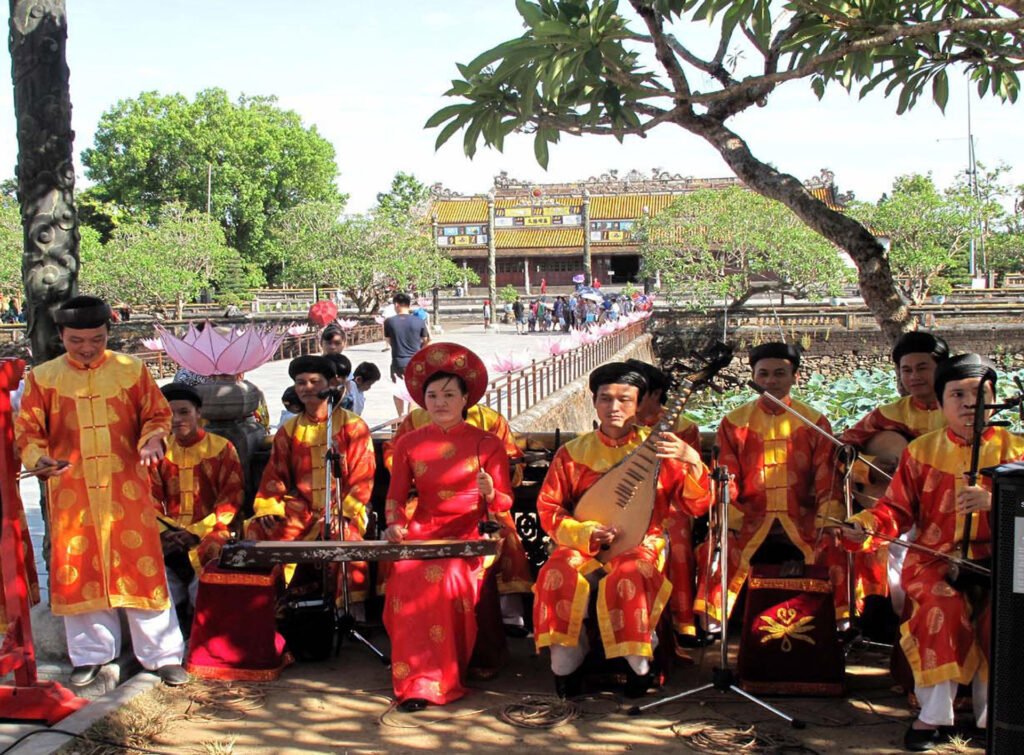
Hue was the capital of Vietnam from 1802 to 1945, under the thirteen emperors of the Nguyen dynasty. That is not long — a hundred and forty years — and it is enormous: everything the country produced that is most refined in architecture, cuisine and court music comes from this period and this city.The city paid dearly for the 20th century. In 1968, the Tết Offensive and the twenty-six days of fighting that followed destroyed a large part of the citadel. What you visit today is therefore an ensemble under permanent restoration, UNESCO-listed since 1993, where rebuilt palaces stand next to empty fields where only the foundations remain.
Rebuilt palaces stand next to empty fields where only the foundations remain.
The citadel and the Purple Forbidden City
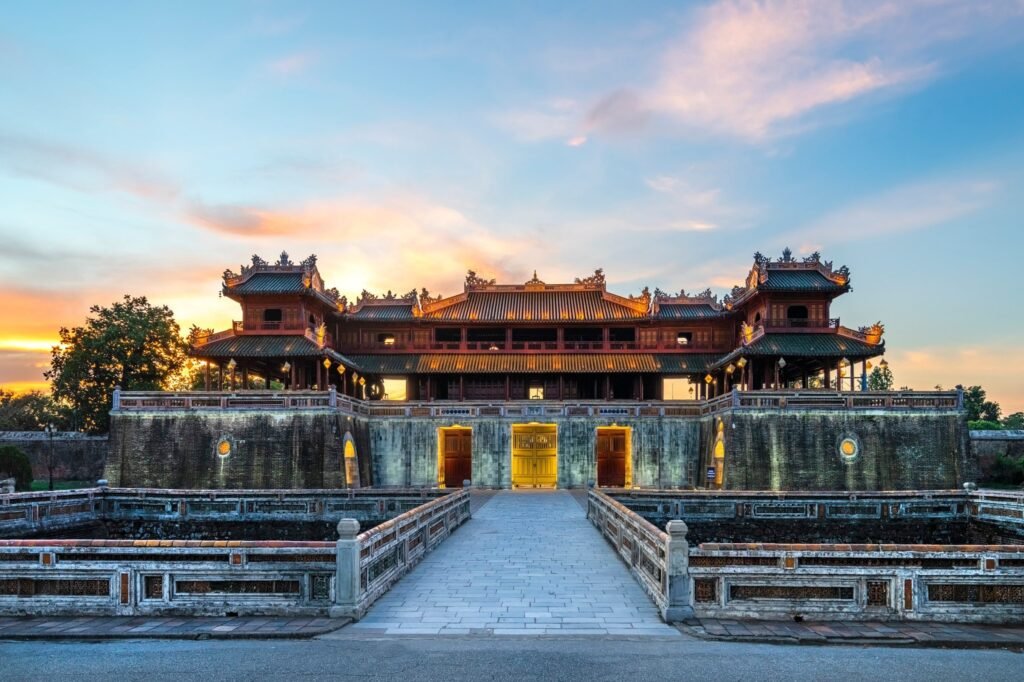
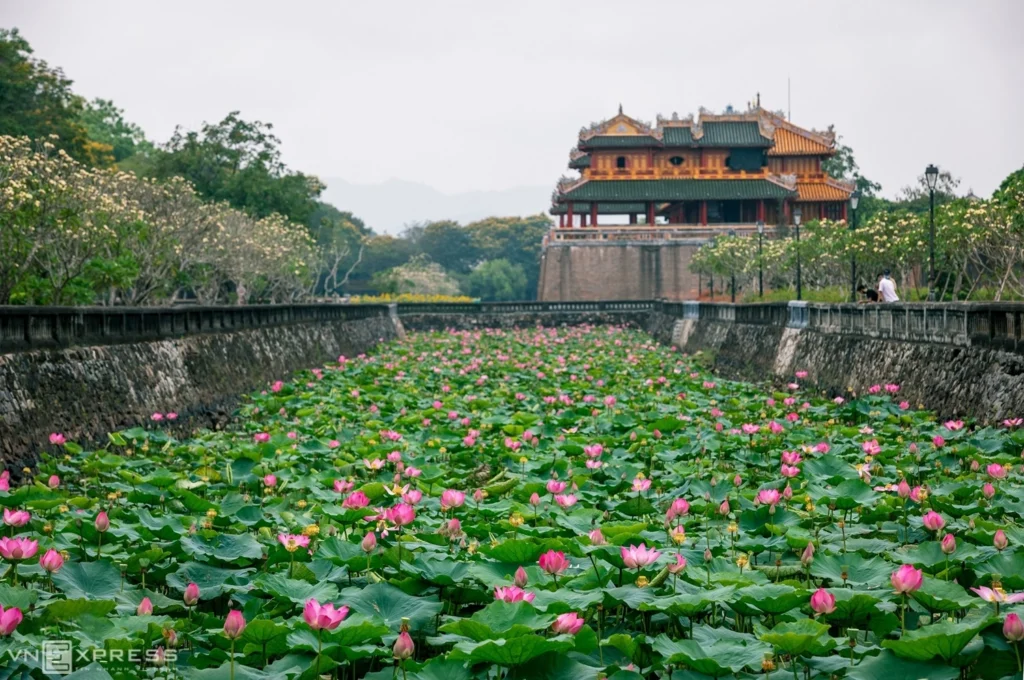
The citadel is a two-kilometre square, ringed by ramparts and moats, built on the Vauban model by French engineers in the service of Gia Long. Inside is the Imperial City; inside that again, the Purple Forbidden City, reserved for the emperor and his household.Allow three hours. The Palace of Supreme Harmony, the royal library, the Duyet Thi Duong theatre and the Nine Dynastic Urns in bronze are the highlights. The Purple City itself is almost entirely razed: it is a grassy esplanade, and it is perhaps the most eloquent place on the site. Go at opening time, seven o’clock, before the heat.
The imperial tombs: choose rather than see everything
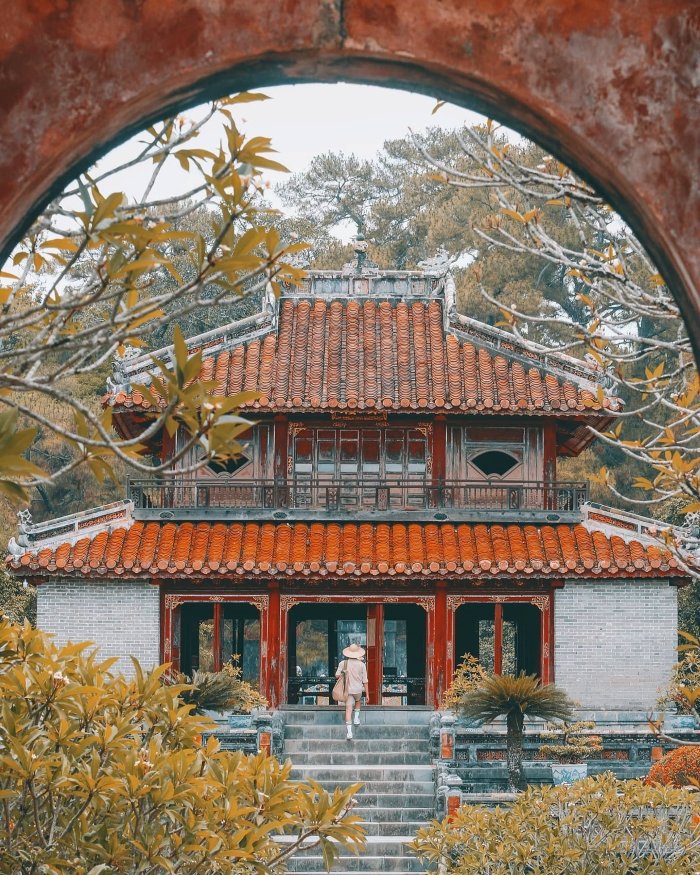
Seven imperial tombs are scattered across the countryside south of the city. Visiting them all would take two days and leave you indifferent. We keep three, which are nothing alike.
Tu Duc : the most poetic, a park with a lotus lake and a pavilion where the emperor wrote poems. He lived there during his lifetime.
Minh Mang : the most classical, perfectly symmetrical along a seven-hundred-metre axis. Confucian to the core.
Khai Dinh : the strangest, blackened concrete and porcelain mosaics, half European, half Chinese, completed in 1931. You love it or hate it.
Two are enough in half a day. The best route is still the Perfume River by dragon boat to Thien Mu pagoda, then the car to the tombs.
Imperial cuisine and Dong Ba market
Hue claims to be Vietnam’s best table and the argument holds: the court demanded dishes that were numerous, small and well presented. What remains is a cuisine of detail — banh khoai, banh beo, banh nam, little rice cakes served by the dozen — and bun bo Hue, beef soup with lemongrass and shrimp paste, spicier than pho.Dong Ba market, by the river, is where all this is eaten standing up for two euros. We like to take our travellers there in the morning with a guide, before the citadel.
When to come
This is the tricky point. Hue is one of the rainiest cities in South-East Asia, with nearly three metres of rain a year, most of it falling from October to December. Floods in the old town are regular in November.February to May is the right window: dry, mild, bright. June to August are dry but very hot, with a wind from Laos that pushes the thermometer beyond thirty-eight degrees. The Hue festival, held every two years in spring, is worth checking before you set your dates.
The mistakes we see most often
Spending only one night: the citadel and two tombs don’t fit into a day.
Wanting to see all seven tombs. Three well explained are worth more than seven rushed through.
Scheduling Hue in November without a fallback plan.
Visiting the citadel at noon: the courtyards are unshaded and the concrete throws back the heat.
Hue’s calendar, and why it matters more than elsewhere
Hue receives nearly three metres of rain a year, one of the highest totals in South-East Asia, and most of it falls over three months. Choosing your dates is not a detail of comfort: it decides whether you visit the citadel or watch it from the window.
Period
Temperatures
What you need to know
February – April
20 to 30 °C
The right window: dry, mild, bright. Our recommendation.
May – July
28 to 39 °C
Dry but brutal. The wind from Laos pushes the thermometer beyond 38 °C. Visit before 9 am.
August – September
26 to 34 °C
First rains, heat easing. Still fine.
October – December
20 to 26 °C
Nearly two-thirds of the annual rainfall. Regular floods in November.
January
18 to 23 °C
Cool and grey, persistent drizzle. The city has charm, the photos less so.
The Hue festival, held every two years in spring, is worth checking before you set your dates: the city fills up, hotel prices double, and the show is worth it.
The seven tombs: which to choose
Visiting them all would take two days and leave you indifferent. Here is what you need to choose knowingly.
Tomb
Style
Length
For whom
Tu Duc
Park, lotus lake, poet’s pavilion
1 h 15
The most poetic. Our first choice.
Minh Mang
Confucian symmetry over 700 m
1 h
Lovers of classical architecture.
Khai Dinh
Blackened concrete, porcelain mosaics
45 min
The strangest. You love it or hate it.
Gia Long
Ruins in the forest, very isolated
1 h 30 with the drive
Those who want to be alone.
Thieu Tri
Sober, little restored
40 min
Skip it if you are in a hurry.
Two tombs in half a day is the right dose, and the best combination is Tu Duc then Khai Dinh: a century separates them, one Confucian and verdant, the other Europeanised and stony. The comparison alone tells the story of the dynasty.
What classic programmes skip
The garden houses
In Kim Long and Thuy Bieu, mandarin residences arranged around an orchard, a pond and a screen hedge — the domestic version of the geomantic principles that shaped the Imperial City. Several can be visited and you can have lunch with the family, under the pomelo trees.
The Tam Giang lagoon
Fifteen kilometres away, the largest lagoon in South-East Asia: seventy kilometres long, with thousands of families living from fixed-net fishing. A boat trip at sunrise, when the traps are hauled in, is worth any tomb.
Dong Ba market
By the river, it is the best place in the country to understand fermented pastes. mắm ruốc, Hue’s shrimp paste, is sold by the basin: tiny shrimps, salt, six months of sun. A spoonful gives a soup a depth nothing else gives — it is what separates bún bò Huế from phở.
What a day in Hue costs
Item
Indicative price
Citadel entrance
~ 8 €
Entrance to a tomb
~ €5 each
Dragon boat on the river
€10 – 20 per boat
A bowl of bánh in Hue
3 – 7 €
Imperial cuisine dinner
20 – 45 €
Hotel night
35 – 200 €
Hue is noticeably cheaper than Hoi An for the same standard, which is one of the reasons we advise spending two nights there rather than one.
Two full days: one for the citadel, one for the imperial tombs and Thien Mu pagoda.
How do you get from Hue to Hoi An?
By the Hai Van Pass road, 3 h 30 with photo stops — far more beautiful than the tunnel. The train also runs along the coast and is a spectacular alternative.
What is the best time?
From February to August for the dry season. Avoid October to December if possible, the rainiest period in all of Vietnam.
Is the combined ticket worth it?
Yes if you visit the citadel and at least two tombs: about €15, compared with €6 to €8 per site taken separately.
Which imperial tombs should you visit in Hue?
Two of the seven, in half a day. The best combination is Tu Duc, a park with a lotus lake, then Khai Dinh, concrete and mosaics: a century separates them and the comparison tells the whole dynasty’s story.
Which month should you avoid in Hue?
November. Hue receives nearly three metres of rain a year, two-thirds of it from October to December, and the old town is regularly flooded. February to April is the right window.
How many nights in Hue?
Two. One day is not enough for the citadel and two tombs, and the city is noticeably cheaper than Hoi An for the same standard.
Audience measurement. We would like to know which pages are useful to you, using Google Analytics. Nothing is stored without your consent, and you can change your mind at any time. Learn more

 The essentialsVietnam in 15 daysHanoi — Pu Luong — Ninh Binh — Lan Ha Bay — Hue — Hoi An — Saigon — Mekong Delta15 days / 14 nightsfrom €2,070