Hanoi does not reveal itself to those who rush through it in two days. It is a city of details — a stall, a doorway, a smell of charcoal — and it asks you to slow down. Here is how we organise this stop for our travellers.
In brief
Best time
October to December, dry and bright autumn; March–April mild; June–August heavy
Getting there
Noi Bai airport, 45 min from the centre; 2 h 15 flight from Saigon
How long
Three nights: two for the city, one as a buffer before or after the bay
Combine with
Ninh Binh 2 h away, Lan Ha Bay 3 h away, Sa Pa and Ha Giang to the north
How many days should you plan in Hanoi?
Two full days are enough to see the city; three nights is the right format, because the first is spent recovering from the flight. Hanoi is a human-scale capital whose historic heart can be explored on foot: Old Quarter, Hoan Kiem Lake, French Quarter, all within a two-kilometre radius.It is a thousand years old, and you can feel it — that is the fundamental difference from Saigon. Within ten minutes’ walk you find an 11th-century temple, an opera house modelled on the one in Paris, Soviet apartment blocks and third-wave coffee shops.
An 11th-century temple, an opera house modelled on Paris’s and a speciality coffee shop within ten minutes’ walk.
The Old Quarter, street by street
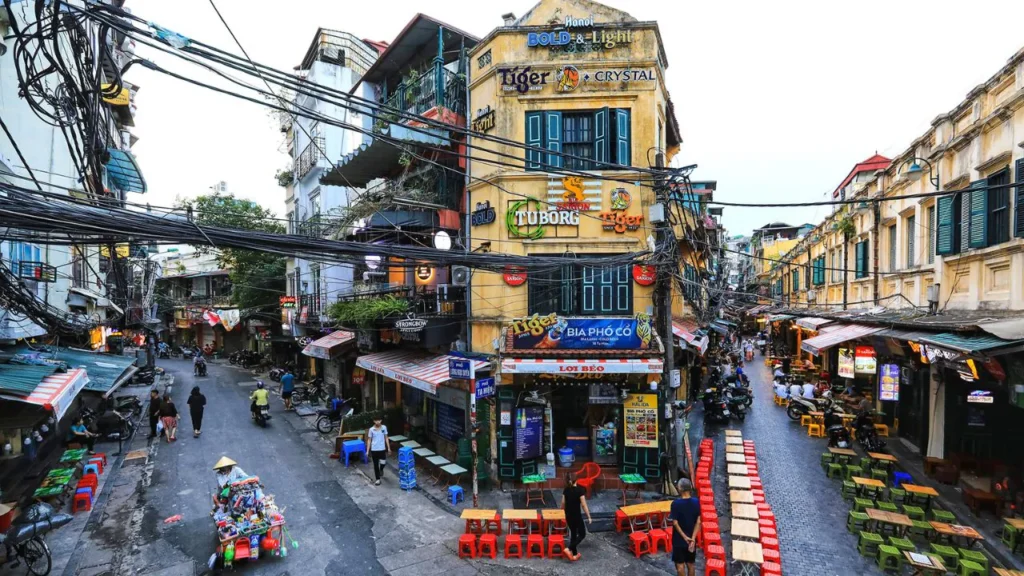
The “thirty-six streets” each bear the name of a trade: Hang Bac, the silversmiths; Hang Ma, votive paper; Hang Thiec, tinware; Lan Ong, the Chinese herbalists. Many have changed business, but several still practise their original trade, and you can hear tin being hammered at seven in the morning.The houses are narrow — two to three metres wide at the front — and thirty or forty deep, because tax was calculated on the width of the façade. The heritage house at 87 Ma May, open to visitors, shows this string-of-rooms layout with its two inner courtyards.
Around the lake and in the French Quarter
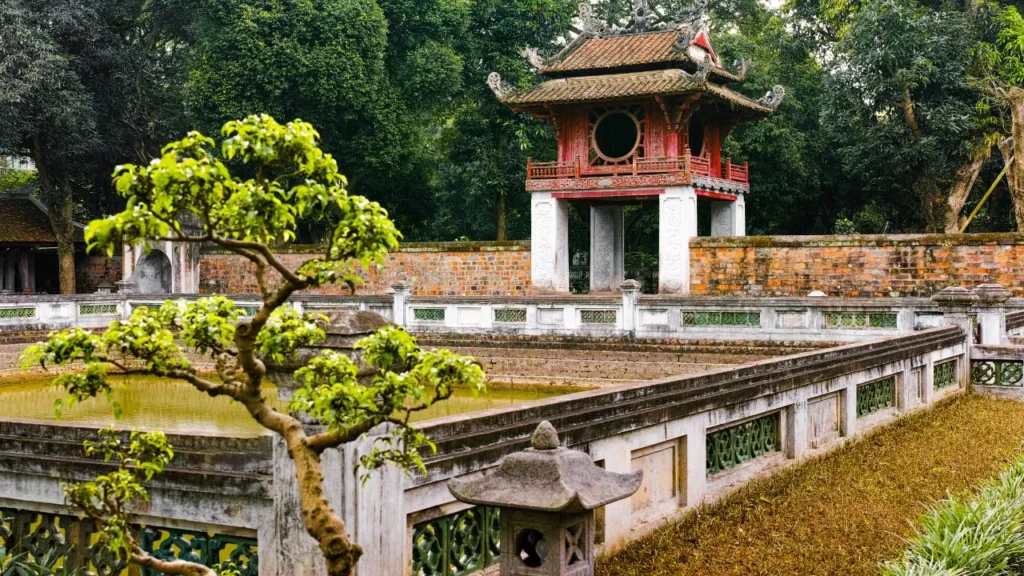
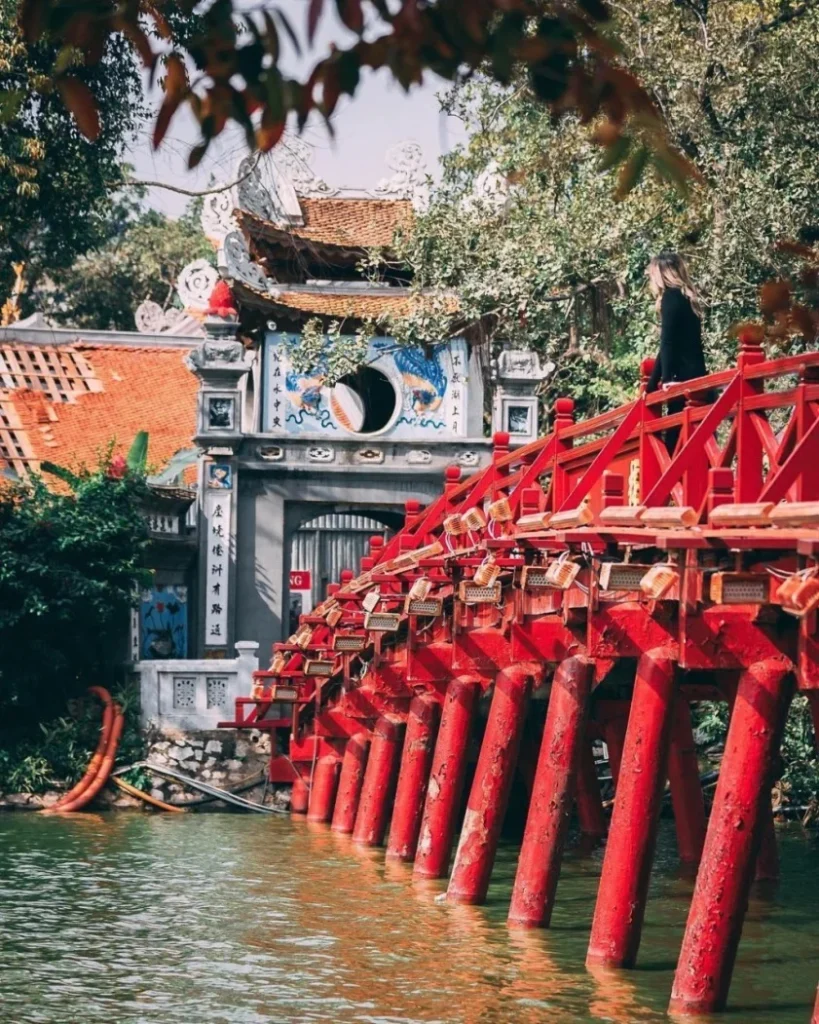
Hoan Kiem Lake is the city’s centre of gravity. Come at six in the morning: tai chi, badminton, joggers, ballroom dancing to loudspeakers. Ngoc Son temple, on its islet, keeps the preserved remains of one of the lake’s giant turtles, a species now extinct here.To the south-east, the quarter built by the French lines up villas, tree-lined avenues and public buildings: the 1911 opera house, the Indochinese-style National Museum of History, the Metropole hotel. To the west, the Temple of Literature, founded in 1070, the country’s first university, with its steles of doctors carried by stone turtles. And Hồ Chí Minh’s mausoleum, where the queue is long and dress is regulated.
Eating in Hanoi: the five dishes not to miss
Pho bo in the morning, never in the evening: the broth has simmered all night.
Bun cha at noon: charcoal-grilled pork in a warm sweet-and-sour broth. It is Hanoi’s dish.
Cha ca : fish with turmeric and dill, cooked at the table, served on Cha Ca street for a century and a half.
Banh cuon : steamed rice rolls, ladled onto a cloth.
Ca phe trung, egg coffee, invented here in 1946 when milk was scarce.
The best places are pavements and close once they have sold their pot. Our guides know theirs; it is one of the services you won’t find in a paper guidebook.
What else to see if you have three days
The Museum of Ethnology, twenty minutes from the centre, is the best museum in the country: fifty-four ethnic groups presented seriously, with life-size houses rebuilt in the garden. Do it before heading up north.The Thang Long water puppet theatre has become very touristy, but the art was born in the flooded rice fields of the delta and exists nowhere else: one hour, and children love it. Finally, “train street” and the railway that runs between the houses can be seen from the street, the cafés lining the tracks having been closed for safety reasons.
Where to stay and how to get around
The Old Quarter puts everything within walking distance but stays noisy until late: ask for a room facing the courtyard. The French Quarter is calmer and more elegant, ten minutes’ walk from the lake. Allow from €35 to several hundred.To get around, ride-hailing apps, car or motorbike. The airport is forty-five minutes away. And to cross the street: move forward slowly, without sudden moves, watching the drivers — they go around you, provided you are predictable.
The mistakes we see most often
Spending only one night before rushing off to the bay: you miss the city and arrive tired.
Eating pho in the evening in a restaurant with tablecloths.
Skipping the Museum of Ethnology before heading off to the minorities.
Waiting for a gap in the traffic to cross. There won’t be one.
When to come to Hanoi: the month-by-month calendar
Hanoi is the only big city in Vietnam with four real seasons, including a winter when the thermometer drops below fifteen degrees. It is the first surprise for travellers packing for a tropical country.
Period
Temperatures
What you need to know
October – December
18 to 27 °C
The best window. Dry air, clear skies, golden light on the lake. Little rain.
January – February
13 to 20 °C
Damp cold and stubborn mist. Bring a proper jacket: accommodation has no heating.
March – April
20 to 28 °C
Mild, but drizzle can veil the city for several days in a row.
May – August
28 to 38 °C
Hot and very humid, storms at the end of the day. Visit early in the morning.
September
25 to 32 °C
End of the monsoon, heat easing. A good compromise if you are continuing to the rice fields of the North.
Two dates to check before booking your tickets. Tết, the lunar new year, falls in late January or February: the city empties, many shops close for a week, and domestic transport is saturated. And the Mid-Autumn Festival, at the full moon of September or October, which turns Hang Ma street into a corridor of lanterns.
Where to stay in Hanoi: four districts, four different stays
The Old Quarter
Everything on foot, constant bustle, the best street addresses fifty metres away. The downside is the noise: horns until midnight, deliveries from five in the morning. Always ask for a room facing the courtyard, not the street. Allow €35 to €90.
The French Quarter
Tree-lined avenues, colonial villas, wide pavements. Calmer, more elegant, ten minutes’ walk from Hoan Kiem Lake. It is our default choice for a first stay, and the only district where you can really walk. From €70 to €300.
West Lake (Tay Ho)
The expatriate district: bakeries, Western restaurants, more breathable air, water views. But you are twenty minutes by car from the historic centre, which weighs on a two-day stay. A good choice for a week or more.
Ba Dinh
Around the mausoleum and the ministries. Very quiet, very green, but no neighbourhood life in the evening. Best kept for those who want to sleep.A tip that costs nothing: whatever the district, check that the hotel has a lift. Hanoi’s tube houses often rise six storeys, and the stairs are steep.
How to get around the city
On foot, and how far
The historic heart fits within a two-kilometre radius: Old Quarter, Hoan Kiem Lake, French Quarter. All of it is walkable. Beyond that — Museum of Ethnology, West Lake, Temple of Literature — you need a vehicle.One detail that avoids surprises: the pavement is not a pedestrian space. It is taken up by parked scooters, kitchens and stalls, so you walk in the road. It is not disorder, it is a different way of sharing space.
Apps and taxis
Ride-hailing apps work very well and show the price in advance, which settles the question of bargaining. Allow one to three euros for a ride in town, half that by motorbike taxi. Avoid taxis hailed in the street around tourist sites.
The metro and the cyclo
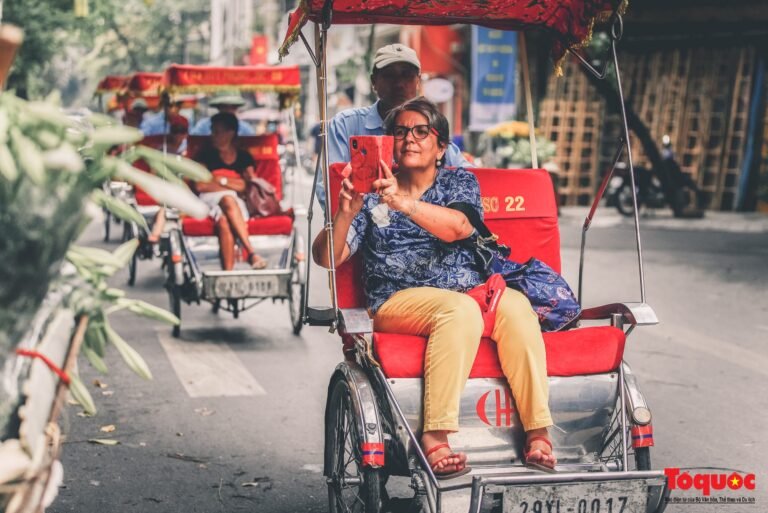
The first metro line opened in 2021 and a second has followed; the network remains marginal for a visitor, but the elevated line offers an unexpected view over the rooftops. The cyclo, a pedal tricycle, survives as a tourist ride in the Old Quarter: half an hour is enough, agree the price before getting in, and know that the drivers are mostly men over sixty.
A typical day, hour by hour
It is not a programme to follow to the letter, but order matters more than you think in Hanoi, where every place has its hour.6 am — Around Hoan Kiem Lake. Tai chi, badminton, ballroom dancing to loudspeakers, joggers. It is the moment when the city still belongs to itself, and it doesn’t last.7 am — phở standing at a stall that serves nothing else. The broth simmered overnight; by noon it will be gone. Nobody eats pho in the evening, except in tourist restaurants.8:30 am — The Old Quarter, street by street, before the heat and the groups. Hang Bac the silversmiths, Hang Thiec tinware, Lan Ong the herbalists.11 am — The Temple of Literature, or the Museum of Ethnology if you are heading up to the minorities next.1 pm — Lunch then a break. Hanoians take a siesta; offices close, some shops too. It is too hot to walk from May to September.4 pm — The French Quarter and the opera house, then an egg coffee upstairs overlooking the street.6 pm — bia hơi on a thirty-centimetre stool, then dinner. From eight in the evening, the Old Quarter streets around Ta Hien get noisy; Hang Buom street less so.
What a day in Hanoi costs
Orders of magnitude, in euros per person, excluding accommodation.
Item
Simple
Comfortable
Street breakfast
1 – 2 €
3 – 6 €
Lunch
2 – 4 €
8 – 15 €
Dinner
3 – 6 €
15 – 35 €
Coffee or beer
0,20 – 1,50 €
2 – 4 €
Rides in town
2 – 5 €
8 – 15 €
Site entrance fees
€1 – 4 each
—
A full day therefore costs between ten and twenty euros eating in the street, and around sixty in restaurants. It is one of the cheapest capitals in Asia, and the difference in quality between the two columns is much smaller than you might think: Hanoi’s best addresses are pavements.
Two full days at least, three for a comfortable discovery including the Museum of Ethnology and an excursion to the craft villages.
Is Hanoi a safe city?
Yes, very. The things to watch are snatch thefts near the lake and the traffic, which remains the city’s real danger.
What is the best time to visit Hanoi?
October and November: dry air, clear light, 25 °C. Winter is cool and misty, summer hot and humid with heavy showers.
Should you avoid street food?
No. Choose the stalls where Vietnamese people eat: turnover is fast and the produce fresh. Just avoid dubious ice cubes away from busy places.
How many days should you plan in Hanoi?
Two full days are enough to see the city; three nights is the right format, because the first is spent recovering from the flight. Beyond three days, it is better to head out on an excursion to Ninh Binh or Lan Ha Bay.
Which district should you stay in in Hanoi?
The French Quarter for a first stay: calm, elegant, ten minutes’ walk from the lake. The Old Quarter puts everything within reach but stays noisy until midnight — ask for a room facing the courtyard.
What is the ideal month to visit Hanoi?
October to December: dry air, clear skies, 18 to 27 degrees. January and February are cold and misty, May to August very hot and humid.
Audience measurement. We would like to know which pages are useful to you, using Google Analytics. Nothing is stored without your consent, and you can change your mind at any time. Learn more



 The essentialsVietnam in 15 daysHanoi — Pu Luong — Ninh Binh — Lan Ha Bay — Hue — Hoi An — Saigon — Mekong Delta15 days / 14 nightsfrom €2,070