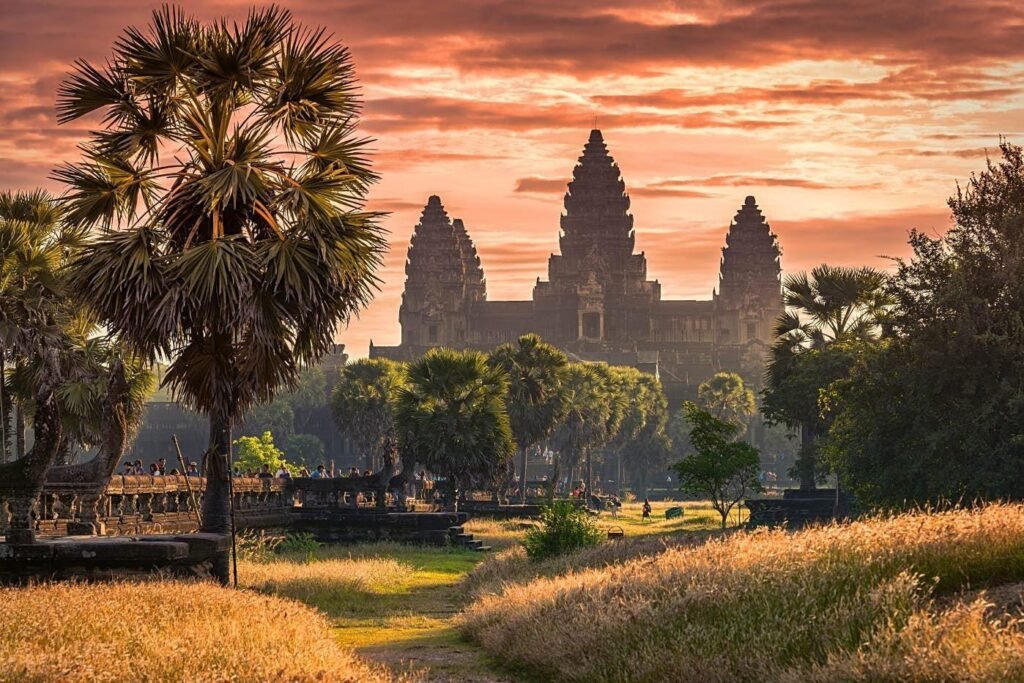
We are asked almost every week: can you add Angkor to a trip to Vietnam? Yes. But we don’t sell it ourselves, and here is why — along with everything you need to know to do it properly.
In brief
Minimum recommended length
18 days for both countries without rushing
Easiest crossing
Flight Saigon–Siem Reap, about 1 hr
Most beautiful crossing
Boat Chau Doc–Phnom Penh along the Mekong, one day
Visa
Exempt in Vietnam until 14 March 2028 (French citizens), required for Cambodia
Our position
We only operate Vietnam and point you in the right direction for the rest
Our answer, straight
We only sell Vietnam. Not out of commercial principle, but because our value rests entirely on one thing: our guides are Vietnamese, they have known the provinces they work in since childhood, and we have checked every hotel, every boat and every family that hosts you ourselves. None of that is true for us in Cambodia.An agency that sells four countries at once subcontracts three of them to partners it doesn’t control. It is perfectly legal and often very well done, but it is no longer the same promise — and that is exactly the difference you pay for when you choose a local agency rather than a tour operator.
We would rather tell you honestly that Cambodia isn’t our business, and point you to a colleague in Siem Reap we trust, than sell you a week we haven’t built.
In practice: we organise the Vietnamese part from start to finish, put you in touch with a Cambodian ground handler we know, and coordinate the dates and the border crossing with them. You have two contacts instead of one, and two agencies that genuinely answer for what they sell.
How many days you really need
It is the question that kills most combined plans. Angkor needs three full days to be seen properly — two if you rush, and you rush enough already. Add Phnom Penh and a travel day at each end, and you are at six days minimum for Cambodia alone.
Total length
What it gives you
12 days
Don’t do it. You will skim both countries and really see neither.
15 days
Doable, but tight: northern Vietnam, Hoi An, Saigon, then three days at Angkor. You give up the delta and the mountains.
18 to 21 days
The right length. A real North-to-South Vietnam, plus Angkor and Phnom Penh without rushing.
Less than 15 days
Choose one country. It is the advice we give most often, and the one we are most often thanked for.
Our position, frankly: under three weeks, adding Cambodia costs Vietnam more than it brings. You sacrifice the Mekong Delta or the northern mountains — that is, what sets Vietnam apart from its neighbours — for three days of temples.
The three ways to get from one country to the other
By plane. The simplest and fastest. Saigon–Siem Reap takes about an hour; Hanoi–Siem Reap two hours, with some direct flights depending on the season. It is what we recommend in most cases: half a day lost instead of two.By boat along the Mekong. From Chau Doc to Phnom Penh via the Vinh Xuong crossing, in one day on the water. It is the most beautiful of the three options: you travel up the river, the border is crossed on a pontoon, and the landscape changes slowly. It is also the slowest and the most sensitive to water levels in the dry season.By road. Saigon–Phnom Penh via Moc Bai, six to seven hours. Cheap, of no particular interest, and the land-border formalities are the slowest of the three.In all three cases, one thing matters more than the rest: never schedule a border crossing on the day of your international flight. Always a day’s margin.
Formalities: what changes when you cross the border
On the Vietnamese side, French citizens are exempt from a visa for 45 days, including entry and exit days, until 14 March 2028. Other nationalities should check the rules for their passport. Note one point many people don’t know: the exemption applies to each new entry. If you leave for Cambodia then come back to Vietnam, a new 45-day count starts — but always check the rule in force for your dates, as this policy is renewed in three-year periods.On the Cambodian side, French citizens need a visa. It is obtained online before departure, or on arrival at the airports and main land crossings. Bring a passport photo and US dollars in cash: Cambodia runs largely on the US dollar, including for official fees.Health and money. No additional vaccination is required for Cambodia compared with Vietnam. Do change your payment habits, though: cards are accepted much less than in Vietnam outside the big cities, and prices in Siem Reap are often shown in dollars.
What Vietnam has that Cambodia doesn’t, and vice versa
It isn’t a contest, but setting out the difference helps decide what to sacrifice.Cambodia has Angkor, and Angkor has no equivalent. It isn’t a temple but a city of four hundred square kilometres, abandoned then reclaimed by the forest, and the first time you see it at sunrise remains a memory apart. Vietnam has nothing on that scale: My Son, its most important Cham site, would fit in a corner of Angkor Thom.Vietnam has diversity. Sixteen hundred and fifty kilometres from north to south, three climates, fifty-four ethnic groups, mountains, a delta, two thousand kilometres of coast. Cambodia is more uniform: you go for Angkor, and the rest is a bonus.At the table, Vietnamese food is more varied and far more present on the street. On language, French has left more traces in Vietnam, and French-speaking guides are far more numerous and better trained there.
What we do, in practice
If your plan includes Cambodia, tell us in your first message. We build the Vietnamese part with the rest in mind: we put the stops in the right order, leave the spare day in the right place, and put you in touch with a ground handler in Siem Reap.What we won’t do: charge you a margin on a service we don’t operate. You pay for Cambodia directly to the Cambodian agency, at its own prices.And if, after reading the above, you decide to keep your fifteen days for a single country after all, we will consider that this page has done its job.
Angkor: how many days
To visit the temples of Angkor without rushing, allow two full days, three if you want to see the more distant sites such as Banteay Srei or Beng Mealea. The temples are best visited early in the morning and late in the day, when the light is most beautiful and the heat bearable. With the journey from Vietnam, the Cambodian extension therefore needs at least four days.
The Cambodian visa
Cambodia requires a visa for French travellers. It can be obtained online before departure, as an electronic visa, or on arrival at certain airports and border posts. Check the conditions in force at the time of your trip on official websites, and keep a passport photo and some US dollars in small notes.
Our position
We organise the Vietnamese part of the trip, and we tell you how to continue to Cambodia in the best conditions: flight times, border crossing, recommended length. For the Cambodian part, we recommend using a local agency in Cambodia.
We organise Vietnam from start to finish and put you in touch with a Cambodian ground handler we know. We coordinate the dates and the border crossing, but we charge nothing on the Cambodian part.
Are fifteen days enough for both?
It is doable but tight, and you will give up the Mekong Delta or the northern mountains. Under fifteen days, we advise choosing a single country.
Do you need a visa for Cambodia?
Yes for French citizens. It is obtained online before departure or on arrival at the airports and main land crossings. Bring a passport photo and US dollars in cash. Other nationalities should check the rules for their passport.
Is coming back to Vietnam after Cambodia a problem?
No. The 45-day exemption applies to each new entry. Just check the rule in force for your dates: this policy is renewed periodically.
When is the best time for both countries?
November to March suits both. It is the dry season in Cambodia, and the period when southern Vietnam is at its best.
Putting it into practice
The tours where you experience what this article is about
Audience measurement. We would like to know which pages are useful to you, using Google Analytics. Nothing is stored without your consent, and you can change your mind at any time. Learn more



 The essentialsVietnam in 15 daysHanoi — Pu Luong — Ninh Binh — Lan Ha Bay — Hue — Hoi An — Saigon — Mekong Delta15 days / 14 nightsfrom €2,070